
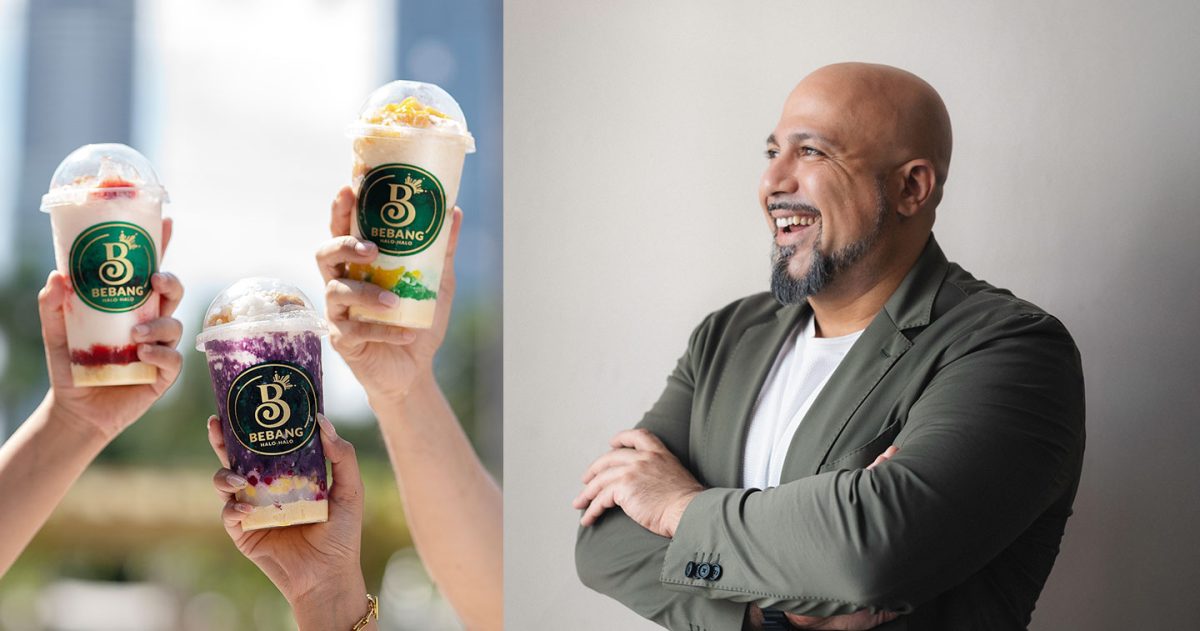
MANILA, PHILIPPINES – When Sam Karazi launched Bebang, he didn’t know how to fry an egg. Today, he’s managed to turn the widely famous frozen dessert brand into one of the country’s fastest-scaling food empires.
Behind every business are a series of gambles and risks—some small, others slightly bigger. Nothing worth pursuing ever comes without them. Even a brand like Bebang Halo-Halo, with its snaking queues of enthusiastic customers, was built on extreme bets. Yet speak with its President and CEO Sam, and you’ll find there’s a method to the madness. After all, how else could a young business scale at such a pace and deliver astonishing returns in so short a time?
The road to Bebang’s success wasn’t all smooth. The brand’s journey is proof that you can, in fact, have too much success, especially at the nascent stages. It’s a good problem, but one that comes with its own birthing pains. Growth forces you to jump the gun, make big changes on the fly, and believe that you’ll figure it out along the way despite uncertainty.
A viral push


The first time the brand went viral, Sam woke up to 5,000 cups of halo-halo sold out before 8:00 a.m. What now? he thought, blindsided by demand.
Just months earlier, Bebang had been a small Quezon City sari-sari type shop co-founded by Daymae Salumbides with recipes inspired by her grandmother, Lola Bebang. They’d only just moved to a bigger space along Shaw Boulevard when the popular Filipino cold dessert made more irresistible by its signature crushed iced milk and generous portions exploded in popularity.
That’s when Sam took his first big gamble.
“We didn’t have the capacity to serve 5,000 cups (at that time), so we had to basically refund everything, cancel all the orders, and shut down operations to figure out what we needed to do next,” he recalls. “If we didn’t do that, we’d destroy the business.” For three days, the store shut operations. This short pause allowed the team to rebuild its systems, outsource freezing, and stockpile enough ingredients for the next two weeks while assuring customers they’d be first in line once the store reopened. It was a lesson in scaling: viral fame needs to be supported by systems that can keep up.
But rather than slow momentum, the pause showcased the product’s staying power. Proof of concept had materialized and manifested itself despite setbacks. When something resonates that deeply, customers wait. With a promise to deliver products “frozen or your money back,” and a halo-halo made with generous helpings of premium ingredients and shaved milk instead of the usual ice and milk—which prevents flavor loss and enhances texture—it’s easy to see why.
Ironically, Sam himself is allergic to dairy, but the fact that he’s never actually tried his products in full has become more of a boon than a disadvantage; it keeps him receptive to customer feedback. When you cultivate that kind of balanced, objective relationship with your product and market, the result is a business that swiftly adapts to needs, meets demand, and still stays true to itself.
“Until now, even at the end of our peak season, people are lining up in front of our stores. Every time we open a store, so many people gather, celebrating Bebang expanding to their area. The response has been very encouraging for us as we open more branches,” the CEO shares.
First the Philippines, soon, the world


In just four years, Bebang has grown from a single neighborhood shop to more than 39 locations nationwide (as of this writing)—a pace that rivals far older food empires. “We thought we’d have 20 stores by the end of 2025, but the numbers changed very fast because of the demand. We’re basically scheduled to open around 53 this year,” Sam shares.
Now that the brand has proven itself locally, the business is setting its sights on international growth. “From an investor perspective, people want to put their money into something that has already proven itself,” he says. “We’re not selling something that hasn’t passed the proof-of-concept stage—with all the bells, whistles, and shining stars. We showed everyone there’s demand. We showed everyone the product is good. That’s what investors are looking for.”
Today, the number of franchisees eager to be part of Bebang’s growing vision continues to rise. There is a waitlist of partners resembling the queues that famously line Bebang stores. “Everyone reaching out to us now actually wants to franchise in Metro Manila,” Sam discloses. “Outside Manila, we’re looking for seasoned investors who are already successfully operating five to 10 businesses.”
Beyond its strong track record — delivering ROI in less than half the usual time of larger brands — Bebang offers investors a chance to join something much bigger.
“Our franchisees get a good business, but they also get a brand they can take pride in,” Sam explains, “We’re not an imported concept — we’re a concept that’s grown from here, which we plan to introduce internationally.”
Dubai is the first stop, where there is a strong Filipino community present in a highly global market. “I always thought Bebang is very scalable internationally, not just because people outside want halo-halo, but because we made it in a way that will also appeal to international markets and Filipinos abroad,” the CEO expounds. “Filipinos will be our entry point; they’ll be our ambassadors in the beginning.”
He points to the success of other Asian dessert concepts as examples of what’s possible. “Because of the success of milk tea, bingsu, and similar concepts, I think we can do a lot better. I think our halo-halo is better than bingsu, if we present and market it properly to people who aren’t Filipino,” he says. “I’ve never met anyone from Malaysia, Singapore, or the Middle East who didn’t say that our product is a really good product.”
For Sam, that appeal comes down to design as much as flavor. “We structure our product to meet certain standards,” he elaborates. “There should be the crunchy, the chewy, the creamy—every mouthful is a surprise.” It’s this precise sensory engineering and understanding of customer psychology that positions Bebang Halo-Halo to not only represent Filipino desserts abroad, but also redefine how they’re perceived on the world stage.
Go big or Go home


Evident in Sam’s leadership style is a deep commitment to the “no risk, no reward” philosophy. For him, growth demands conviction: the courage to move fast, take bold bets, and invest as much as you hope to gain (sometimes, even more). So far, that mindset has delivered in spades.
With characteristic humility and candid humor, Sam admits he started out “not knowing how to fry an egg, let alone run a food business.” Marketing and e-commerce systems have always been his greatest strengths, what he calls his “superpowers.” The rest of it? A rewarding, extemporaneous journey with its share of bumps. “Every scar is like a learning curve, and you discover something new,” he ponders.
Sam understands that taking risks often means creating opportunities and trouble shooting if necessary. Case in point: malls were initially hesitant to grant him the prime locations he wanted for Bebang. Instead of settling for less than he envisioned, he made another bold move — redesigning the brand. This meant translating how Bebang elevates and modernizes a traditional Filipino frozen dessert into a visual language so compelling, it earned front-and-center placement. Today, its opulent green-and-gold storefronts — proudly Filipino in aesthetic and prominently positioned in major malls nationwide — show that his decision paid off.
Rapid expansion also demands taking chances, not just on systems, but on people. Bebang could no longer operate like the small shop it once was: hiring five people through posters gave way to building a team of 600, including a dedicated food scientist, and establishing three offices.
By cultivating a work environment grounded in shared values and a collective standard of excellence, Sam has built a team that helps the business scale sustainably.
“You cannot choose how people are,” he says. “Sometimes we hire people for their skills, but culture matters. We want to make sure everyone fits.” Operational discipline, combined with streamlined production and a franchise-ready model, is why Bebang continues to flourish long after the viral buzz has faded.
The resiliency of extremity


Sam is a man of extremes when it comes to business. We return to the title of this feature: no risk, no reward. And when you look at what motivates him to keep taking an undeniably Filipino, dessert empire to new heights — despite being Lebanese and allergic to dairy — it’s the thrill of it all, the adrenaline rush of solving problems and being quick on his feet, more so when he’s on the edge of a precipice.
“I love the process — the creative, building part,” he explains. “My biggest strength is in building something new. When things become routine, that’s when I empower my team to take over operations, so I can focus on the next big strategic move. I get a rush from solving the hard problems, from figuring out the next marketing campaign, from trying the bold idea that others are too afraid to touch.”
When many business owners long for easy sailing, Karazi thrives on the high-stakes challenges that come with rapid growth.
“I actually thrive when the pressure is on,” he says with full earnestness. “High-stakes situations don’t intimidate me—they make me work 10 times harder, 10 times more creative. When your back is against the wall, that’s when you find the real breakthrough. It’s stressful, sure, but when you push through and win, that feeling is everything. Promise!”
Sam’s comfort with uncertainty has become the company’s greatest asset: a mindset that turns volatility into strategy and pressure into performance. By embracing the leap of faith that growth demands, he’s built more than a business — he’s created a brand that thrives on motion, momentum, and the courage to keep reinventing itself.