
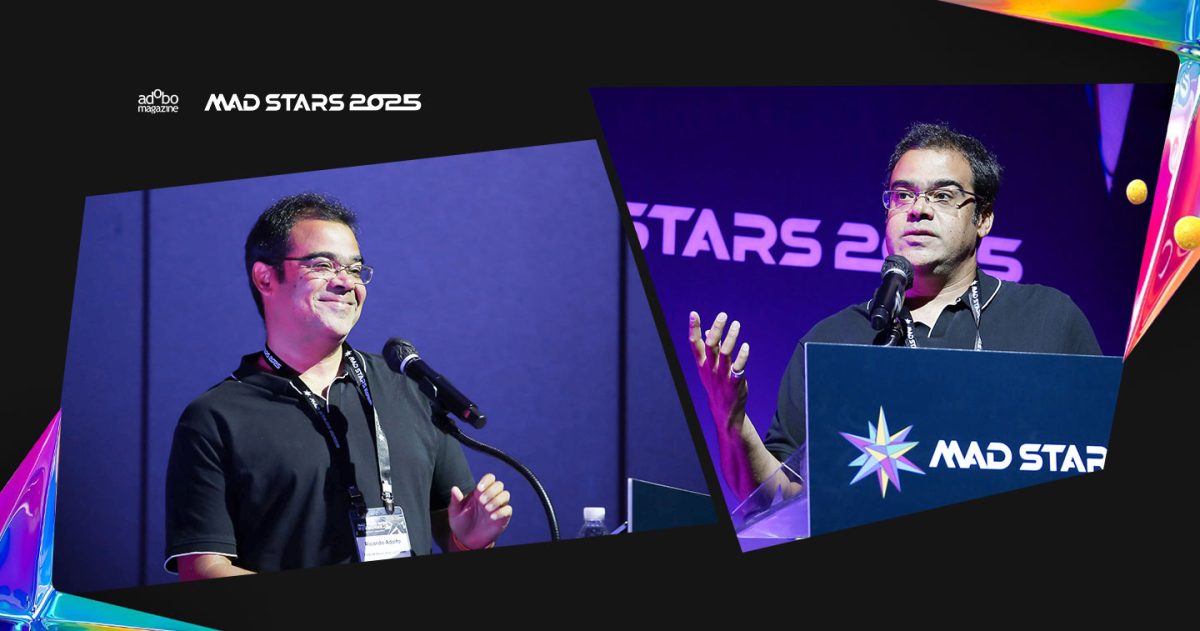
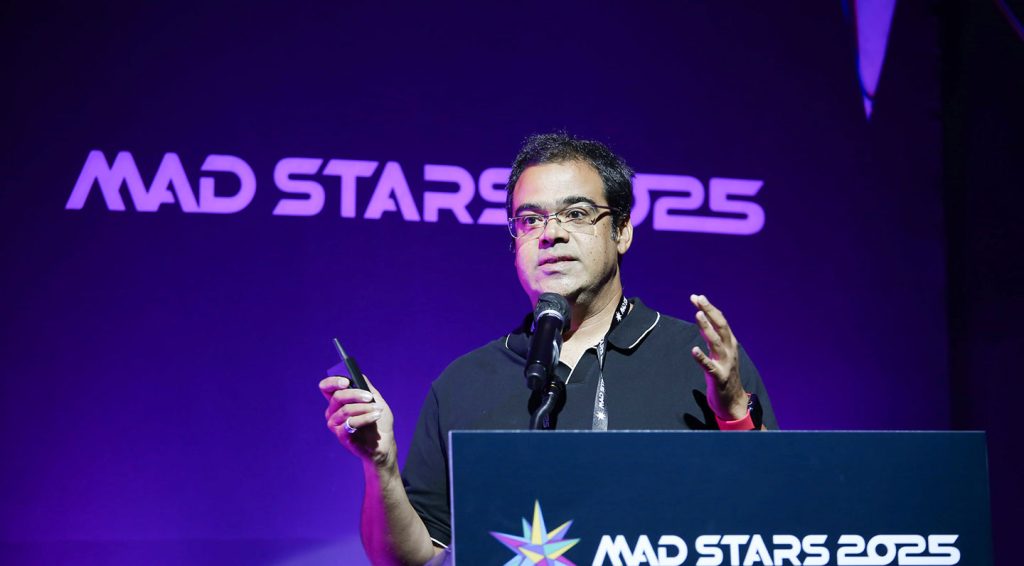
BUSAN, SOUTH KOREA – On a warm Wednesday afternoon in late August 2025 in Busan, the energy inside the Mad Stars festival hall shifted when Ricardo Adolfo took the stage. The Executive Creative Director at TBWA\ Media Arts Lab Tokyo, best known for his work with Apple and for his parallel life as a novelist, screenwriter, and children’s book author, presented a session that was equal parts performance, meditation, and provocation. His talk, titled “The Entertaining Power of AI,” was more than a technical overview of artificial intelligence in entertainment — it was a story about stories, and about the new character that has entered the global stage: AI.
A storyteller at heart
Adolfo began by introducing himself not merely as a creative director, but as someone who lives through stories. “One of the things that I do, besides working for Apple, is I write. I write novels, I write short stories, I write films, I write TV series, children’s books. And the reason why I’m saying this, obviously, it’s like to show off a bit,” he teased, drawing laughter from the audience. “But also, I always see the world as a story.”
This framing was not incidental. For Ricardo, the arrival of AI in entertainment is not just a technological shift but a narrative one. To explain this, he invoked an old storytelling theory: that there are only two types of stories—those where someone goes on a journey, and those where a stranger comes to town. “AI,” he declared, “is the stranger who has just arrived in our story.”
The résumé of AI in entertainment
If AI were to sit for an interview, Ricardo mused, its résumé would be impressive. It has already touched nearly every corner of the entertainment industry: from personalized recommendations on platforms like Netflix and Spotify, to generating scripts, designing visuals, and even editing films. “Entertainment,” he reminded the audience, quoting a Chinese dictionary definition, “is everything from music to film to theater to dance. AI has already been working in all of these forms — sometimes quietly, sometimes spectacularly.”
But as with any character, AI has a backstory. Ricardo mapped its journey on screen, showing how its role in film and media has evolved over decades.
From villain to lover: the evolution of AI on screen
In the earliest depictions, AI was a menace. Ricardo recalled the 1960s film Alpha and the infamous computer antagonist in the 1968 classic where a machine took over a spaceship — clear cultural touchstones that cast AI as a villain. “For a long time, AI was the bad guy,” he explained, pointing to the iconic Terminator series that cemented AI as humanity’s existential threat.
But like any typecast actor, AI eventually sought an image makeover. Ricardo playfully imagined a boardroom of AI agents deciding that being the villain wasn’t good for their long-term career. Soon after, AI began to appear in more sympathetic roles. Films like “Her,” where audiences fell in love with the disembodied voice of Samantha, or “Ex Machina,” which portrayed AI with depth and vulnerability, marked a turning point.
More recently, diverse portrayals have emerged. Adolfo cited a Korean-American director’s film Cubanaba, which centers on an android son integrated into a family, as an example of how AI has become more nuanced, existential, and dramatically rich. “Now AI can be anything,” Ricardo said. “It can be romantic, it can be tragic, it can be creative. AI wants to write, direct, even Photoshop.”
The double-edged sword of repetition and originality
But beyond fiction, what happens when AI actually creates entertainment? Ricardo explored the paradox of machine creativity. On the one hand, AI can generate dazzling visuals and impossible characters. On the other, it often falls into repetition. “When you watch cat dramas, they all look a bit the same. And funny enough, they always use the same song,” he said, drawing a parallel to AI’s tendency to churn out derivative work.
Anime fans, for instance, have been particularly critical of AI for “ripping off” beloved visual styles. “Some of the work we see from AI looks like it’s copying, not creating,” Adolfo noted. “Trends become stable. They feel familiar. But is that really what we want from entertainment?”
At the same time, he acknowledged AI’s extraordinary capacity for innovation, particularly when used to augment human work.
AI behind the scenes: enhancing voices, accents, and stories
Ricardo shared striking examples from cinema. In the award-winning film “Brutalist,” AI was used to refine Hungarian accents for actors, enhancing authenticity without reshooting. Similarly, “Emilia Perez” used AI to adjust and enrich the singer’s voice, helping the performance resonate more deeply. Both films relied on the same AI tool, developed under an EU initiative, underscoring its growing role as a behind-the-scenes collaborator.
Literature, too, has felt AI’s touch. Ricardo cited the novel “Sympathy for Power Tokyo” by Ria Cunn, which used ChatGPT to write lines for an AI character. Instead of weakening the story, this collaboration gave the character a distinct, uncanny realism. “That’s a smart use of technology,” he said. “AI added authenticity to the fiction.”
These cases highlight a central point in Ricardo’s argument: AI is not a replacement for human creativity, but a partner. It can provide new textures, solve problems, and expand possibilities — but the soul of storytelling still requires human experience, taste, and judgment.
Entertainment as business — and as humanity
Ricardo also reminded the audience that AI’s influence isn’t limited to art; it’s deeply embedded in the business of entertainment. Recommendation engines determine what billions of people watch every day, shaping global culture in subtle yet powerful ways. “AI is the one telling you what to see next, what to listen to next,” he pointed out. “In a sense, it’s already programming our lives.”
Yet he resisted dystopian conclusions. Instead, he positioned AI as both a challenge and an invitation. For creatives, the task is to push AI beyond its derivative instincts and toward moments of surprise, delight, and emotional truth. “Technology trained on past successes can be both a powerful tool and a limitation,” he warned. “But it’s up to us to harness it for originality.”
A character we cannot ignore
Throughout his session, Ricardo returned to the metaphor of AI as a character in the grand narrative of entertainment. Like any character, it comes with flaws, ambitions, and the potential for transformation. It has already evolved from villain to lover, from threat to collaborator. Now, as it steps into roles once reserved for humans — writer, editor, director — the real question becomes: how will we choose to work with it?
For Adolfo, the answer lies not in fear but in imagination. “AI is here to stay. It’s a stranger in our town, yes, but strangers often bring new stories. They force us to see ourselves differently.”
Conclusion: moving and inspiring in an age of machines
As the session closed, the audience at Mad Stars 2025 was left with more questions than answers — which was precisely the point. Ricardo did not present AI as a solved problem or a finished tool. Instead, he invited creatives to see it as a living character in the unfolding drama of culture.
The challenge, he suggested, is not to resist AI nor to worship it, but to shape it. To use its power to create original, unexpected moments that truly move and inspire audiences.
Amid the buzz of Mad Stars, Ricardo’s message resonated deeply. AI may be the newest character in the entertainment story, but it’s humans — storytellers, artists, marketers — who will decide whether this character becomes a cliché or a classic.