


MANILA, PHILIPPINES – Gelli Arceño captures how artist Elwah Gonzales redefines discipline and play in her solo show Elwah Store at Gravity Art Space.
“What if this year, I become more obsessed with my art making?” Artist Elwah Gonzales says to me as soon as I sit down with her at a local café in Bacolod City. I can’t help but laugh, after all she just got back from producing 200 paper works for her fourth solo show titled “Elwah Store” in Gravity Art Space and curated by Sachet Projects that ran June 6 to July 6, 2025.
I didn’t think she could get more “obsessed” with her art making than that. She laughed along, “I mean, I have always been prolific with producing (art) works but it mostly depends on my environment…” This precedes a conversation about art, tiny apartments, improv, and the poignant state of growing with your art as a young woman in her early 30s.


At the beginning of every year, Elwah would make it a point to start making new art. She would sit with her sketch book and with whatever material she has available, she would just go at it; be it a small painting or a sketch. She believes it sets the tone for the rest of the year.
“Here, I wrote in my journal last January 2 (2025), ‘I came across a reel about artists or athletes being obsessed with what they do and that’s what makes them who they are.’ Then I said to myself, ‘What if, I’m giving myself this time to be obsessed with what I do. How would it turn out? I’ve got one life and if I want to try it out, when will I find out? Anyways, that’s the gist of the idea.”
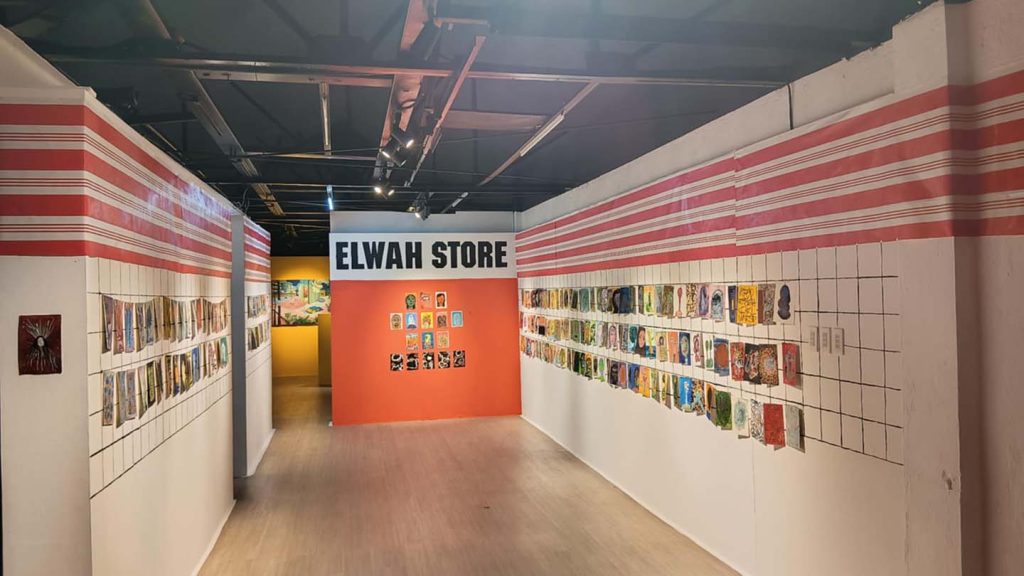
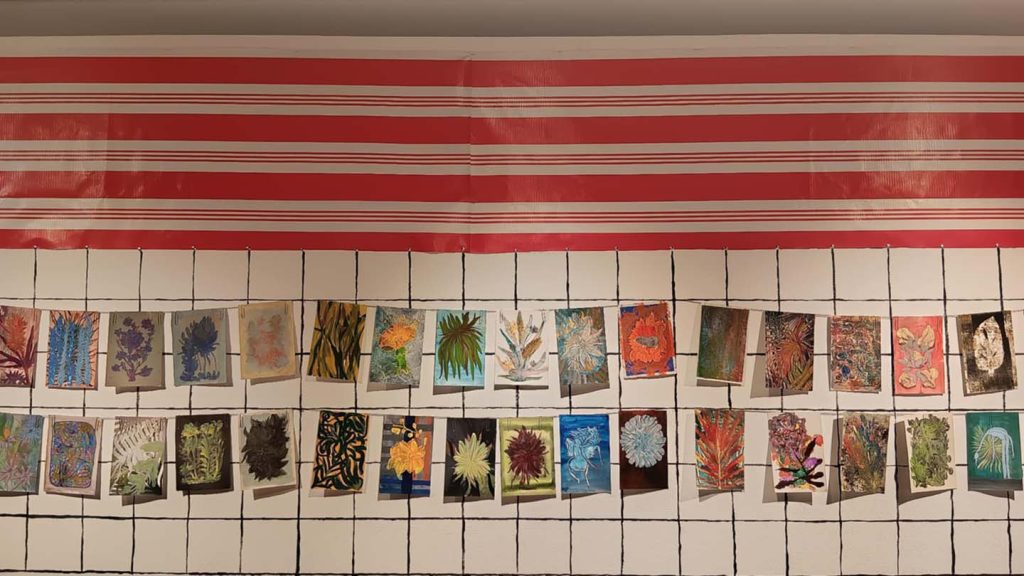
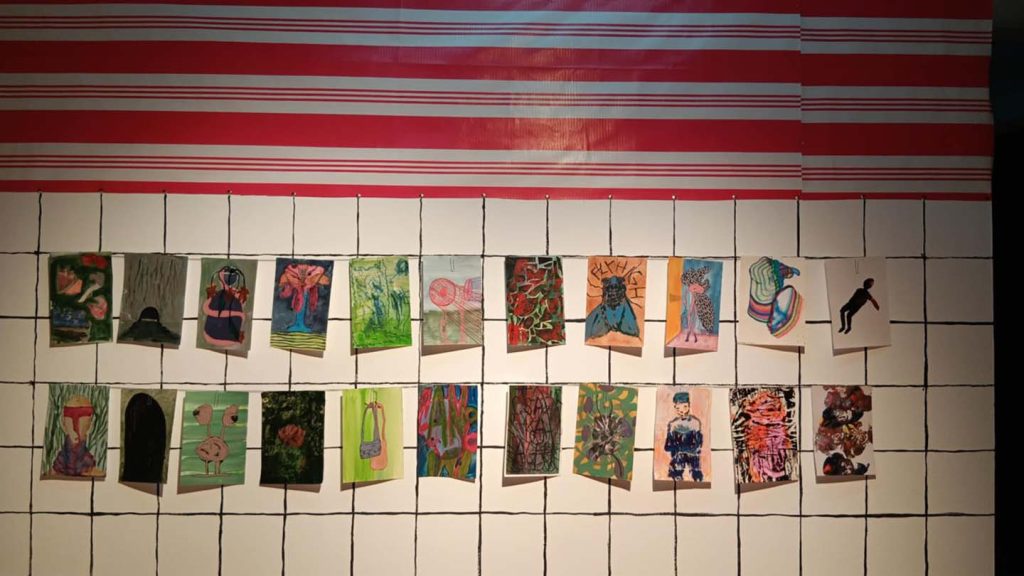
How would it turn out, indeed? At first glance the Elwah Store exhibition is unafraid of line and color. Elwah would play with gouache, acrylic, oil, ink, and collage as mediums of the 200 paper works. She compares it to going crazy, playing around with fevered passion. The works of strong red reds bleeding into true blues, and other bold colors shifting into each other. Her lines and words entangled and bursted out of the paper, almost a jungle of visual anarchy. However, looking at it individually reveals subtle restraint, the lines strong but precise and the narratives clear with each a story that allows us to get to know Elwah not just as an artist but as a person. According to her, everything in Elwah Store is a testament to her existence. It made me wonder, what did her art practice look like before?
“Like I said, I am quite prolific in producing work, but it really depends on my environment. I am always complaining that I really want to produce bigger works but I don’t have a studio, I have no space.”
As someone with no permanent housing, Elwah had to move places a lot. She constantly needs to adjust to a new living condition. It causes a lot of frustration on her part, especially that as a transient resident she is unable to freely make big works. “What if the paint spills, this isn’t my floor or what if something gets on the wall. I always work in very limiting spaces.”


Her limitations are not confined to just physical spaces but also in terms of having to maintain a means of living. She recalls the often-erratic nature of having to hold a job while trying to flourish as an artist, occasionally having to resign from work to pursue artistic opportunities and then having to let go of artistic opportunities to sustain herself with work. “I would resign from work because l have a residency abroad, then go back to Bacolod and find work again.”
She recounts her time in Linangan Artist Residency and how for her three months of stay there, she can compare the type of big works she can produce with a big space compared to a significantly smaller one. She feels constricted and can’t indulge herself as an artist.
Elwah muses that is why she rarely spared any negative space in her past works. She considers most of her work as maximalist. Often filling the canvas, even painting over the borders of the frame, her surrounding is as crowded as her former works.
Despite her limitations, she always feels compelled to paint by her need for a lot of outlets. Besides being a visual artist, she is also in a local improv group, used to having a sense of spontaneity in her art practice.
This year, something in her clicked and she said, “After many years of complaining, perhaps it is time to make do with what I have.”
“I started in January, as in everyday. I treated it as a 9 to 5 work. When I was in Bacolod, I’d wake up and start making something. After lunch, I’d go back and produce one work of quality. One to two works a day. Just a small one.”
For Elwah Store, she said she had A5 small pieces and started making art with whatever was available. She did half of her 200 paper works in Bacolod City and the other half in an art workshop at Studio Maya in Quezon City. She would take her classes and then sit in on an oil painting class. She gasps “Did I really do that? 12 midnight to 8am, I did my remote job then sleep a little around 9am to 11am. I would then go to my 1 to 3pm class. Art class.”
Elwah would first practice portraits but would eventually follow whatever inspiration captures her, in form and feeling. “Sometimes I would do something abstract or explore mediums — what if I mix oil and acrylic, what will happen? What about collage?”
Her past works have always been described as playful, but there is a distinct difference between how she plays with her art for Elwah Store compared to her past works. She compares Elwah Store to her first solo exhibition entitled “Gibberish” at House of Frida in 2015 with how she incorporates play into her work. “Now I am more curious with the medium as opposed to Gibberish where I feel compelled to fill the space.” She said, noting that her works then look more like studies, and now for Elwah Store, each feels more like finished pieces.


“I want to mold myself — like I want to be like other artists. Polished. Like, how can I be like them? So I couldn’t help myself, I made a big piece.” Her 4 by 5 feet work amongst a mass of A5 work is Elwah’s statement to herself, that she can do bigger works, and she plans to do more in the future. “If people ask me: what’s next? This is it, larger pieces. I want to produce more quality works.”
However, what does she consider “quality” works? “I saw a post or comment saying, ‘If you know how to paint it’s hard but if you don’t know how to paint, it’s easy.’ So, I think I don’t know how to paint, because for me it’s easy. Because I just produce–” Urging her to elaborate, she says “I feel like it’s quality if it’s well researched. I feel like my entire career I just apply the rules of improv: unscripted, unrehearsed. I want to challenge myself with a work that has a story, a medium, a study, everything.”
For Elwah, a work of quality is something she approached with intention and worked on with full presence. She wants to take her time with the pieces and only stop when she is finally satisfied.
This feeling of satisfaction manifested in her favorite piece in Elwah store, the big 4 by 5 feet piece of a sunset scene. “I made this in QC (Quezon City). I really enjoyed the process of doing that one. I posted a video on Instagram where I am painting and dancing. I was like ’this is nice, I think I can do this’. If I didn’t like the final product, I can always come back to it. It is a reminder that I love what I do.”
Finally, she talks about the kind of artist she wants to become in the future and how she wants to continue honing her technique. “I want to debunk the idea, the notion, of quality over quantity. Quantity can lead you to still create quality work. It’s a process for me, I have my usual stylized long neck works but it doesn’t end there for me. As much as possible, I will create as much works as I can, small or big works. I want to make a statement that I will never stop until I become who I want to be, someone who never stops creating.”