
MANILA, PHILIPPINES – This year’s Gerety Awards has finally come to a close, with a record participation of 270 judges from 52 different countries. And four victors to the Grand Prix have emerged:
- The Final Copy of Ilon Specht for L’Oréal Paris by McCann Paris (France) in the Entertainment CUT, Online Video
- Senna’s Cut for Netflix by Monks Buenos Aires (Argentina) in the Craft CUT, Editing
- Price Packs for PENNY by SERVICEPLAN GERMANY in the Communication Cut, Product & Packaging Design
- Never Just A Period for Bodyform/Libresse by Abbott Mead Vickers BBDO (United Kingdom) in the Craft Cut, Art Direction
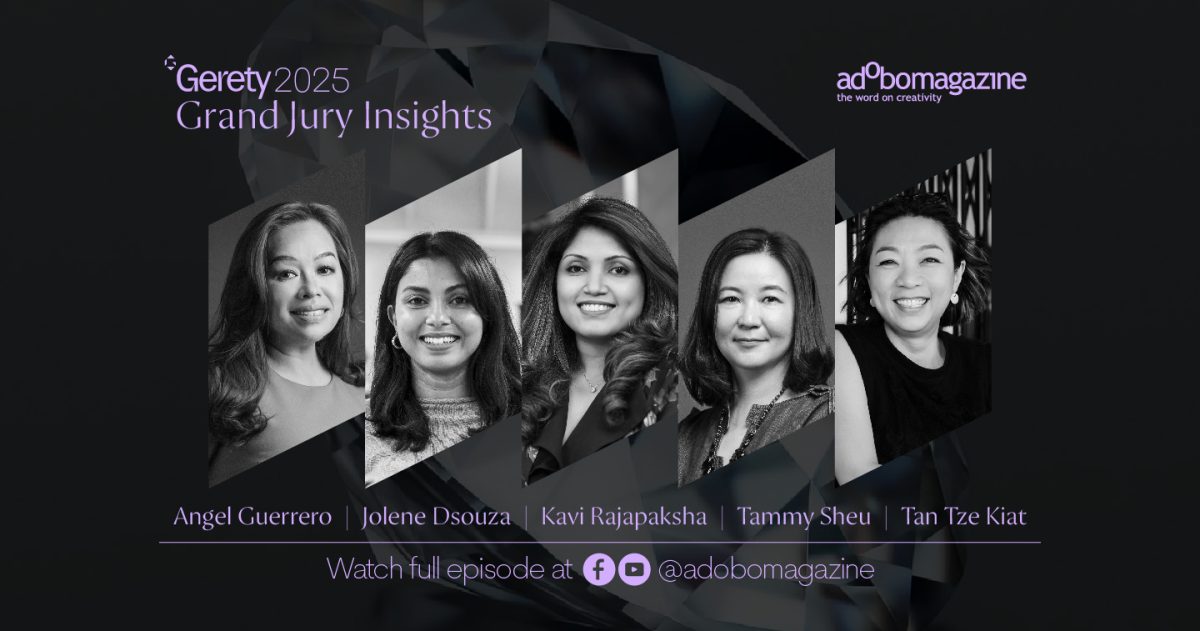
In this remarkable feat of a female-led jury, the campaigns were hand-picked for a singular theme that seemed to resonate with all the jurors: impact. adobo Magazine had the honor of taking a peek into what went behind the closed doors of the jury room. Last September 09, 2025, the Gerety Awards 2025 Grand Jury Insights streamed live on YouTube and Facebook, where four jurors shared their thoughts on the judging process, their personal favorite campaigns, and what they think the future looks like for advertising.
Hosted and moderated by adobo Magazine’s Editor-in-Chief and Founder, Angel Guerrero, the online discussion group consisted of:
- Jolene Dsouza, Group Strategy Director at Special Group in New Zealand
- Tan Tze “Z” Kiat, Chief Executive Officer of BBDO Asia in China
- Tammy Sheu, Chief Executive Officer of Banana Balloon in China
- Kavi Rajapaksha, Chief Marketing Officer of Sunshine Consumer in Sri Lanka
The jurors dived deep into how their judging process was for Gerety, specifically, as it’s a one-of-a-kind award-giving body that is purely female-led. They noted:
Kavi: At Gerety, the specialty is that the decision-maker — the female who makes 80% of the decisions — is in the spotlight. And having an all-female jury it actually enabled us to really look at, “Does this really drive the intent, that inclination to consider brands for the female decision-maker?” While the criteria has always remained the same, I think there’s a special lens that also came in because it’s for that female decision-maker.
Jolene: As a strategist, one thing that you’re trained to do is to look for the commercial impact. That’s something that I really look for. But when it comes to Gerety, it’s very much about creativity — the impact that creativity has. And I feel like we all put that lens to that. But there’s also an element of human impact or social impact for that matter. “Does this piece move people? Has it changed the way we live? Has it created something new or a new experience?
Z: Recently, BBDO has a new mantra called, “Do big things.” So I’ve started to focus on that. During this judging, I wanted to focus on “big” — big idea, big thinking, and big impact — whether it’s regionality, brave storytelling, or cultural relevance. But I believe that the big, strongest works take risks; they connect emotionally; and [they] feel timeless, regardless of the format. So when we were looking at that together with the other jury, we loved those kinds, especially when there’s an argument in there. That’s how we judge.
Tammy: Apart from creativity, the constant criteria has always been for the work to respect people, feel human, and push culture forward. Beyond craft or scale, I look for empathy, inclusivity, and truth — that’s where advertising has real power. At Gerety, that lens sharpens. It’s not only about brilliance, but whether the work broadens perspectives and makes our industry, and life, better.
Each juror was asked to share their favorite campaigns — Grand Prix-winning and otherwise — but it was clear that there was a crowd favorite. The campaign film “The Final Copy of Ilon Specht” for L’Oréal Paris by McCann Paris made an impact on all of the women in the room jury for its touching storytelling, and has earned a Grand Prix for Entertainment CUT, Online Video. As women in the field, it felt like a personal message of encouragement from one of the women who paved the way.
“Everyone liked this. This was so powerful. This is more than advertising — this is a cultural statement. It’s not from the production skill, but honesty, the courage, the simplicity. It is a kind of work that I admire,” Z shared.
Jolene also reflected on the parallels between two great women, Ilon Specht and Frances Gerety, who both coined iconic lines in advertising that would live on forever.
Another Grand Prix-winning campaign that they liked was “Never Just A Period” for Bodyform/Libresse by Abbott Mead Vickers BBDO, which won the Craft Cut, Art Direction award. The striking visual storytelling and musical score stood out to the jurors, who each related to cues on womanhood shown in the film.
“I liked that the agency leaned into purely visual language. The texture, the metaphors. You don’t need translations, you can just understand it. When you see a surreal blood-red ocean or an oversized pad, you feel it, no matter your mother tongue. For visual storytelling, it shows real progress. We’re moving into a space where ideas can travel across borders without subtitles, because the craft itself carries the message. In a way, it proves that empathy and imagination are the most universal languages we have,” Tammy expounded.
Z also shared that she had the honor of knowing the team behind this campaign, and shared a quote from AMV BBDO Chief Creative Office Nadja Lossgot: “When you’re not able to talk about something, you can find a visual way of expressing that feeling. Then to be able to talk about it, is a creative catharsis and an alchemy that happens that feels very interesting.”
Wrapping up the insightful discussion, the jurors reflected on what they think the future holds for advertising and their final thoughts on the campaigns they’ve seen this year:
Kavi: As a marketer, every day you try to do something meaningful. You have to make a dent in society for this to work. We have to mean it from the bottom of our hearts and do things that matter. But in a corporate world where you need short-term sales, to fight for these things takes a lot of might. That hasn’t lessened because now the pressure on KPIs is so much more with AI coming in. Everybody thinks that these things can be done in two seconds. The pressure has mounted. But I always believe that no matter how bad the changes, what we do, it’s basics, the principles of actually caring about your consumer, understanding insights. Not just observations, but insights actually hold true universally through time. Doing work that emotionally bias that inclination because no discount is gonna get you that level of brand love. There’s no loyalty because there’s so many things — love has to come from a deeper place. I think those things are gonna be cornerstones moving forward.
Jolene: I think the main thing for me is the importance of cutting through and being distinctive and standing out. There’s just so much out there. You’re constantly just inundated by so many different ads, so much content, so much to see all the time. It requires a lot of courage to be bold, to be different. But I think creativity trumps everything else when it comes to cutting through and the importance of being really creative and being really impactful. The other thing that really struck me with these campaigns is that they all felt very distinctive to the brands that they came from. All of them feel like no one else can pull them off, and I think that’s super important — being able to have these ideas and think about how you bring the brand to life in a way that no one else would be able to replicate. No one else would be able to own that in the same way. That thought of being true to who you are as a brand but also layering that with cultural insight or consumer insight is super important going forward.
Z: I really admire those winning campaigns and I realized that there’s not many works from the Asian market. We realized today that there are many works in Asia based on activation and solving a lot of short-term issues. But again, I wanted to express that activations are tactical, not strategic. They don’t play the brand story and you will end up putting another rock on the pile of rubble, rather than another brick in the brand wall. We hope that we can continue making powerful work that is human, that is brave, and that is culturally relevant. And hopefully one of the Grand Prix one day will be from Asia.
Tammy: In China, it’s especially challenging. If you look at China today, brand narratives that come with real solutions may prove even more powerful than traditional brand campaigns. They don’t just tell stories, they solve problems. I think that’s how they become the true pillars of brand building in the Chinese market. Having said that, what I see in these winning campaigns is honesty — they go beyond selling to reflect the human condition. Whether it’s gender equality, social justice, or the cost-of-living crisis we are facing. They show advertising is at its best. It’s not apart from life — it’s part of life.