
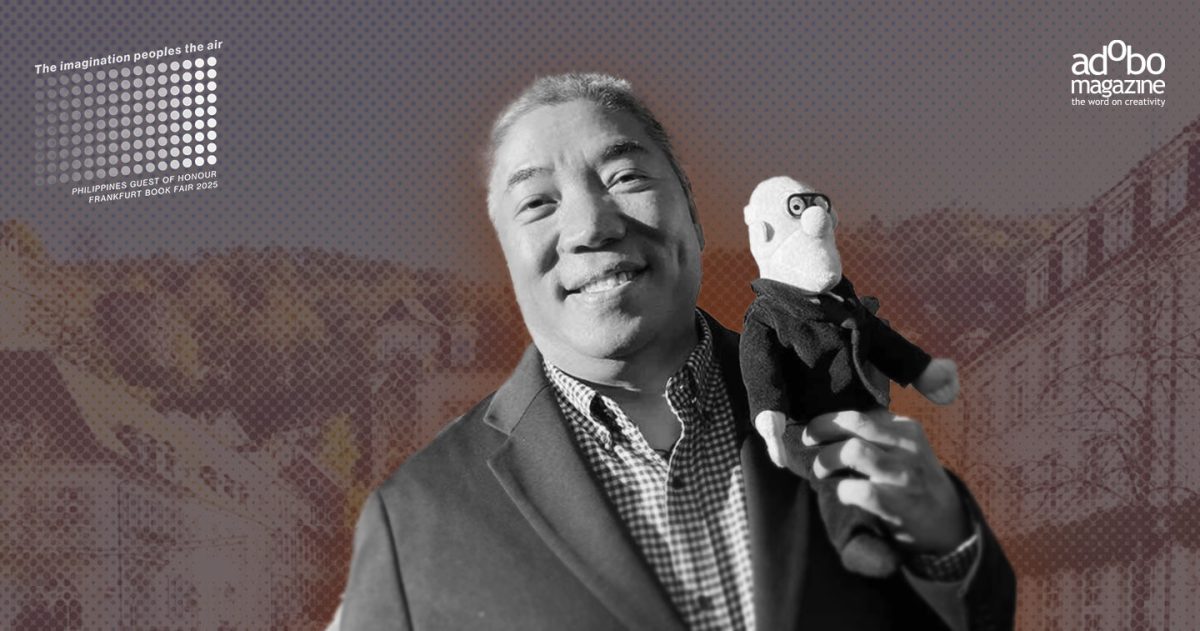
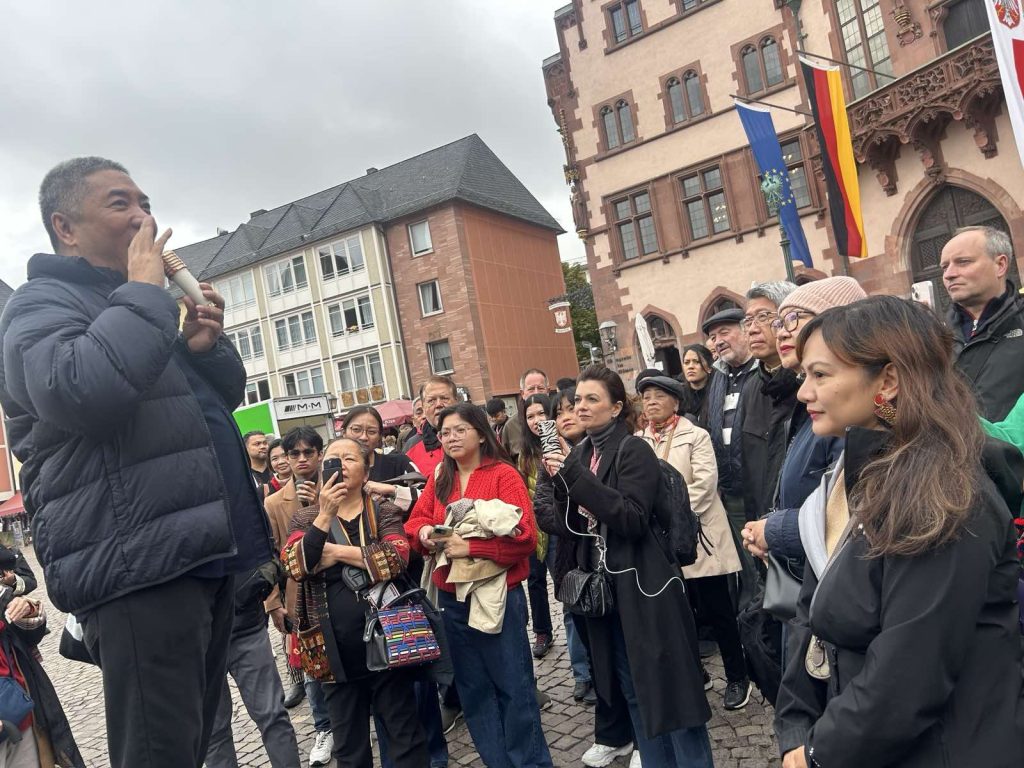
MANILA, PHILIPPINES – It’s raining in Frankfurt – something Ambeth Ocampo calls “not Rizal weather.” Back home, he quips, “it never rains on Rizal Day.” But on this gray European morning, a crowd of Filipinos and curious foreigners huddle beneath umbrellas, following the country’s most beloved historian through cobbled streets and centuries of history.
The tour, part of the Philippines’ Guest of Honor program at the 2025 Frankfurt Book Fair, isn’t your typical literary pilgrimage. Ambeth’s “Rizal in Frankfurt” walk retraces the brief, almost invisible traces Jose Rizal left in this city — a place he once called “the second most beautiful” in Europe, though he never revealed what topped the list.
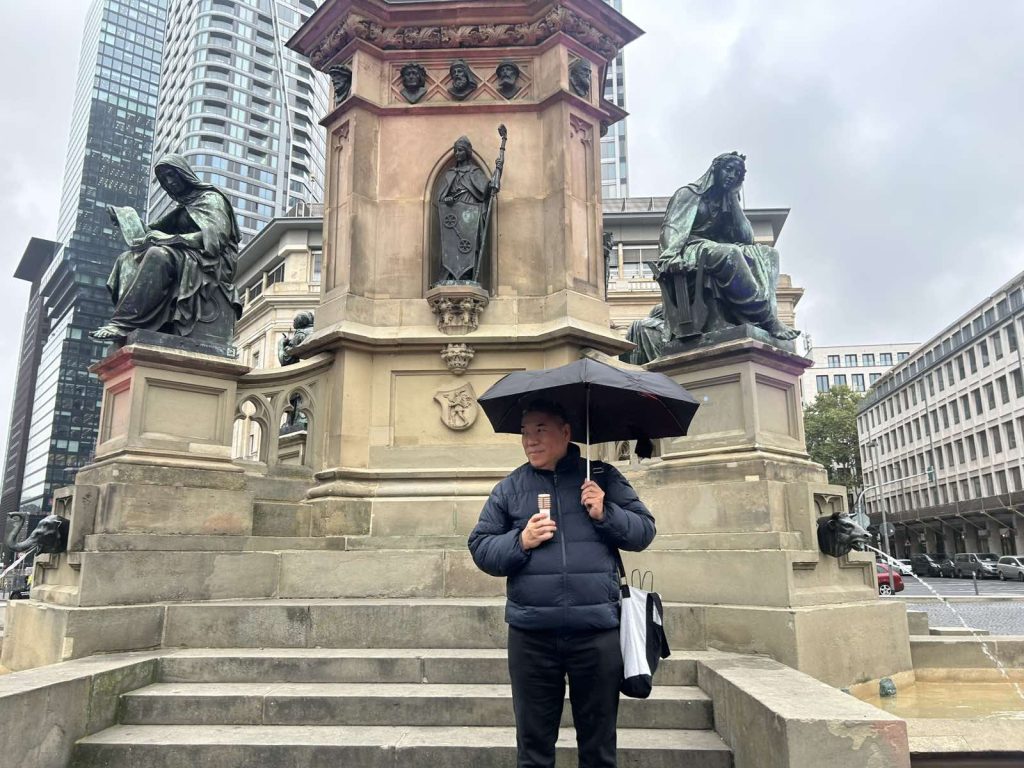
But as Ambeth reminds his listeners, “much of what Rizal saw is gone.” Frankfurt was flattened in World War II; its beauty rebuilt in glass and steel. “When we look at these monuments,” he says, “we see the old and the new going together — which is what history is: seeing the old in the new, and the new in the old.”
A national hero abroad
The first stop: the Gutenberg Monument, honoring the father of printing – fitting, Ambeth notes, for a tour linked to the world’s biggest book fair. Rizal, after all, was not a warrior or politician but a writer – a novelist who wielded words against an empire. Yet even he was unimpressed by the monument, dismissing it in his diary as “not worth my time.”


From there, Ambeth leads the group toward the Goethe statue. Rizal admired Goethe deeply, sketching the philosopher’s likeness in his notebooks — a small gesture of connection across cultures. “What I love about this,” Ambeth says, “is that Goethe’s monument survived the war, and so did Rizal’s admiration.”
He then speaks of water – a motif running through Rizal’s letters and novels. “Wherever he went, whether the Thames, the Seine, or the Neckar, he always compared them to the Pasig River,” Ambeth explains. “He saw the world through the eyes of home.”
That longing, he argues, shaped the man who would become a national hero. “Rizal’s love for his country grew stronger when he was abroad. If he had never left, we might have had a very different Rizal.”
Of book burnings and banned books
The group later stops near a bronze plaque marking the square where the Nazis once burned books. Ambeth pauses, his tone shifting. “Rizal was never burned,” he says, “but his books were banned.”
He recounts how, in 1957, the Catholic Church in the Philippines tried to block the Rizal Law, which made his novels Noli Me Tangere and El Filibusterismo required reading. “The Church has only opposed two laws in our history — the Rizal Law and the Reproductive Health Bill. Both times, the Church lost,” Ambeth deadpans, earning a laugh from the soaked but smiling crowd.

His point is serious, though: censorship, nationalism, and the freedom to read are not abstract ideas. “People walk past this square without knowing its history,” he says. “That’s why monuments exist – to remind us. Because books should always be read freely.”
He adds, “Rizal wrote for a nation that does not read him. And worse, we read him in translation.” It’s a piercing observation — that Filipinos are twice removed from their own hero, separated first by language, then by history itself.
The Santo Niño and the panther
The tour ends in front of the Städel Museum and Liebieghaus, where Ambeth shares one last discovery. While searching for a 19th-century sculpture called Ariadne and the Panther, he stumbled upon something unexpected — four medieval statues of the Santo Niño.
“One of them,” he says, “was made in the same Flemish workshop as the Santo Niño de Cebu.” Naked and pale, it offers a glimpse of what Magellan’s crew may have presented to the Queen of Cebu in 1521 — before centuries of devotion, humidity, and candle soot darkened it. “In the 1970s, he got an overdose of glutathione,” Ambeth jokes. “Now in Cebu, he’s brown again.”
Beyond humor, the anecdote speaks to how faith, like history, transforms – molded by time, culture, and imagination.
History, digitized
Ambeth talks about his current work: digitizing Rizal’s entire 25-volume corpus, annotated for online access. “There’s so much misinformation online,” he says. “I want to make Rizal accessible — complete and searchable.”
He also shares a dream project: restoring the lost 30% of El Filibusterismo that Rizal erased for lack of funds. “When your children read the Fili someday and find it longer,” he jokes, “blame your teacher — I put it back.”
Yet beyond the wit, there’s a quiet urgency in his message. “People think there’s nothing new to say about Rizal,” he says. “But I’ve studied him for forty years, and I still find something new every time.”
Seeing the old in the new
As the tour ends, the rain lightens. The group disperses into Frankfurt’s rainy streets, a modern city rebuilt from ruins – much like the way Ambeth rebuilds the fragments of history into stories that breathe again.
“History,” he says, “is about looking at the past and realizing it’s still with us. Rizal’s footprints are faint in Frankfurt – but the ideas he carried are what brought us here.”
adobo magazine is with the National Book Development Board of the Philippines at the 2025 Frankfurt Book Fair.