



GLOBAL — Artificial intelligence is quickly becoming a focal point of modern advertising, powering everything from media planning to creative optimisation. A new global report, including Singapore, Japan, Thailand and Australia and 12 other countries, from programmatic media partner MiQ, reveals that while a majority of JAPAC marketers say they plan to use AI more in the next 12 months, only Japan is confident in its knowledge of AI tech.
Globally, the findings are similar, with 72% of marketers planning to apply AI in more ways over the next 12 months, but only 45% feel confident in their ability to apply it successfully. In short, while adoption is rising fast, marketers are signalling an uneasiness in how best to put it to work.
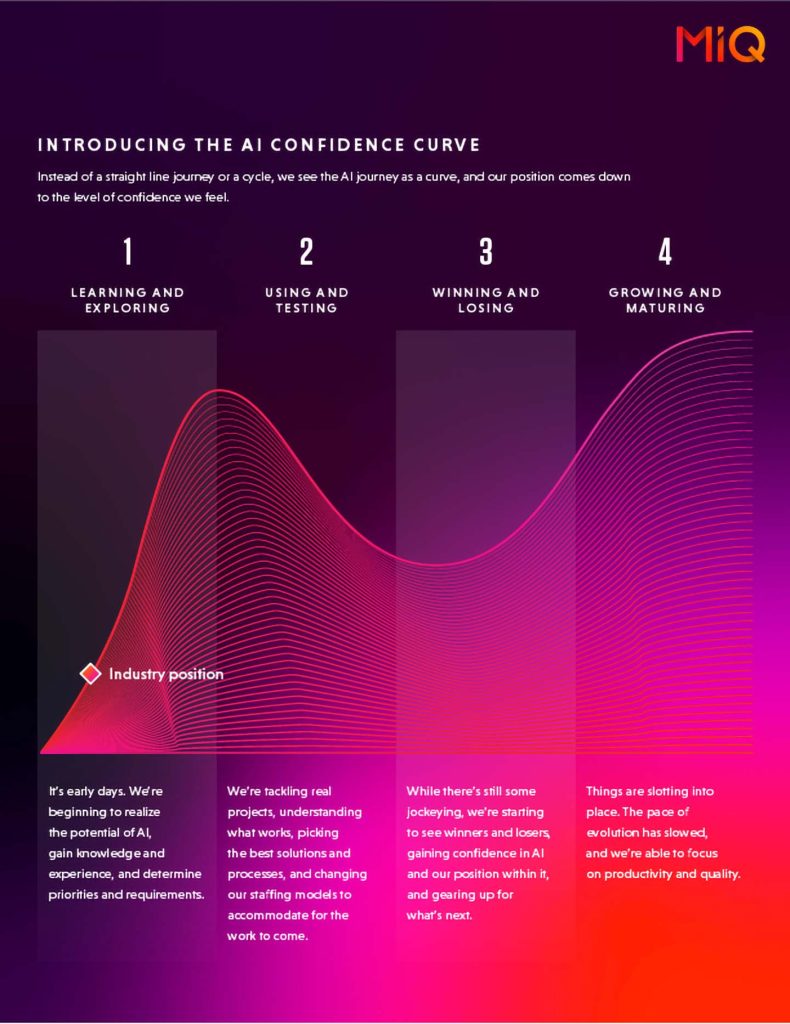
The AI Confidence Curve report, surveying 3,169 marketers across 16 countries, sought to understand usage and readiness levels around different aspects of AI in advertising. Responses paint a picture of an industry in transition—eager to advance, yet still developing the skills and systems needed to have AI fulfill its potential.
Singapore is among the most AI-forward markets in the world, using multiple AI systems for marketing, and using them most often (51%) compared to any other country surveyed. In Thailand, a reported 62% of workers have integrated generative AI into their personal and professional lives, marking the country as a potential transformative hub for Southeast Asia when it comes to workforce transformation. AI adoption in Japan, however, has been slower with only two-thirds (66%) of marketers saying they planned to use AI more in the next 12 months. In Australia, AI adoption is on the uptake and higher for larger companies, with 82% of companies of 200+ employees adopting AI tools, and 21% using AI for marketing automation.

“The study demonstrates the varying levels of confidence and uptake in AI, although Southeast Asia has emerged as a transformative region when it comes to embracing AI,” said Jason Scott, MiQ JAPAC CEO.
Scott added, “The challenge centres on knowledge gaps and measurement. In Singapore, for example, only 38% of marketers were fully confident in their team’s ability to optimise performance against marketing KPIs, one of the lowest results in the study, while in Thailand, only one-third strongly believe they have the correct measurement systems in place to track performance—again one of the lowest scores in our study. This speaks to a landscape where few marketers are fully confident in their capabilities and tools.”
Jordan Bitterman, Chief Marketing Officer at MiQ, said “We discovered that most marketers are bunched together at the early stages of a confidence curve. We’re at the start of a journey that will ultimately see us all move up the curve as we apply AI to more of our mission-critical work. Usage currently outpaces readiness by 27 percentage points, and we see that as pure opportunity. To close the gap, industry leaders must tap into tools and training.”
The Confidence Conundrum
Levels of confidence in AI differ across the region. In Singapore, 86% of marketers say they plan to use AI more in the next year—the highest result of any country surveyed. However, only 47% say they are “fully confident” in their knowledge of AI technology. In Australia, 75% say they plan to use AI more, but only half are fully confident in their knowledge.
In Japan, understanding AI isn’t the issue—51% of marketers are fully confident in their knowledge of AI technology, but only two-thirds (66%) will use it more. Meanwhile, in Thailand, only 45% plan to use AI more, the lowest result of any country, and only 42% are confident in their knowledge of it.
Of those marketers globally who say they are not confident, 40% report that their organisation does not understand AI or large language models (LLMs) well enough, due to a lack of training and understanding. This drives marketers toward generalised tools over bespoke solutions.
Globally, 38% cite lack of training, 42% mention data-sharing restrictions, and 44% point to an inability to track results against the right goals. Nearly two in five senior marketers admit they are still building the education, measurement, and workflow systems needed to use AI confidently and consistently.
The Mission for Meaningful Measurement
Marketers use different metrics for measurement across the region. Australia leads in using proxy metrics such as web traffic and engagement (49%), while Singapore prioritises engagement and financial metrics like ROI and ROAS (55%). Thai marketers also lean on financial indicators (46%), and Japanese marketers are most focused on web traffic (49%).

However, only about half of marketers in these markets believe strongly that they have the right measurement systems or are tracking the right goals. Despite this, nearly half believe they have the right channel mix and are meeting their performance goals.
Current Uses of AI in Advertising
Marketers are already using AI for various tasks:
- In Australia, visual design tools like Canva (39%) and social media management tools (38%) top usage.
- In Japan, content creation (46%) and ad creative optimisation (37%) lead.
- In Singapore, consumer journey applications (29%) dominate.
- In Thailand, focus is on the purchase journey (31%).
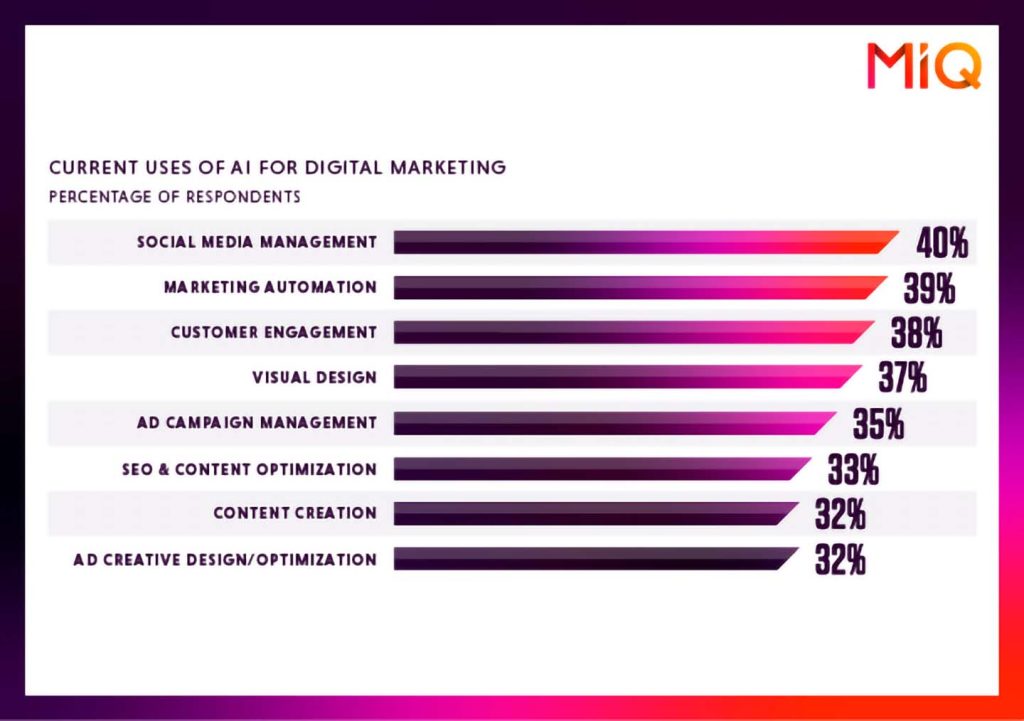
Globally, social media management (40%), marketing automation (39%), and customer engagement (38%) are the top three AI applications.
The Path Forward
Despite concerns, optimism remains high. MiQ’s report outlines steps to improve AI confidence:
- Adopt partner-agnostic solutions to integrate multiple platforms and eliminate data silos.
- Integrate AI into performance measurement to directly link AI systems with business impact.
- Invest in AI literacy across teams through ongoing training.
- Preserve human expertise by keeping marketers involved in decision-making and validation.
“Every marketer is trying to find the balance between learning and leading with AI,” Bitterman added. “The ones who advance fastest will treat confidence as a capability, something built every day through connection, curiosity, and collaboration.”
Read the full MiQ AI Confidence Curve report here.