



SINGAPORE — Jobstreet by SEEK today released The Great Expectation Gap: Rethinking Work and Worth in Singapore, a new report uncovering how job mismatches, trade-offs, and conditional compromises have come to define the working life of Singaporeans.
Conducted in partnership with Milieu Insight, the study of 800 employees and employers explores how both sides of the hiring table understand fairness, balance, and satisfaction in today’s talent landscape.
The findings reveal a workforce that is pragmatic but disappointed. Eight in ten employees say their jobs do not match what was promised, and six in ten spot this mismatch within their first three months. At the same time, nine in ten employers also say worker priorities change over time. With the goalposts constantly shifting, employers are left to chase evolving priorities while employees continue to renegotiate what “fair work” means in real time.
Most Singaporeans find jobs don’t match what’s promised
Early mismatches between expectation and reality are widespread. Mid-career professionals are most likely to experience them, with 62% spotting gaps within the first three months due to pay–responsibility gaps (29%). At the same time, younger workers (25–34) also encounter early misalignment, often finding job scopes differ from advertisements (25%.)
Across all age groups, the leading causes of job mismatch are pay misalignment (24%), unclear roles (22%), and culture mismatch (19%), underscoring a persistent gap between hiring perception and workplace reality.
Employees are redefining fairness through conditional compromise
Although many may label Singapore’s workforce as ‘entitled’, what the data shows is a pragmatic talent pool who make deliberate, rational trade-offs to find balance in a competitive labour market. Employees recognise that they cannot have everything, and that some compromises are part of modern employment.
While 46% of employees rank pay as their top priority, 23% say they would compromise on it when job hunting, reflecting the practical choices workers make amid current market pressures. Yet, this doesn’t mean employees are willing to settle. Instead, they practice “conditional compromise” — open to trade-offs only when the exchange feels fair, transparent, and future-focused.
For many, flexibility and salary are no longer deal-breakers but competitive advantages they may trade temporarily for better culture, stability, or career growth. These compromises are short-term and calculated, with most employees still expecting transparency in the deal they sign up for, and viewing fairness as non-negotiable.
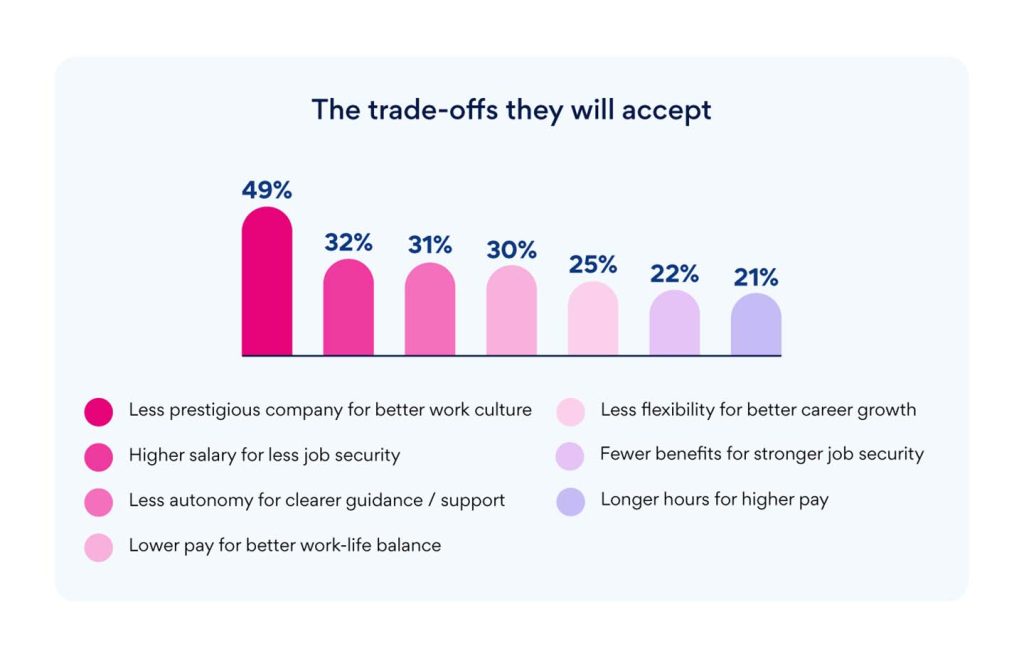
Across the board, 49% of employees would trade prestige for culture, 30% would accept lower pay for balance, and 25% would give up flexibility for career growth — reflecting a workforce that values clarity and reciprocity over perks or promises.
Fairness thresholds vary by age. Among younger employees (25–34), almost half (49%) would be willing to trade prestige for better work culture, reflecting a group that is driven by learning, culture, and mentorship.
Mid-career professionals (35–44) value balance and authenticity most, with 51% willing to trade prestige for better work culture and 35% agreeable to lower pay for better work-life balance.
Still, half of employees would not accept any pay cut — even for full flexibility (50%) or a four-day work week (49%) — proving that flexibility is now a baseline expectation, not a perk.
Employers share the same goals, but face real constraints
Insights from the report reveal that top challenges faced by employers in Singapore include skills shortages (44%), salary expectations (41%), and budget pressures (39%). Across organisation type, SMEs struggle with pay expectations (43%) and budget limits (37%), while MNCs struggle with skills shortages (51%) and role misalignment (29%).
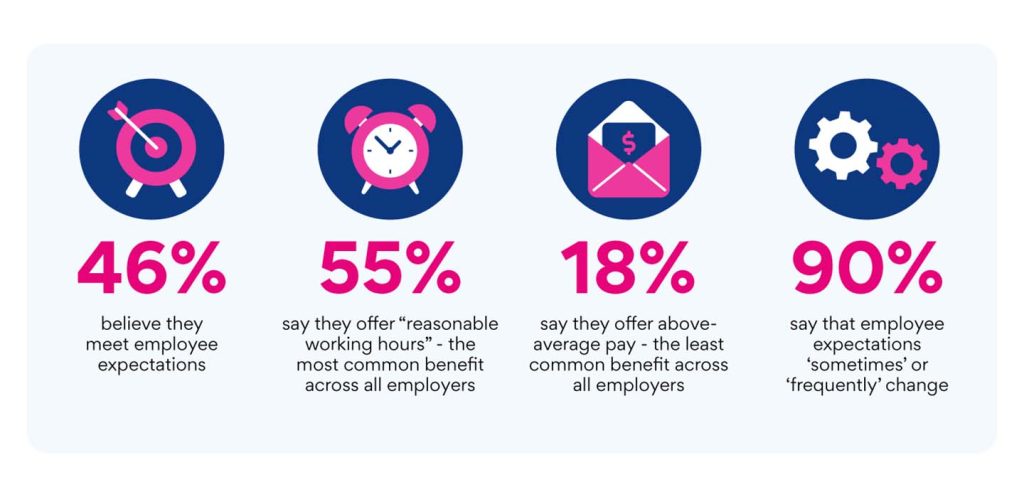
While employers share employees’ desire for fairness and engagement, the intent doesn’t always translate into impact. Nearly half (46%) believe they meet employee expectations, offering benefits like reasonable working hours (55%), bonuses (52%), flexibility (43%), and career growth (36%). Yet, only 18% provide above-market salaries, revealing a major blind spot in financial fairness.
Like employees, employers are pragmatic — seeking resilience over perfection. When talent is scarce or budgets tight, 64% would hire less-experienced candidates with good attitudes, 36% would accept lesser experience for lower pay, and 28% would prioritise cultural fit over skills.
Bridging the gap: From promises to alignment
Ultimately, both sides are aligned in principle but divided in practice. They value fairness, balance, and growth, but shifting priorities and operational constraints keep them out of sync.
“The expectation gap is a reflection of how quickly Singapore’s employment landscape is evolving,” said Yuh Yng Chook, Director, Asia Sales and APAC Service, Jobstreet and Jobsdb by SEEK. “The labour market remains resilient, with stronger-than-expected employment growth and steady unemployment in Q3 2025. Yet beneath these positive indicators, our findings show that good intent isn’t always enough. Employers believe they are being fair, and employees are already adapting — but their definitions of fairness don’t fully align. Bridging this gap begins with a clearer, shared understanding of what fairness means in a dynamic job market. For both employers and employees, acting on insights around competitive pay, culture alignment, work-life balance, role clarity, and transparent communication will be key to strengthening trust on both sides.”
About the Report
The Great Expectation Gap: Rethinking Work and Worth in Singapore is a study conducted by Jobstreet by SEEK in partnership with Milieu Insight. The study surveyed 800 respondents in Singapore—500 employees and 300 employers—across industries, life stages, and company sizes, between October and November 2025. Access the full report here.