
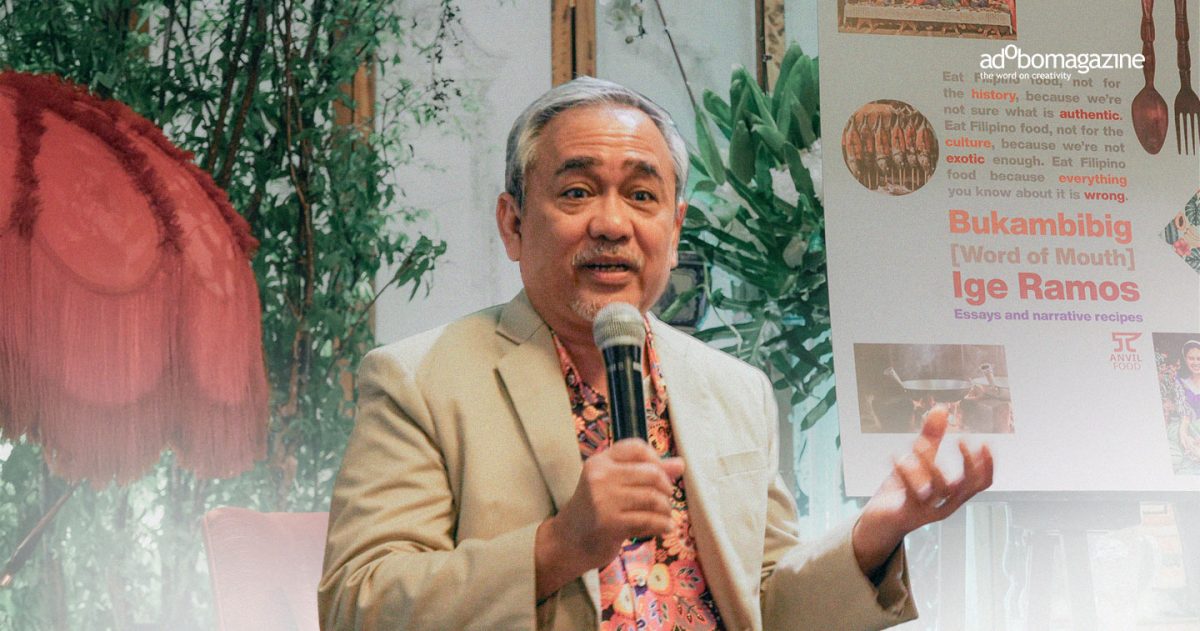
Quite a controversial statement, but there it is, right on the cover. Ige Ramos imploring readers to eat Filipino food because “everything you know about it is wrong.”
His new book, Bukambibig (Word of Mouth), is a collection of 14 essays that combines accounts from Ige’s long-winding culinary discovery and adventures — a journey that started when he was a young boy and has brought him everywhere from Quaiapo to Barcelona — with the profusion of knowledge he has gathered throughout his journey.
A Filipino writer writing about Filipino food in English? It’s not exactly contrarian, come to think of it. It’s a decision resulting from the realization and admission that most people who can afford books in this day and age read and better understand literature in English.
Nothing is authentic anymore
Now, one might label Ige as a contrarian for subtly admonishing restaurants and businesses that still herald their offerings as “authentic.”
At the first of events launching Bukambibig, Ige, in a casual Q&A and discussion with author and editor Yvette Tan, said: “What is authentic? Nothing’s authentic anymore. Please stop using this word.”
“In Filipino food, let’s forget history because we’re not authentic anymore,” he added, emphasizing his point.
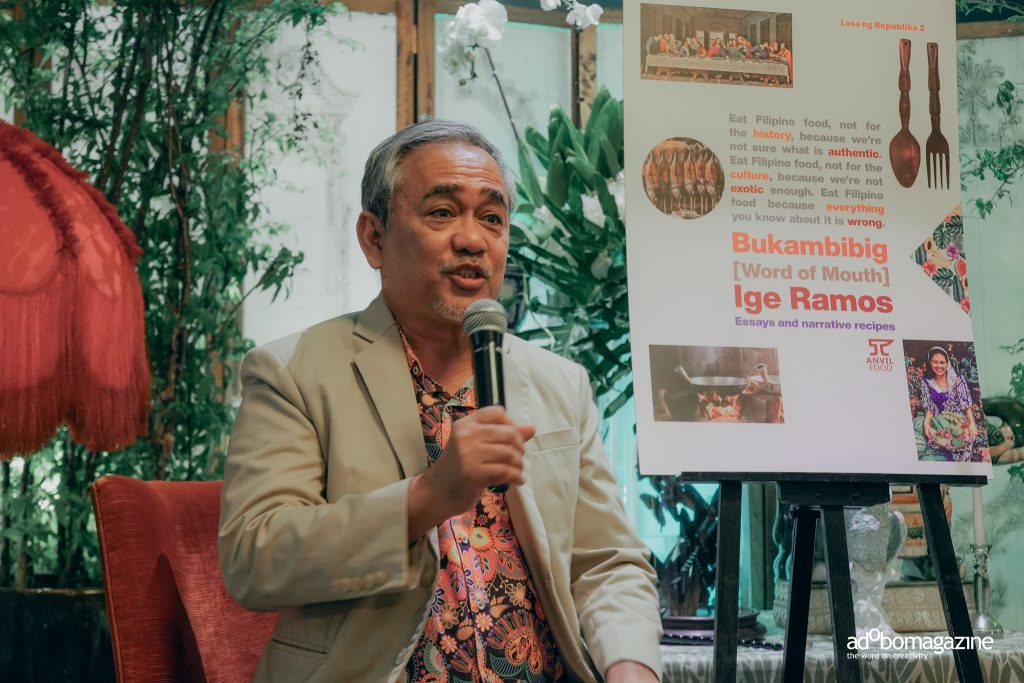
Ige challenges notions of authenticity because the meaning of authenticity in Filipino cuisine does and will continue to evolve.
Filipino cuisine, after all, has been touched by so many foreign influences that it has become difficult to set a barometer for what is truly authentic. And it isn’t necessarily a bad thing.
Ige noted that while Filipino cuisine cannot out-exoticize the food of its Southeast Asian neighbors, it does have a homecourt advantage.
“Yung laban natin is taste (Our edge is taste),” he said.
Filipino food may not be considered exotic enough for being distinctly spicy or stand out for one particular flavor, but it appeals to and satisfies the palate – perhaps because, according to Ige, it can “adapt to any ingredient.”
He also observed that when it’s time to eat, everything is customized. Filipinos like to put condiments like chili, toyo (soy sauce), patis (fish sauce), or calamansi to make the dish suit personal preferences.
Filipinos shouldn’t shun a particular dish because it’s not authentic or exotic enough in the puritanical sense.
Take, for example, the almondigas (meat ball soup). Ige wrote about it in Bukambibig. Even provided a recipe for it.
The dish has Spanish-Mexican origins. The addition of misua and patola? Supposedly Chinese. And yet it is found in many Filipino carinderia (eatery). Pinoys love it.
Ige’s take? “It’s Filipino food. We embrace it. It’s our own.”
Filipinos are chromatic eaters
“Rice is the center of our palate, and then we paint it with different textures and colors, and we are chromatic eaters. And that’s the way we are.”
Ige recalls saying this yet again controversial and contended statement about a decade ago, drawing a comparison between the eating habits of Europeans – which he said were cognitive eaters – and Filipinos. He admits getting flak for it.
Like many insights presented in Bukambibig, it’s not packaged as absolute truth. Not everyone has to agree. But perhaps, everyone could listen.
Ige is an explorer. He goes from place to place to understand the culture, sample the food, and learn about its origins – locally and internationally. He’s a scholar who does his homework and does the grunt work. His statements are grounded in research, expertise, experience, and genuine, concretized passion for the gustatory.
He is worth listening to. And worth reading.
Read, reconsider, and eat

Did you know that the term “Filipino” originally referred to Spaniards born in the Philippines (Maybe you picked this up during a grade school history lesson, but soon forgot about it), or that former president Emilio Aguinaldo loved boiled saba (plantain) dipped in bagoong (shrimp paste) and calamansi (Philippine lime)?
Did you know that makurilyu, a fear of running food during celebrations, is deeply rooted among Kapampangans? Did you also know that Ige’s family had an avocado-colored 1960s General Electric refrigerator in their home in Cavite, and that Ige loved crunchy tuyo (dried fish) dipped in spiced vinegar as a child?
Reading Bukambibig is like going on a virtual museum tour, food crawl, and tête-à-tête with its author. You land at intersections of food and history, at times time traveling and traveling the Philippines and the world, exploring food through Ige’s reflections and recollections.
The essays may be deeply personal, but foundational knowledge, qualitative insights, and peer-supported propositions come in full servings. It’s a lot to take in – a buffet, if you’ll allow the metaphor – but easy to digest, leaving you full and satisfied after every read.
But don’t take Ige’s bukambibig or word of mouth for it. The book is more than a conversation starter. After it challenges preconceived notions of Filipino cuisine, it entices readers to go out, plot their own culinary journeys, and experience Filipino food on their own terms.
Bukambibig is available online and in select National Book Store branches.