

Screenwriter and author Sarge Lacuesta clearly remembers the time when he and his parents went to Iloilo. They were aboard a second-class boat, the low-cost alternative for traveling to Lambunao, his grandparents’ hometown.
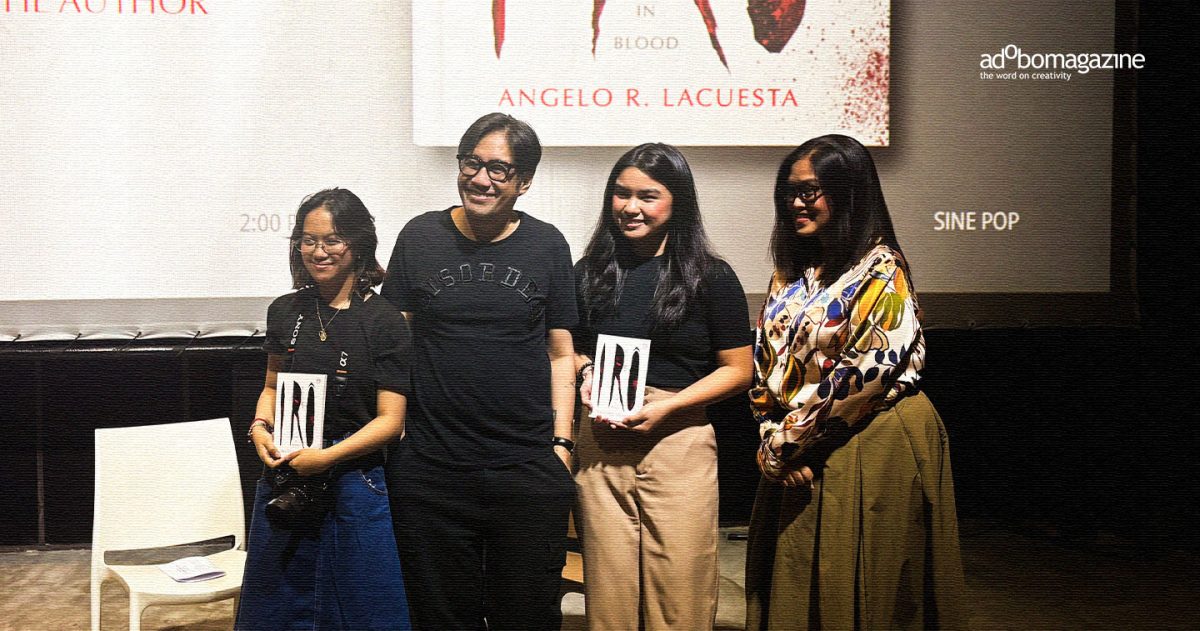
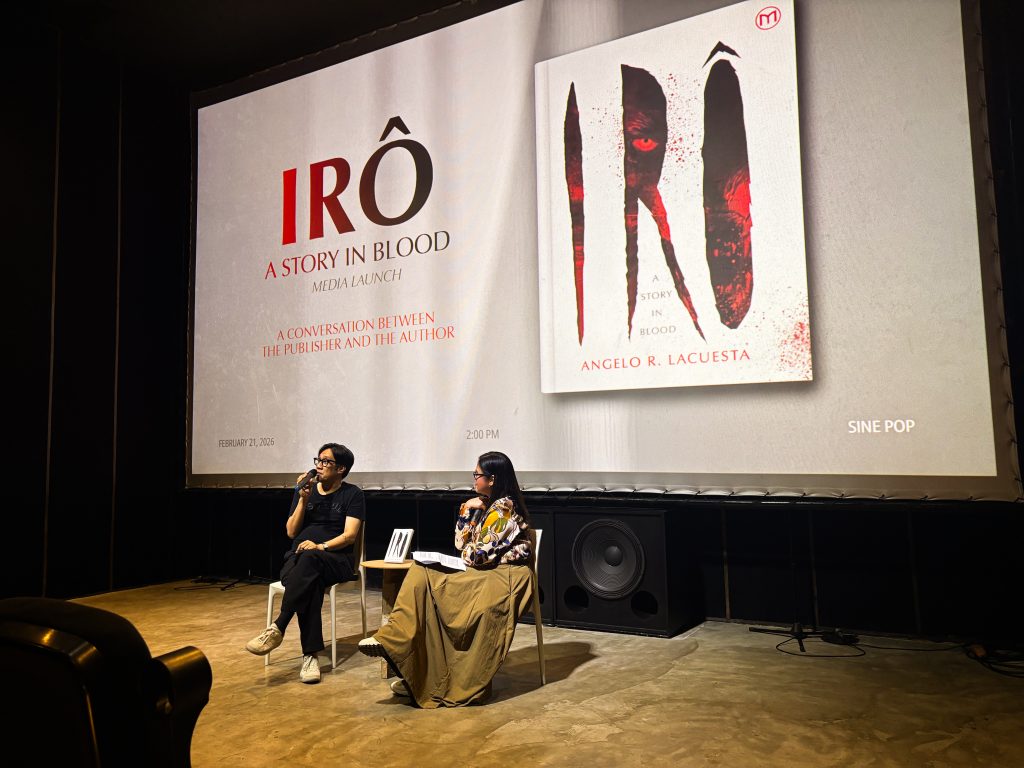
He shared anecdotes from his childhood and more at the launch of his new book, Iro, held on February 21.
Although Sarge’s parents are from Davao, yearly trips to Iloilo constitute core memories of his childhood. He would see mothers breastfeeding their children. Pigs and chickens on a passenger boat. At a time where cultural norms were different, these weren’t normal sightings for kids.
But that was just the start of his culture shock, coming from the perspective of a “Manila boy.”
He saw only one traffic light in the town of Lambunao.
“The town was very rural,” Sarge said, as if stepping back into reality, addressing guests at the event.
Lambunao may be a quiet rural town, but the story of a man-eating hybrid has become part of its collective memory. Lore dictated that the town had its own infamous aswang, a shape-shifting monster in Filipino folklore known to split its victim’s skin open and eat whatever is inside.
“Puro aswang ‘yung town na ‘yun. Pagdating namin ng Lambunao, dito talaga ‘yung mga aswang” Sarge said.
He recalls seeing cans behind the jalousies of windows. The elders said they were intended for burglars, but young Sarge knew they were for something far more sinister. He knew they were used as defense mechanism against creatures that came to get your intestines – aswang.
For many Pinoys who grew up in the province, the story of the aswang has been a staple for terrorizing both children and adults.
For Sarge, it wasn’t just a story. It was the weird flapping above their house. A bird? No! It was too big to be a bird.
The flapping had targeted only one thing — their house in Lambunao. Sarge’s hands would tremble from contemplating the possibility of what it could be. But at the back of his mind, he knew where the flapping had come from.
At the time, his father didn’t believe him, but Sarge knew it was real.
Given this experience in his tender years, Sarge — a top screenwriter and author today — crafted his book Iro with supernatural and mystery elements.
The road to Berlinale
Sarge and Andrea Pasion Milflores, his publisher, were the only people of color in the room.
They stood in the middle of the Berlin International Film Festival — better known as the Berlinale — surrounded by a sea of polished pitches and industry veterans. The competition was unforgiving from the very start. Nearly 200 producers submitted their projects, but the organizers would select only 10 titles to move forward.
From the Philippines, several entries were considered. But when the final list was announced, only one remained: Sarge’s.
And unlike the others, his wasn’t a safe drama or a quiet arthouse piece. He was pitching a creature story — bold, folkloric, and unapologetically strange.
In a lineup dominated by conventional narratives, his project stood out, not simply because it was the only Philippine title chosen. It was the only one daring enough to focus on a monster.
“And because of that, I think the book will go tplaces.” Andrea, co-owner of publishing house Milflores Publishing, said.
Marta and the mystery
The story of Iro follows Marta Mallari, the young mayor’s wife, who is drawn to the mystery of the town killings. First it was the dogs, then the townspeople, then people close to her. Marta journeys through political dynasties, patriarchal systems, and social media as she uncovers why the killings had happened — and why only men were slaughtered.
“Social media is very much a part of the monster of the book,” Sarge said.
The elements in the book closely mirror what common folk, even in the metropolis, experience daily. Political dynasties are widespread in the Philippines. Social media has become a weapon used by politicians. Patriarchal systems power the very reality we are living in.
Although cliché, Sarge pays no mind. “It is a way of life,” he said.
The book, after all, reflects what is happening in the Philippines, where many live in uncertainty.
Simply put, the story is about a corrupt, patriarchal dynasty. A story you would hear over breakfast, while watching the news.
And that, Sarge would later say, was precisely the point.
What made the book different — what made it unsettling — was that it wasn’t fantasy for fantasy’s sake. It was rooted in something lived.
“The horror in Southeast Asia is really something else,” Sarge said. “Kahit ano pang gawin nila sa West — Hereditary, for example.”
“Nakakatakot talaga,” Sarge added, acknowledging the craft, the tension, and the brilliance of films like Hereditary.
“But iba ‘yung nakakatakot sa Pilipinas,” he continued. “Kasi totoo.”
In the West, he explained, horror can function as escapism — a controlled fear inside a dark theater, something you shake off when the credits roll.
But in the Philippines, fear doesn’t end when the screen goes black.
“When you watch a horror movie here, you understand that it’s real,” he said. “Kasi uuwi ka pa. Mahihirapan ka sumakay. Brownout. Madilim ang kalsada. You live in this constant precarity.”
The monsters aren’t confined to folklore. They exist in unstable systems, in unsafe streets, in the everyday uncertainty of getting home.
The creature in Iro
The book can be summarized by answering one question: “What happens to a system if it’s corrupt for too long?”
While Marta was deep into solving mysteries, Sarge saw the opportunity to introduce a mythical creature. But he didn’t use any of the already existing folklore creatures. He wanted the monster to embody not the horrors of yesterday, but the horrors of today.
“Hindi ito parang World War 2 na alam mo kung sino ‘yung mabait. Because I want to depict today’s horrors, I had to configure this monster. An aswang, for me, is a good creature. It is a moral creature. It’s created by decisions which are moral.”
“It’s loaded with cultural expectations,” Sarge, added, referring to the aswang as folklore weaponized by the Spaniards during their time in the Philippines.
Comparing the struggles of different generations, Sarge said: “If it’s a folkloric creature that exists, then it’s loaded with cultural loads. But people don’t understand, we are in a more violent era than ever before. The violence is internal.” .
“I really wanna see it… as a way for Filipinos to understand the horrors of our times… na talagang we live in horrific times.”
As a creature feature book, Iro‘s pages are peppered with gory scenes. But these too are not just for show. Sarge said that they, too, entail different interpretations.
“Blood stands for dynasty. Blood stands for genetics. Blood stands for violence. “ he said in conclusion.
READ MORE:
On debut novel “Joy”, the writing process, and what it takes to tell a life story — An interview with Angelo Lacuesta
David Guerrero unpacks The Beatles’ ill-fated 1966 visit to Manila in ‘You Won’t See Me’ launch at Fully Booked
Something to chew on: Everything you know about Filipino food is wrong