


MANILA, PHILIPPINES – Schneider Electric, a global energy technology leader, today announced the results of its annual Green Impact Gap survey revealing that Philippine business leaders increasingly view sustainability as a driver of growth and competitiveness, even as they cite economic uncertainty and geopolitical instability as barriers to further sustainability investment.
In 2025, 97% of local companies have set sustainability targets, though only 51% have implemented comprehensive strategies, leaving a 46% gap between ambition and execution. 92% of companies in the Philippines this year are already applying or interested in applying AI to advance their sustainability ambitions, underscoring its potential as a sustainability accelerant.
For the private sector, sustainability investments remain constrained, with economic uncertainty still the top concern but easing from 49% in 2024 to 45% in 2025.
Ninety-seven percent of companies have established sustainability targets. Among them, 58% report that sustainability reporting has become easier over the past year, largely due to technology advancements. Yet, 32% still face challenges, citing factors such as rising costs.
This year, 55% of company leaders identify innovation and competitiveness as key drivers of sustainability, with the strongest emphasis from the semiconductors (71%) and data centers (60%) sectors, followed by real estate (53%) and healthcare (52%). This underscores how industries increasingly link sustainability with business innovation.
Sustainability is also delivering tangible business value. This year, 52% of leaders say it creates new business opportunities, up from 42% in 2024. Similarly, 42% pursue sustainability to strengthen brand and reputation, compared with 32% last year, while 46% cite cost savings and financial benefits, up from 43%. These year-on-year gains demonstrate that sustainability has evolved from a peripheral initiative into a core strategy for competitiveness and resilience.
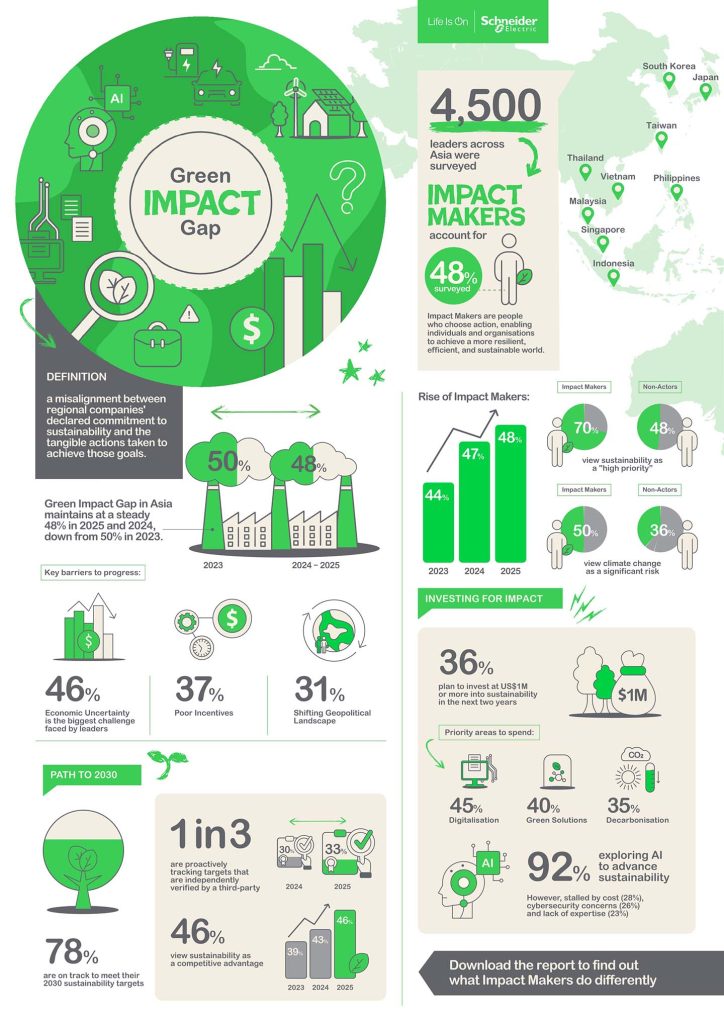
Now in its third year, Schneider Electric’s Green Impact Gap survey with Milieu Insight captures insights from 4,500 executives across nine Asian markets on how businesses are prioritizing and investing in sustainability.
Misalignment between declared goals and tangible action persists
While findings underscore the growing commitment to sustainability in the Philippines, they also reveal a persistent ‘Green Impact Gap’—the misalignment between companies’ declared sustainability goals and the tangible actions taken to achieve them. This year, 97% of companies set targets, but less than half are taking comprehensive action, keeping the regional Green Impact Gap at 46%.
With 2025 marking a critical milestone on the path to 2030 climate goals, companies remain optimistic. Around 84% express confidence in meeting or exceeding their 2030 targets, while 20% report being more than three years ahead of schedule.
“Companies across the Philippines are not just weathering the storm—they’re using sustainability as a compass to navigate it,” said Ireen Catane, Country President, Schneider Electric Philippines. “Despite volatile economic conditions, early movers and adopters are turning to digitalization and AI to drive efficiency, mitigate risk, and create lasting value.”
In parallel, two-thirds of companies (66%) report being very or moderately familiar with Republic Act 11285, the Philippines’ Energy Efficiency and Conservation Act. Among these, 85% express moderate to high confidence in meeting its requirements, signaling readiness to implement concrete energy-efficiency measures.
AI unlocks cost savings and energy efficiency
Artificial Intelligence (AI) is helping companies address financial and energy risks. 92% of companies in the Philippines this year are already applying or interested to apply AI to advance their sustainability ambitions. At 59%, AI for energy consumption optimization now tops the list of energy and resource efficiency applications, rising ahead of waste management (50%) and smart building management and automation (49%).
Companies see AI’s biggest impact on sustainability in automating data collection and reporting (51%), optimizing energy use (44%), and enhancing product design (44%).
With the rise of energy demand in the Philippines, projected to grow 4–5% annually and potentially double total power consumption by 2040 under the Philippine Energy Plan, companies continued to adjust their decarbonization strategies in 2025.
The most widely adopted measures were switching to low-carbon or electric vehicles for transport (27%, up from 25%), and investing in R&D for low-carbon technologies (27%, up from 25%).
Investments hold steady despite economic uncertainty
With business leaders seeing the bottom-line benefit of sustainability, planned investment in sustainability transformation has held steady, with 23% of companies planning to invest at least US$1 million over the next two years.
While investment in sustainability continues to face key limiters, most have eased slightly year-on-year. Economic uncertainty remains the top concern but dropped from 49% in 2024 to 45% in 2025. Internal budgetary constraints declined from 48% to 37%, while regulatory and policy difficulties (37% to 35%) and poor incentives (36% to 35%) also decreased marginally.
These shifts suggest that while structural and financial challenges remain, the investment landscape in 2025 has become relatively more favorable for corporate sustainability compared to the previous year.