


MANILA, PHILIPPINES – When Vic Icasas graduated in 1993, he took a one-week break, got a job as a composer at Hit Productions, and never left. Today, he’s the CEO of the production house, leading with the wisdom you only get from more than 30 years of having a front row seat to each technological shift in the sound production industry.
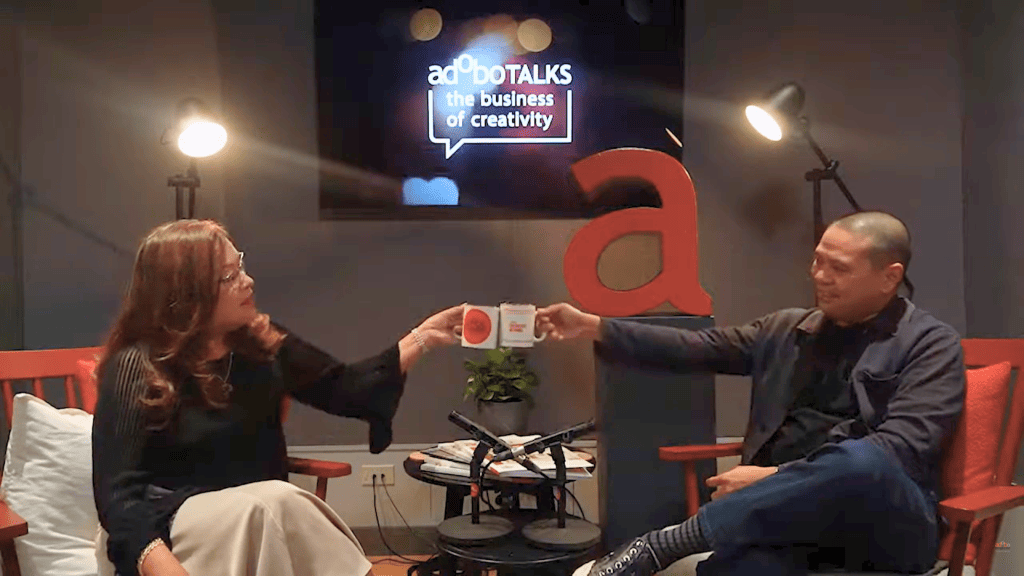
So, who better to talk to about the evolution of the audio landscape in the tenth of adoboTalks Podcast | the business of creativity?
Vic has been shaping the house sound and stewarding a catalogue of work that’s earned the production house metals at Cannes Lions, ADFEST, Spikes Asia, London International Awards and more. He was even at the helm of the company for every single one of the staggering 22 times Hit Productions was named 4As Audio Production House of the Year.
In his episode, “The Sound of Success,” we got a peek into the machinery behind this success as Vic mapped the recent history of audio in the creative industry and how Hit Productions has managed to keep up amid the whirlwind of changes.
A constant evolution of sound


For Vic, the history of Hit Productions is also synonymous with the history of technology and radio advertising.
“[The reason] I sometimes call Hit a tech company is because we have to adapt to the platforms on which the advertising is being released,” he explained.
Long gone are the days of just TV and radio, which were generally what the lane was split into when he started. Now, there’s also Spotify, TikTok, YouTube and more, each with its own formats, specs, audiences and sonic expectations.
And change isn’t new. The constant evolution of technology has kept production houses on their toes for decades now. “When I started, we were releasing ads [on] dual mono,” he recalled. “Then it became stereo, then it became 5.1, and now we have Dolby Atmos.”
“[When it comes to the] evolution as a company, the creativity was always there, but [part of its history was also] adapting to what the industry needed,” he expressed. “To put it bluntly, it’s adapt or die.”
But while there’s no other choice, this constant act of adaptation seems to be far from just an obligation for Vic.
“[It’s] super fulfilling,” he said. “I’m motivated every time there’s a change, because it’s a challenge to see if we can adapt and evolve.”
Of course, nothing has shifted expectations faster than AI. But, like always, Hit Productions is making sure they’re prepared for it, even if it did scare him at first.
But that doesn’t mean they’re going about this with blind faith in whatever new AI development crops up. Hit Productions has hired an IP law firm and is actively involving the voice-talent guild VocAlliance to make sure that they’re going about this ethically and legally.
“I think the fact that we’re involving the right people at every step is what will guide us in the right direction.”
What it takes to stay on top


With the rampant rate of sound technology, we’ve reached a point where anyone with a laptop fitted out with the right apps can produce a track. And that means more competition.
Yet, Hit Productions has managed to stay on top. How? For Vic, there are two aspects to it: the technical fruits of their longevity and the classic ingenuity they’ve been fostering from the start.
“The business that we’re in is much more than just a laptop and a microphone. It’s the 30 years’ worth of sound effects that we’ve created. It is a database of all the voice talents in the Philippines.”
“More important, though, than the equipment would be the fact that we’ve identified something about our culture in Hit. It’s that we’re problem solvers,” he added. “If you throw a deadline at us, if you throw a particularly challenging storyboard at us, if you throw an impossible task at us, we’ll figure out a way to get it done right.”
Of course, keeping that culture requires having the right team. And at Hit Productions, that means hiring people who aren’t just musically talented. They have to know how to serve clients, too.
“I’ve interviewed some really, really talented composers and musicians. And within the first minute or so, I [could] tell that, while they may be musical geniuses, they’re not cut out for advertising.”
Vic detailed the music department’s onboarding process, saying that he always advises prospects to give 100% when composing but to let it go the second they hit send on that submission.
“Chances are 10 people sitting in a conference room are going to rip it to shreds because they’re trying to predict what the CEO is going to want to hear,” Vic stressed. “Some people are cut out for it. Some are not.”
The Filipino sound and the global spotlight
Hit Productions’ problem solving culture has definitely been paying off. Their shelves are lined with trophies, including those awarded to them on the global stage.
In fact, they even snagged the Philippines’ first ever Cannes Gold Lion back in 2007 for the Lotus Spa campaign “Traffic Therapy,” which was produced with agency JWT.
“It was an amazing concept, and we did our best to help execute that concept for JWT, [but] the Philippines was still so unused to being on the international stage for awards,” he recalled.
While that historic first was a shock for them, today, they’re no strangers to international recognition. And that global recognition begets major global clients.
Most notable are studio giants Netflix and Disney. In the last few years, Hit Productions has been tapped for the Tagalog dubs of huge titles, like Encanto, Stranger Things, Nimona, and most recently, the K-Pop Demon Hunters. And they came with a steep learning curve.
“The biggest aha moment for us was how different Philippine production practices are from the way things are done abroad,” Vic admitted.
They quickly realized that if they wanted to play on the big stage, they had to play by big-stage rules. And that meant the little things, too. While the Philippine process is a bit more output oriented, global clients expect every step of the way — from the file naming to what mics to use — to be aligned with specific protocols and standards.
But beyond the technical standards, Vic also thinks that earning international esteem also necessitates knowing how to communicate with them.
“One of the biggest untapped skills that we need to lean into is communication.” He expounded, saying that global clients in the past have expressed that they liked working with Hit Productions because it felt like the team were just people down the street.
“It’s about putting [the foreign clients] in a mindset that [they’re] dealing with a partner and not just someone in the third world,” he continued. “If we can elevate our thinking to always think of ourselves as partners, rather than just vendors or suppliers, that’ll go a long way towards being really seen as equals on the global stage.”
But of course, embodying those global standards and mindset is all behind the scenes. When it comes to the output, the actual finished product, that unmistakably Pinoy touch is still there.
And that doesn’t end in translation work like dubbing. It expands to original tracks and even sound effects that immediately take you to Philippine streets.
“There are uniquely Filipino [sounds], like the annoying jeepney horns!” he said with a laugh. “We have a library that we’ve built up over the years of uniquely Filipino sounds … And you’re not going to get those sounds from an American library.”
Even the attitude towards music in advertising is distinctly Pinoy. Vic called our country “simple jingle centric,” and that’s a hard observation to refute. Filipinos, after all, are the types to still remember commercials with catchy tunes and lyrics from decades ago.
“In the U.S., jingles are seen as kind of corny,” Vic pointed out. “[But in the Philippines,] I’ve heard people [unironically singing] jingles that we’ve done, [and] it’s not because they want to promote the product. They just appreciate a good melody.”
It’s worth noting that this love for musicality doesn’t have to be contorted into Western styles. There may be a challenge to meet international standards, but that doesn’t mean that the content itself needs to be dictated solely by global trends. And the democratization of sound production has made sure of that.
“Back in the day, everybody had to listen to the same thing on the radio,” he reflected. “[Now,] Spotify, Apple Music, [and] Amazon Music have all given us our own personal radio stations. We don’t have to listen to what other people are listening to. We can listen to our very own curated playlist of what we care about.”
“I think the opportunity here is that many people no longer need to mimic,” he assured. “[Filipinos] can come up with their own personal style, and there will be an audience somewhere in the world for it.”
Catch the insightful conversation with Vic Icasas on Episode 10 of the adoboTalk Podcast on Spotify, YouTube, and Soundcloud. The adoboTalks | the business of creativity, is presented by adobo Magazine, the word on creativity and produced in partnership with The Pod Network and Hit Productions.