
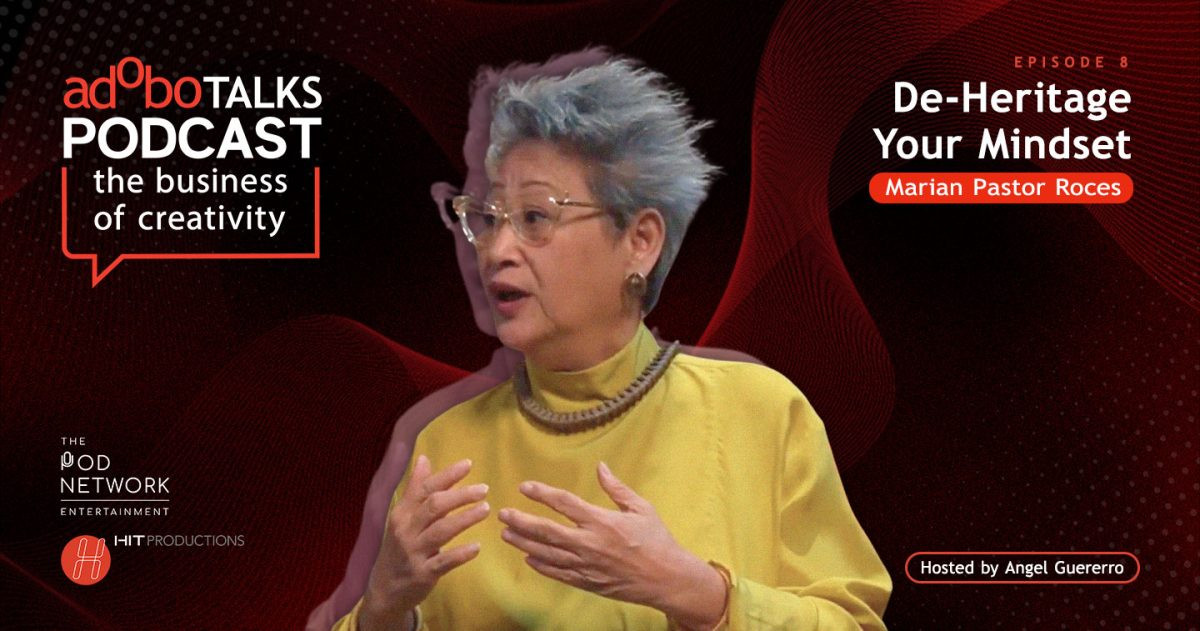
MANILA, PHILIPPINES – What does it really mean to engage with Philippine heritage and creativity? For TAO Management Corporation Chief Executive Officer Marian Pastor Roces who is also a curator and an art critic these are questions of both rigorous thought and practical action.
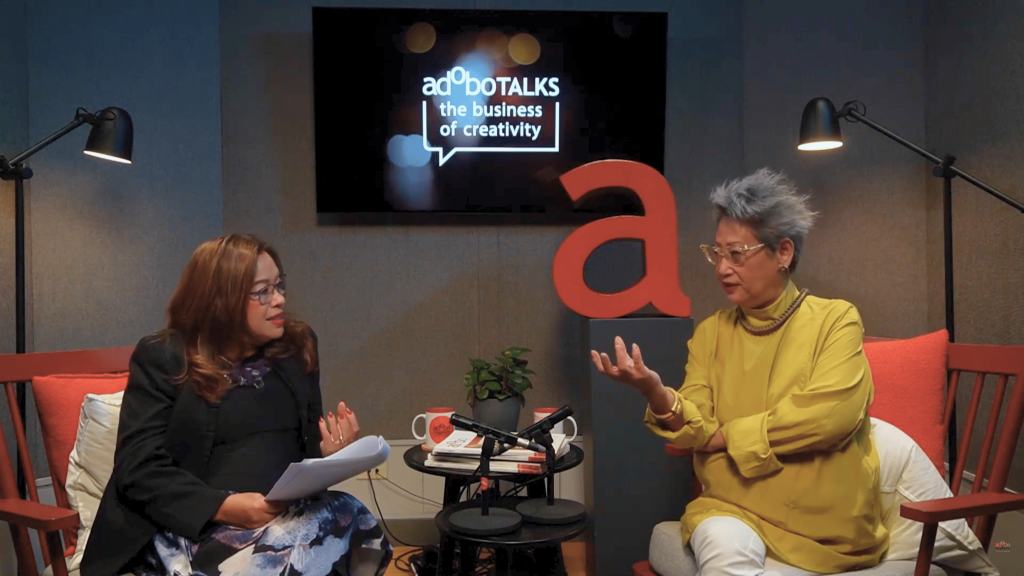
During the eight episode of the adoboTalks Podcast: The Business of Creativity, hosted by adobo Magazine Founder, President and Editor-in-Chief Angel Guerrero, Marian shared her journey, challenges, and lessons in the creative and cultural sectors, offering both a critique and a guide for the new generation.
Marian’s perspective is rooted in over fifty years of experience navigating the arts, from braving the uncertainties of martial law to becoming a globally active curator and institutional critic. She reminds us that the Philippine heritage and creative past is not where we expect it.
Marian is the founder of TAO Inc., a corporation that establishes museums, curates public art projects and assists urban planners including the Yuchengco Museum, the UP Manila’s Museum of History of Ideas and the Museum of Contemporary Art and Design. She is also the woman behind the curation of the 50 Years of Philippine design exhibit held at the National Museum.
Through these substantial experiences, Marian said that criticism — whether in art, culture, architecture, film, or literature — relies on a shared language.
“You can’t really be a critic in the Philippines up to now because we don’t share a common language of criticism. The language of criticism is very dense and philosophically driven, so unless you have a community of critics who speak the same language, you can’t be properly honed. You end up talking to no one,” She said.
Marian added, “But if we had some kind of academic training in philosophy, we could, in fact, have a critical discussion in this country. I’m happy, though, that I found — this is veering sideways — that there is critical discourse in other fields, and that’s how I manage to stay in the Philippines. In fields like political science, there is criticality. They have a common language for criticizing political systems and so on.”
The power of critical imagination


For Marian, true creativity and any meaningful engagement with heritage does not begin with preservation alone, but with what she calls critical imagination.
Far from being a buzzword, critical imagination is an active and ongoing practice of questioning, analyzing, and re-examining the systems that shape culture and creativity. It asks not only what we inherit, but how and why these inheritances continue to function in the present.
“If you have a critical imagination, you’re able to see where certain systems — cultural systems included — are dangerous, and you can identify where they fail or are flawed,” she explained to adobo Magazine.
Furthermore, Marian shared candidly about the scale of heritage loss and the slow work of recovery. Through initiatives like Mapping Philippine Material Culture Overseas, visibility is finally increasing.
“We have uploaded about nearly 10,000 pieces from 33 museums with their permission,” she shared. “So now there’s no excuse not to know what’s out there.”
Still, she is careful to temper calls for immediate repatriation. The process, she explained, is far more complicated than simply demanding objects back. What matters first is knowledge by seeing what exists, understanding its context, and approaching the issue with scientific rigor rather than emotional shortcuts.


“I’m not personally vested in the idea of heritage. I’m invested in the idea that we need to know what people did in the past — we have no more than what we know. And I hope this doesn’t play into the idea of preserving heritage for heritage’s sake, because that’s not what I’m after. What I want is a more critical view of heritage, and a critical view is always supported by science and by hard work,” she underscored.
Likewise, from exquisitely crafted gold artifacts to intricate textiles, Marian pointed out how cultural material continually challenges long-held assumptions.
“Gold that is so fine you automatically think there must have been some kind of royalty or aristocracy. That was the context for this incredible workmanship. The granulation is something you’d really die for — filigree, beads, and truly incredible details you can’t even see without a magnifying glass. The craft is unbelievable,” she reflected.
“So how do you square that with the idea that we didn’t have kingdoms?” Marian continued.
These contradictions, she suggested, are not problems to be resolved quickly, but invitations to think deeper — to move beyond surface-level history toward a more nuanced understanding of the past.
‘You can’t be creative without being critical’

Ultimately, Marian’s insights are anything but abstract. Rooted in years of curatorial practice and critical engagement, her ideas come with clear, practical guidance especially for young creatives drawn to heritage-inspired work.
At the heart of her message is a challenge that is both simple and demanding: Creativity cannot exist without criticism.
“You can’t be creative without being critical. That is a fundamental truth about creativity. Let’s remind ourselves to be more critical, because you can’t be creative otherwise,” she noted while emphasizing the need to question the very idea of heritage itself. She insisted that heritage should not be accepted as sacred, fixed, or beyond interrogation.
“One is to be critical of the word ‘heritage,’ because if you’re not critical of the narratives handed down to you, you just accept them. And perhaps those narratives are not based on good science, updated research, or modern analytical skills. We cannot accept heritage as it was handed to us by previous generations,” Marian added.
She then encouraged creatives to engage directly with cultural artifacts by visiting museums, exploring online collections, and spending time with objects. However, Marian resisted the immediate comfort of explanatory or didactic texts.
“Don’t pay attention to the didactic texts,” she advised. “Try and see if they speak to you. Look closer. Look at the details. Think what it’s saying to you.” This approach, she believes, allows creatives to form personal, unmediated relationships with cultural objects — relationships that are intuitive, reflective, and deeply human.
Through this process of slow looking and critical attention, Marian argued that creatives can move beyond surface-level references. By trusting their own observations before absorbing institutional narratives, they open space for discovery, interpretation, and originality. Heritage, in this sense, becomes less about replication and more about dialogue — between past and present, object and observer.
“Don’t be mediated by texts at first. Look at texts afterward, because they reflect the work of curators with years of professional experience. But it’s perhaps best to have an initial encounter with the things themselves,” she said.
Catch the insightful conversation with Marian Pastor Roces on Episode 8 of the adoboTalk Podcast on Spotify, YouTube, and Soundcloud. The adoboTalks Podcast | the business of creativity, is presented by adobo Magazine, the word on creativity and produced in partnership with The Pod Network and Hit Productions.