
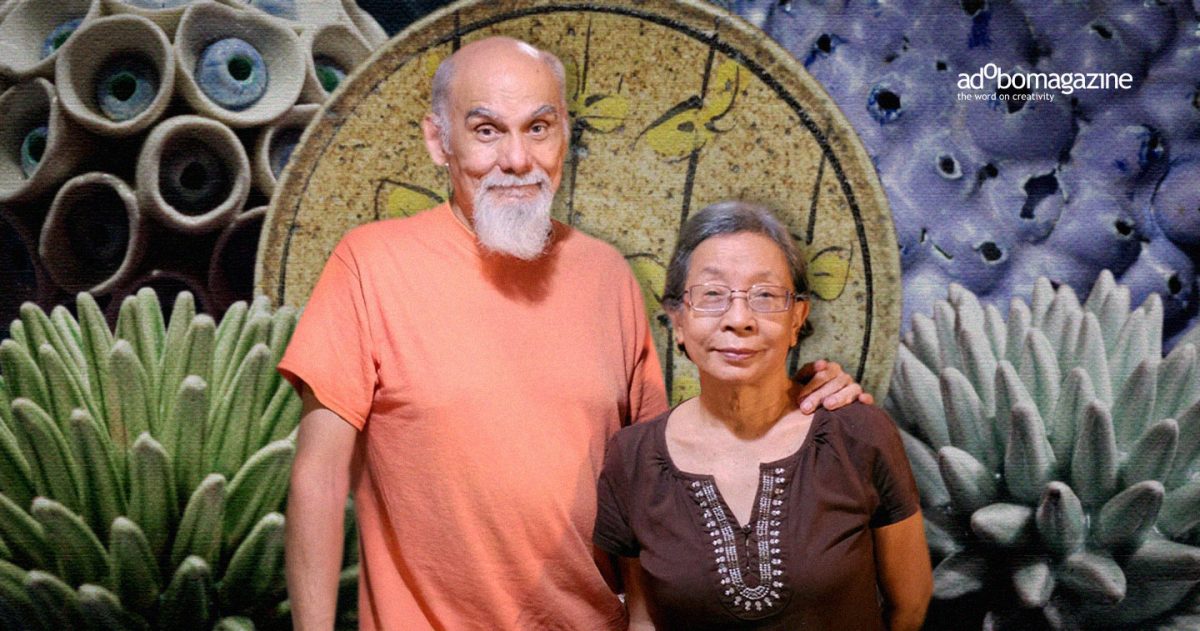
Jon and Tessy Pettyjohn have built a quiet but steady reputation in contemporary Philippine ceramics.
To many, they are pioneers who helped shape the field when resources were scarce and recognition was rare. To generations of students, they are mentors who taught not just technique, but devotion to craft. But to each other, they are lifelong partners bound by marriage, collaboration, and a shared practice shaped, quite literally, by clay.
The couple’s love, work, and legacy are tied to making ceramics. Their story is not about grand gestures, but about choosing the same material, values, and partner every day for almost fifty years.
Beginnings in clay and in love
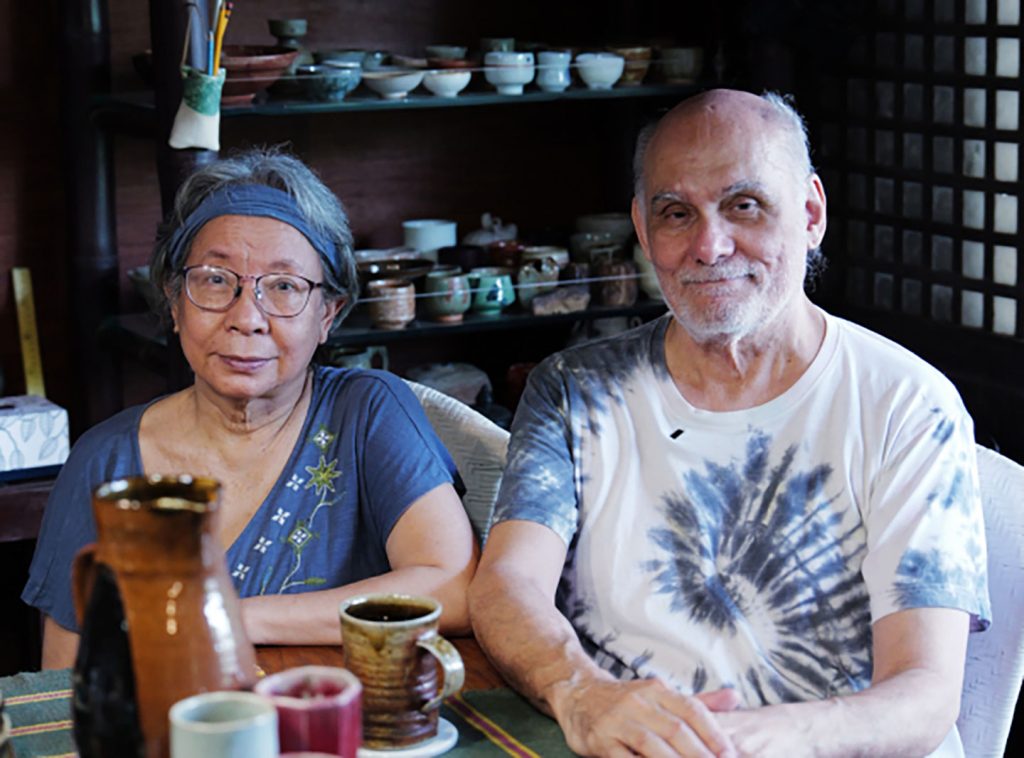
Tessy had already established herself as a potter when she first encountered Jon at his debut exhibition in Manila. At the time, she and a friend were running a furniture shop. A mutual acquaintance suggested she visit the show, thinking Jon’s pottery might be a good fit for their showroom. She went there, and that was where they met.
Jon remembered it simply as his first exhibition in Manila, but for Tessy, it was the beginning of everything else. They married in 1978, the same year Tessy became a full-time potter. From then on, they worked side by side every day.
“We’ve been working together ever since,” Jon says in an interview with adobo Magazine.
“He does his work. I do my work,” Tessy explains. “But we share so many things.”
Their partnership was never about becoming the same person. It was about letting their differences exist within a shared life.
Ceramics as a way of living, not just a practice
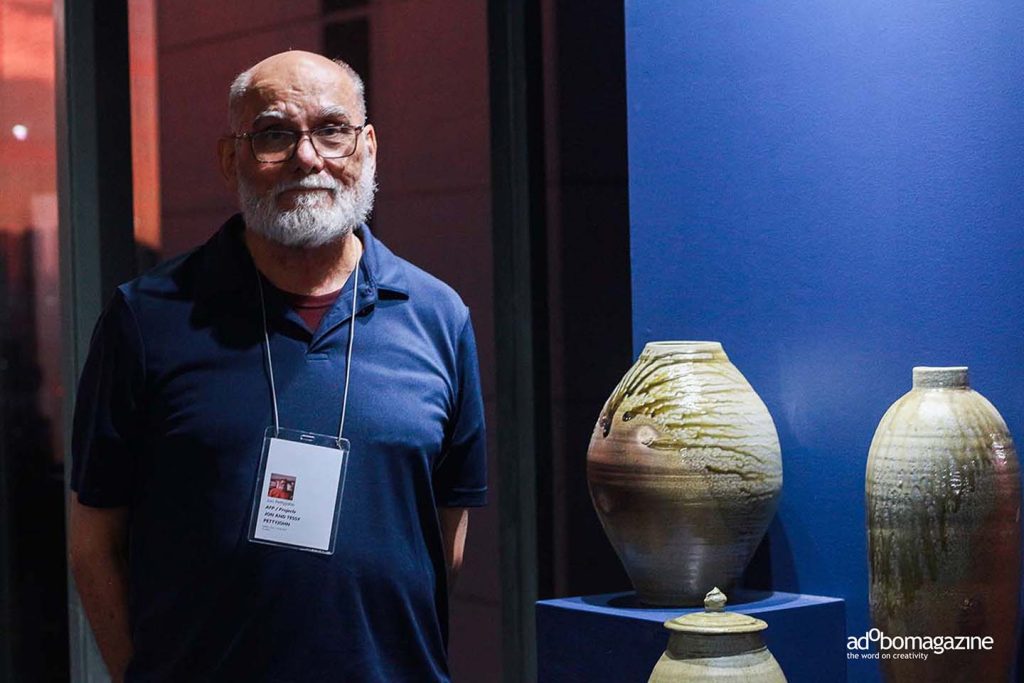
For almost forty years, Jon has focused on high-fire ceramics inspired by Asian traditions. His work is mostly functional, but he also creates sculptures and values both equally. He often uses local materials like clay, stones, and ash. In 2000, he began exploring wood-firing with anagama kilns, which create unique, natural glaze effects.
Tessy is also a leader in Philippine pottery, ceramic art, and sculpture. She started her career in the late 1970s and has held many exhibitions both in the Philippines and abroad. Now retired from teaching, she works in her Laguna studio, where she experiments with clay, pigments, and minerals to make high-fire ceramics and glazes.
Together, Jon and Tessy stand at the forefront of ceramic art in the Philippines, having developed a body of work over many years that is deeply grounded in Filipino materials and sensibilities.
Through these experiences, the couple has found reason to believe that art and life are closely linked. Their work is not limited to the studio but is part of a daily routine shaped by time, patience, and shared commitment.
“It’s a special partnership, a husband-and-wife team who are artists, and more specifically, potters. What makes it work is that their practice is part of their life. It’s not just about making things; it’s a way of living. Like farming, pottery shapes the rhythm of daily life. When shared, like husband-and-wife farmers, it creates a natural teamwork based on trust, hard work, and shared goals,” Jon said.
He adds, “In our waking hours, we’re almost always together. Most couples don’t spend that much time together, but we do.”
This closeness is not framed as compromise or confinement. It is a conscious structure in which one allows marriage and practice to strengthen each other. Being artist-partners is not an extension of their relationship; it is the foundation.
“I do my own work, and we don’t impose on each other. There are moments when I feel the urge to critique her work, but I hold back. We have to give each other space. I have to respect her process, especially because her work is very different from what I would do,” Jon explains, highlighting their artistic differences.
The two don’t often work together, and they don’t feel they have to. Their work has always been different, shaped by their own instincts, materials, and ideas. But for Art Fair Philippines 2026, they decided to highlight their differences instead of their similarities.
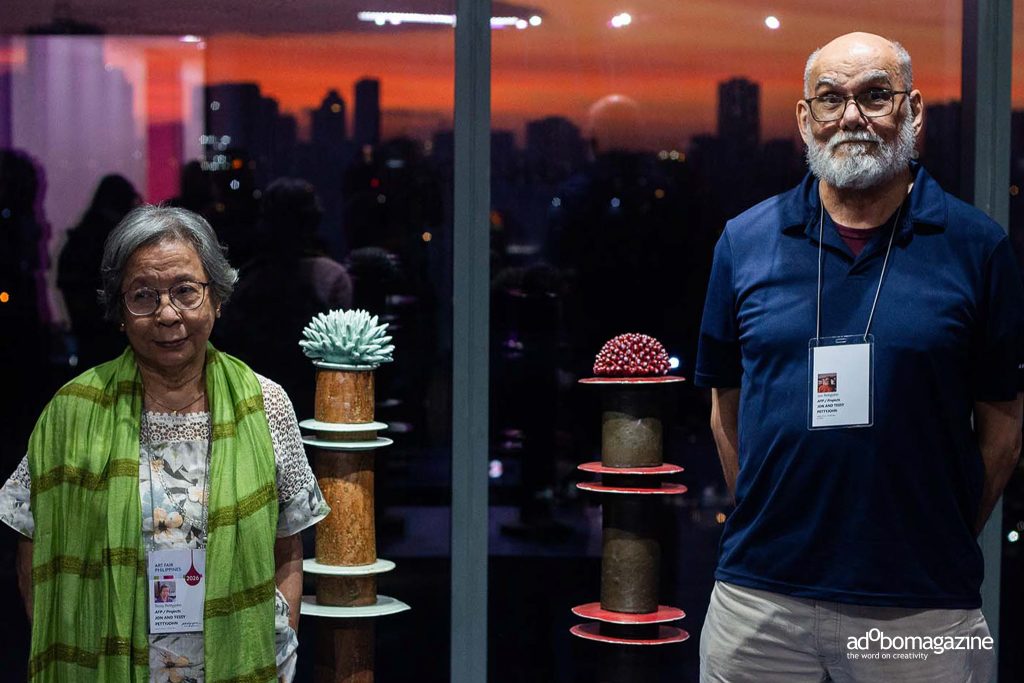
At this year’s fair, through their exhibit called “Intersect,” they show how two artists can share a life, a studio, and a history, even while working with very different approaches to clay, glaze, and form.
Jon’s work is mostly functional and focuses on basic forms. He uses rougher materials and prefers wood firing, working with long anagama kilns where fire and ash create rough, natural glazes. Volcanic ash, stone, and wood all leave their mark. For him, fire is not just a process, but a partner.
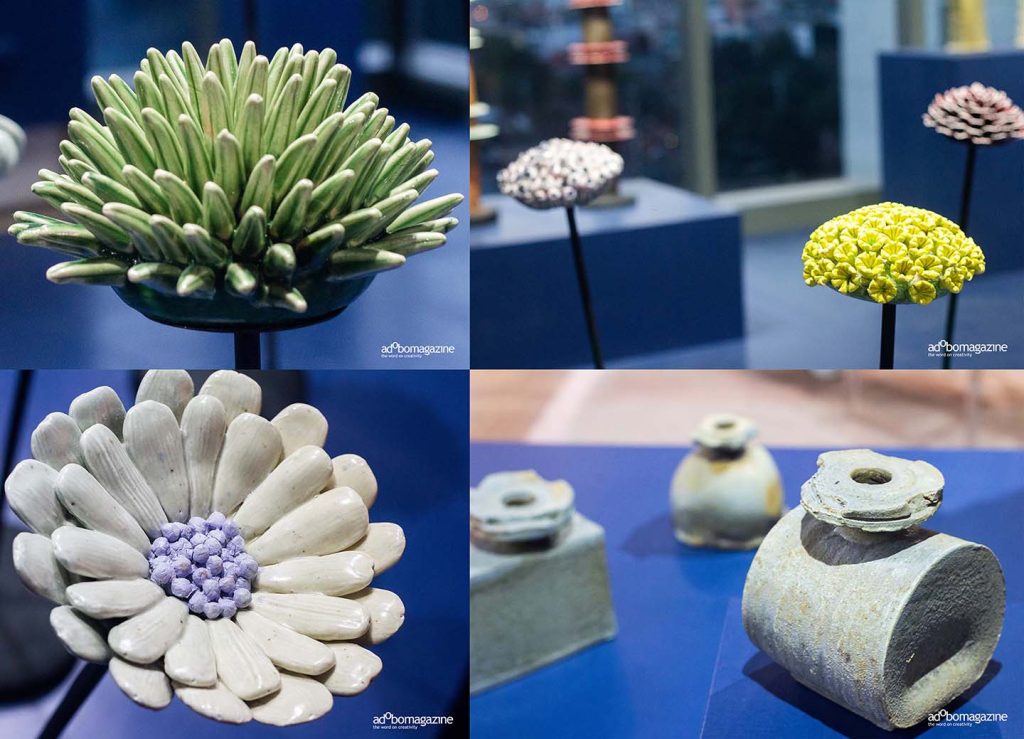
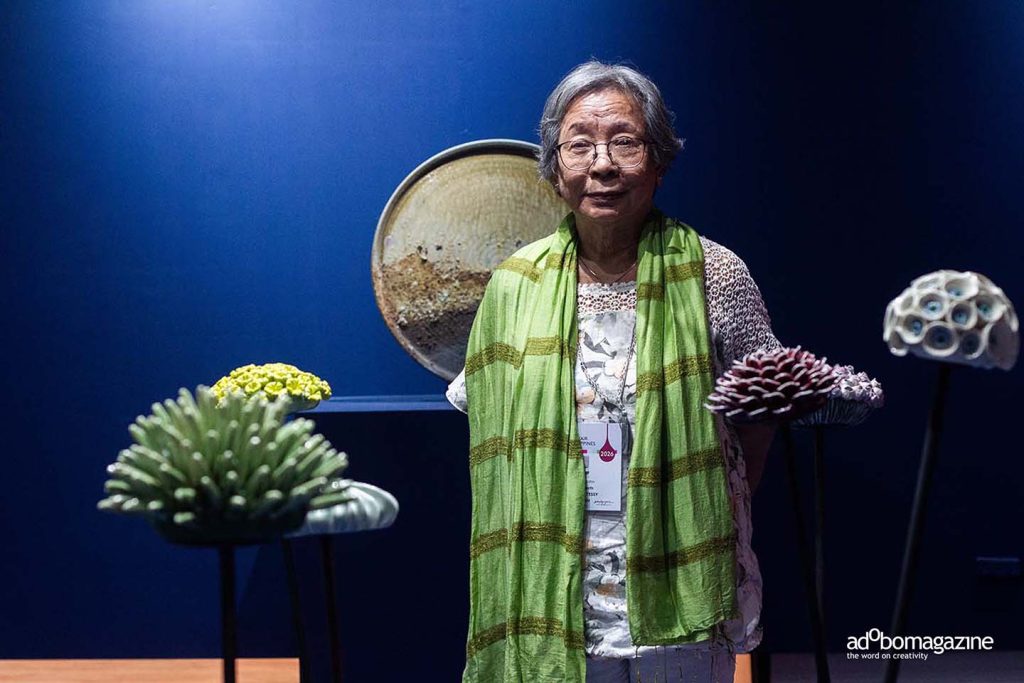
Tessy’s work, on the other hand, often starts with porcelain. She is drawn to color, detail, and sculptural shapes. Her current series of ceramic flowers came not from a technical challenge, but from a quiet moment.
“In one of my meditations,” she recalls, “I had this vision of flowers — vibrant, glowing, beautiful colors.”
At the time, she was making functional pottery. But since Jon was already focused on that area, Tessy felt free to try something new. She followed her vision, moved into sculpture, and eventually created the floral forms that now define her work.
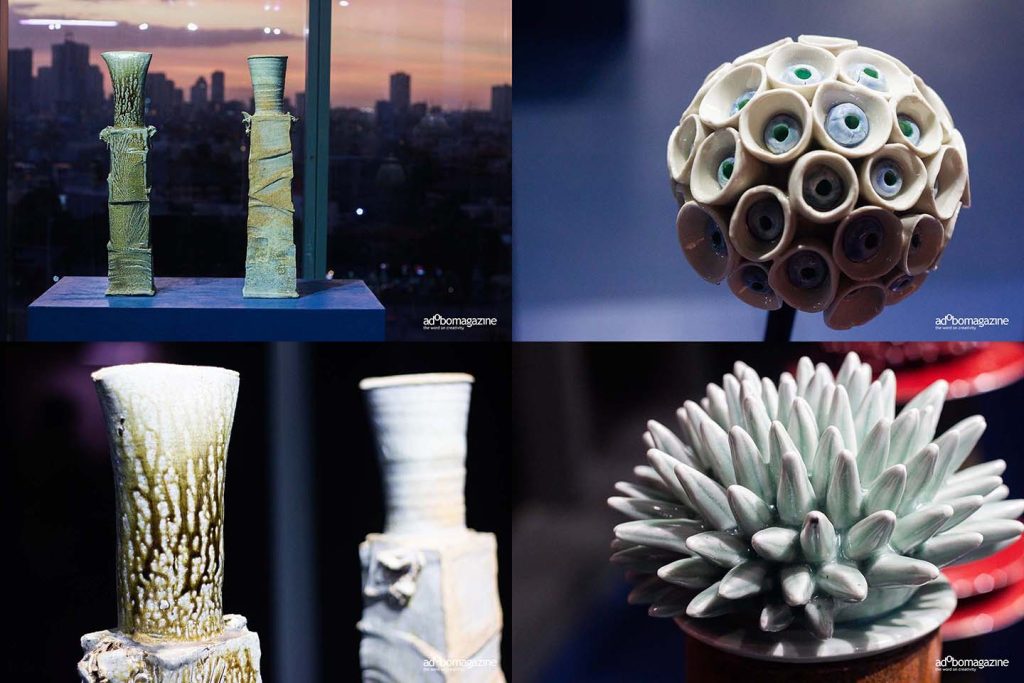
For this exhibition, they also tried something new by working together on tower pieces. Jon made some parts, and Tessy put them together into a single vertical work where their differences are clear and intentional.
“You can see the difference right there in one piece,” says Jon. “We each have our own ideas. We’re pretty different. Sometimes we don’t agree. And yet, the work holds.”
Teaching, influence, and building a creative legacy
Before ceramics were easy to access and studios had plenty of supplies, Jon and Tessy were already working, improvising, and learning out of necessity. Their practice was shaped by persistence, not convenience.
When it was almost impossible to find ceramic materials locally, they traveled around the Philippines looking for clay. They worked with government groups, tested clay deposits, and mixed their own clay from scratch. What started as survival slowly became deep, hands-on knowledge. Yet, they never kept that knowledge to themselves.
For Tessy, sharing knowledge is part of a long tradition. He sees their work as part of a wider Asian ceramic heritage, focused on passing skills from teacher to student, generation to generation. The studio becomes a place where technique and care are handed down.
“We’ve taught a lot of people to do ceramics,” Tessy reveals. “And now, the younger generation can start on a better level.”
Today, their influence stretches far beyond their own practice. Former students now run their own studios, teaching others in turn.
Meanwhile, neither Jon nor Tessy romanticizes the economics of ceramic art. They speak plainly about its realities.
“It’s not necessarily a good way to get rich,” John admits. “But it’s a rich life.”
Tessy agrees. “We’re not rich. But our life is peaceful. We raised our children. Everything.”
Their work supported their family, built a home, and gave them a sense of purpose that lasted through many changes. The rewards are real, they say, but come slowly through discipline and sacrifice.
“There’s a lot of sacrifice,” John acknowledges. “But there are also rewards.”
When asked if their work is a love story, a partnership, or a shared creation, Jon and Tessy don’t separate these ideas. For them, their life is all three. In their hands, ceramics become more than objects; they are a record of love, a practice of partnership, and a living legacy that continues to shape Philippine ceramic art.
“Our whole life is in it. We started together as potters and grew as potters while raising our children. It’s all connected,” Tessy says in conclusion.
adobo Magazine is an official media partner of Art Fair Philippines 2026.
Read more:
This New York-based Filipino artist weaves diasporic experiences into his ‘kulambo’ art installations
Art as devotion: Imelda Cajipe Endaya’s creative practice as lifelong advocacy
Math as a universal language: Isaiah Cacnio bridges Math and Art with his digital masterpieces