
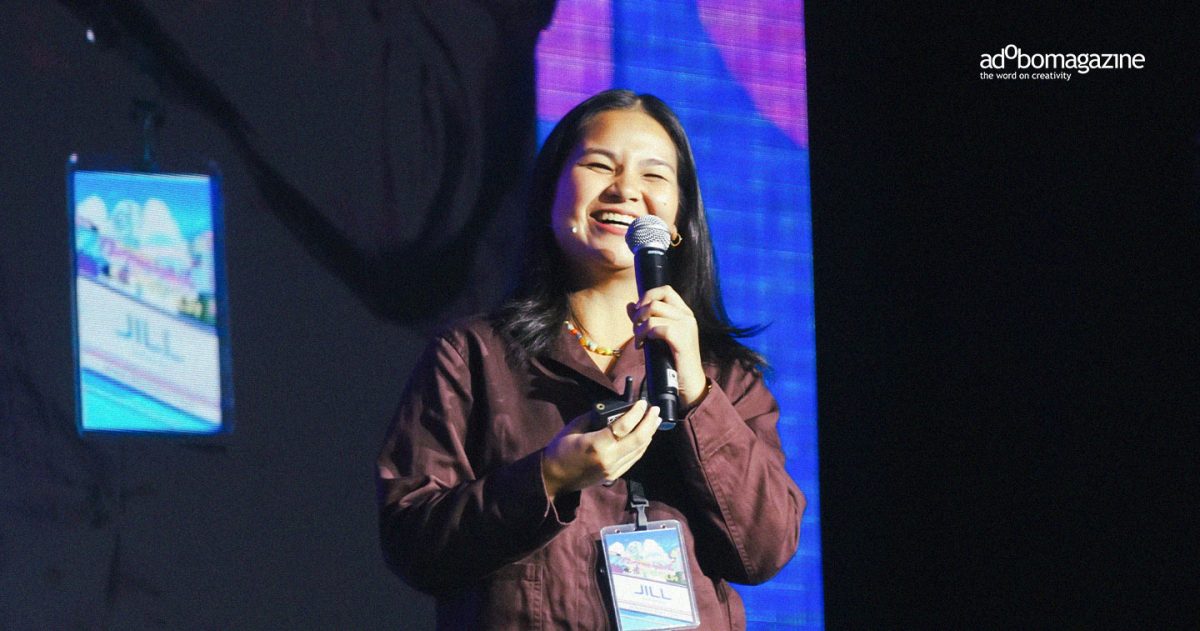
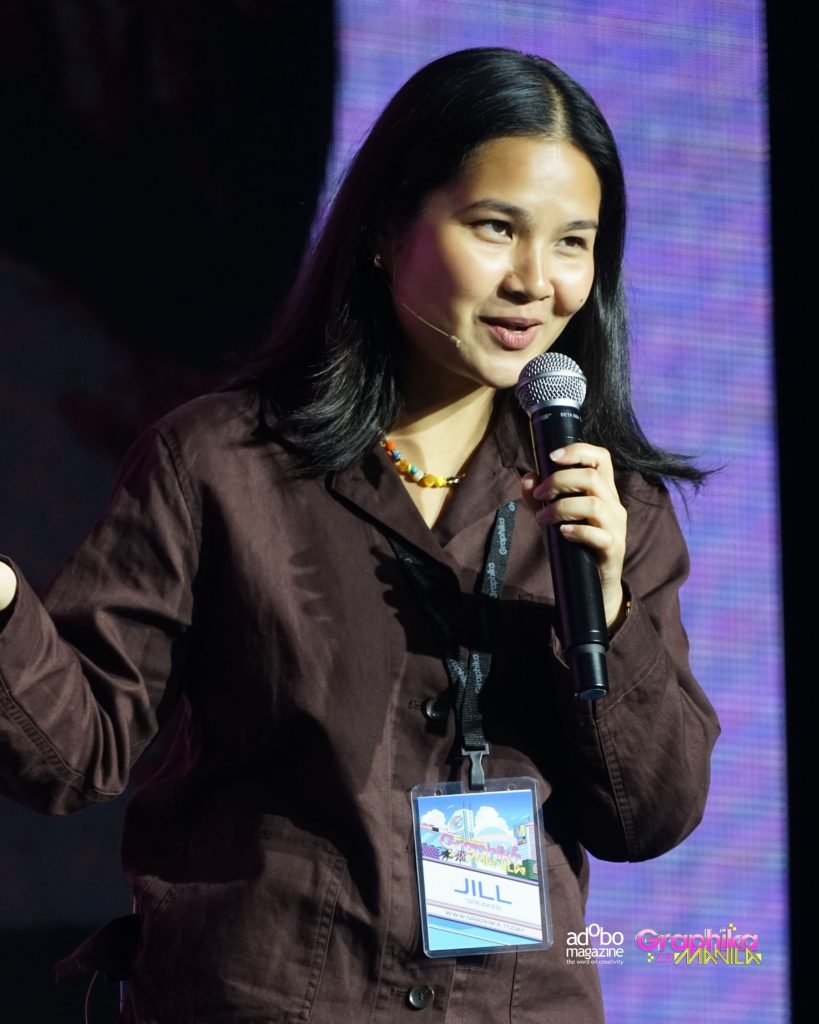
When full-time visual artist and illustrator Jill Arteche talks about art, she doesn’t begin with technique or theory. Instead, she points to something simpler: observation — and a little bit of humor.
During her talk on the second day of Graphika Manila 2026 held at SMX Convention in Pasay City, Jill, known for drawing “funny-looking people in everyday scenes,” traces the roots of her distinctive style. She shared that as a child, she enjoyed watching TV with her younger brother. If it wasn’t WWE, it was cartoons, including Powerpuff Girls, Dexter’s Laboratory, Courage the Cowardly Dog, The Fairly OddParents, and one show that stood out above the rest — the physical comedy of Mr. Bean.
For Jill, Mr. Bean represented something deeper than slapstick humor. Beneath the strange proportions, exaggerated expressions, and absurd situations was a character who was oddly relatable.
“If you’ve ever watched the show, you notice that Mr. Bean is just like us,” she said. “One, he has goals. Second, just like us, he has feelings. Third, he has limitations.”
Yet Mr. Bean is also unmistakably strange. His proportions are off, his eyebrows “proudly shaped like beans,” and his shoes appear to float awkwardly away from his pants. His solutions to everyday problems are often bizarre, roundabout, and hilariously inefficient — but somehow they work.
That relationship between the ordinary and the absurd, first seen in Mr. Bean, would later become the foundation of Jill’s work.
“Mr. Bean showed me that it was okay to see the world differently,” she said. “To do things in my own way, and to find humor in imperfection.”
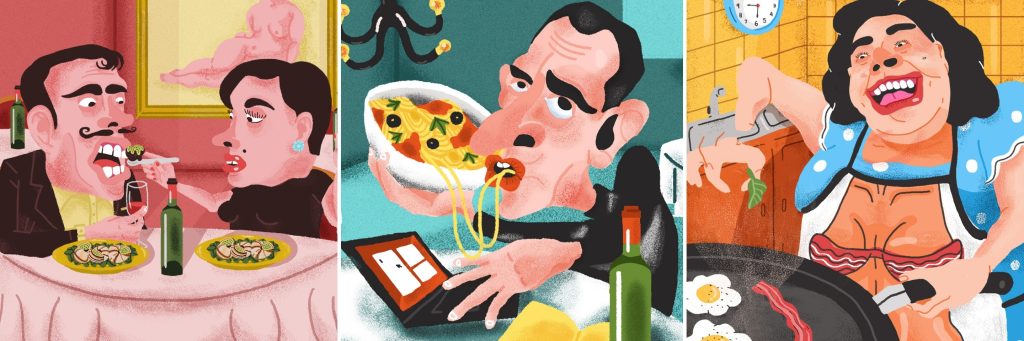
Currently, Arteche is widely recognized for illustrations that depict odd-looking personas in everyday life. Her characters often feature exaggerated noses, awkward expressions, and moments of quiet absurdity — a visual language that turns small human quirks into something both humorous and deeply relatable.
Just as she draws inspiration from Mr. Bean, Arteche also recognizes herself in similar contradictions.
“Like Mr. Bean, I have my goals, my feelings, and my limitations,” she said. “And I like to see the world in my own way and express it in this really weird and funny and sometimes ugly art style that makes people smile.”
The “funny” side of her art
Jill’s path toward her now-distinctive visual style didn’t happen overnight, and like many artists, it began with the disciplined foundations of traditional art training. While studying fine arts in college, she immersed herself in the fundamentals, including human anatomy, color theory, proportion, and technique, which sharpened her technical skills even as she quietly felt that something in her artistic voice was still waiting to emerge.
“Don’t get me wrong. Foundations are very important,” she said, acknowledging the value of formal training, “but I had this itch that I wanted to express myself further.”
That turning point came with a deceptively simple requirement from one of her professors: always carry a sketchbook and draw every single day. The rule sounded straightforward, but the practice quickly became transformative, forcing her to observe the world more closely and capture moments even when they seemed ordinary.
In the beginning, her sketches were largely observational exercises, and she drew whatever happened to be within reach, such as landscapes outside the classroom window, everyday objects on a desk, or tools scattered around the house. Scissors, pliers, and car wheels became subjects simply because they were there, and each drawing became another small exercise in seeing.
But as the habit of daily sketching continued, something interesting began to surface. The repetition sharpened her awareness, and over time, she noticed that her attention kept returning to the same subject.
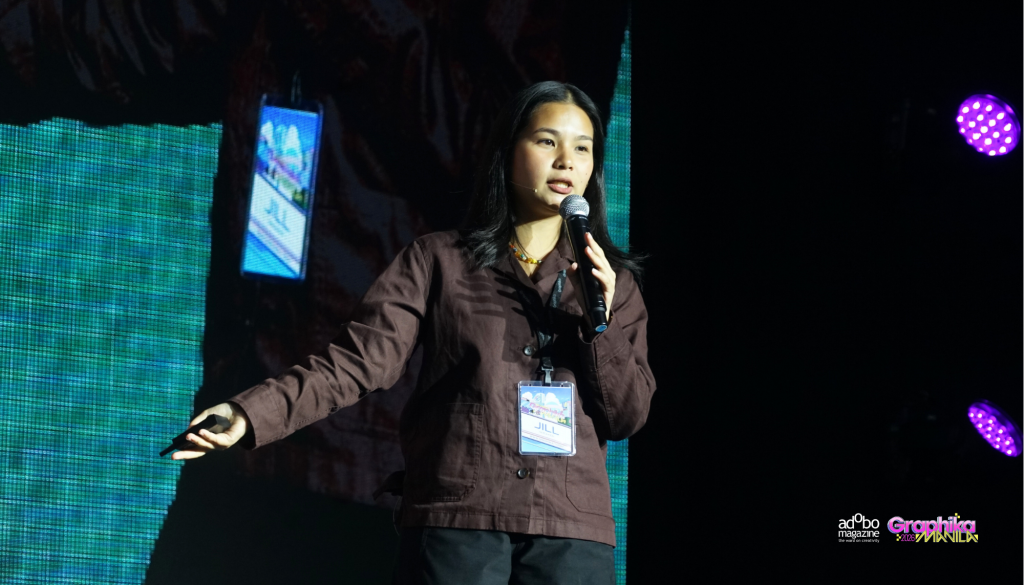
“When you draw every day, you start to notice patterns,” Jill explained, reflecting on the quiet discoveries that come with routine practice. For her, that pattern quickly became clear.
“The pattern was people,” she said with a laugh. “That’s when I realized that I really love to draw people.”
Yet it wasn’t the pursuit of perfect anatomy that captured her interest. What fascinated her more were the quirks, gestures, and fleeting expressions that revealed something deeply human. Instead of idealized figures, she found inspiration in the small, sometimes awkward moments unfolding around her in everyday life.
She began sketching scenes that many people would normally overlook: a man casually picking his nose during a jeepney ride, a furious woman clutching a cigarette while mascara streaked down her face, or two friends animatedly discussing clam chowder while commuting through the city. These moments, both humorous and oddly intimate, became the raw material for her drawings.
“Observation helped me realize that I didn’t just like drawing anatomy,” she said. “I really like to draw personalities.”
For Jill, personality is the point where a drawing “moves beyond technical accuracy” and begins to reveal something about the person inside the frame: their mood, their story, or the emotion they carry in that brief slice of time.
“When you see an artwork, and you already get a glimpse of who the person is, what they’re feeling, or who they might be,” she said. “That’s what really excited me.”
Criticism as power
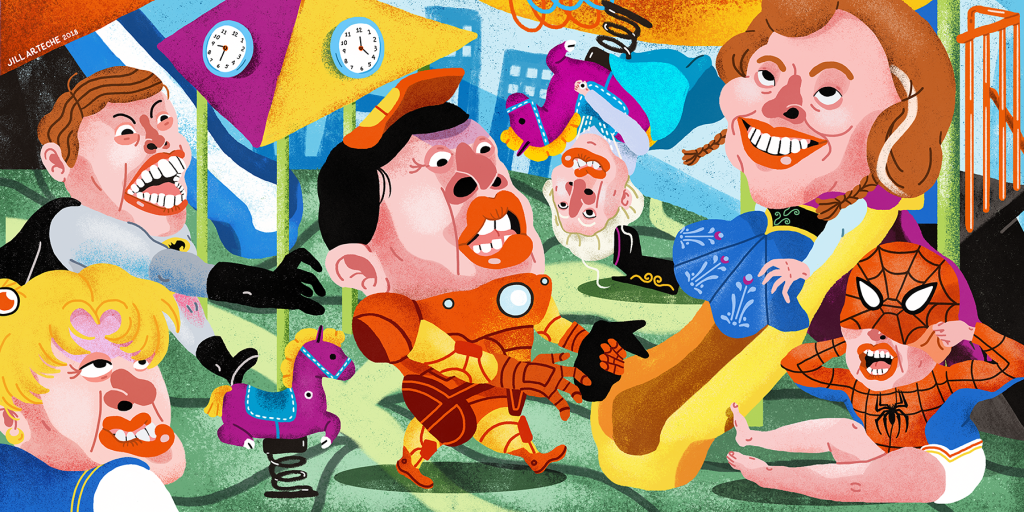
Humor can be a powerful artistic language, but it proved risky early in Jill’s career. Her exaggerated drawings of people featuring oversized noses and expressive, sometimes awkward features often drew criticism from viewers who expected something more conventional, and as a young artist, those comments stung.
“I had comments like, ‘The nose is too big,’ ‘The mouth looks weird,’ ‘They look ugly,’” she recalled. “As a young artist, it made me really sad. It hurt me.”
Over time, however, Jill began to see those reactions differently, realizing that humor is deeply subjective.
“Humor is shaped by our culture, our lived experiences, and our perspective,” she explained. “What’s funny to you may not be funny to other people.”
These criticisms prompted a shift in her mindset. The same principle applies to art more broadly, and Jill eventually embraced a truth that many creatives struggle to accept early in their careers.
“As artists, we have to embrace that our work reflects our perspective and isn’t for everyone — and that’s not only acceptable, but essential to creating authentic art.”
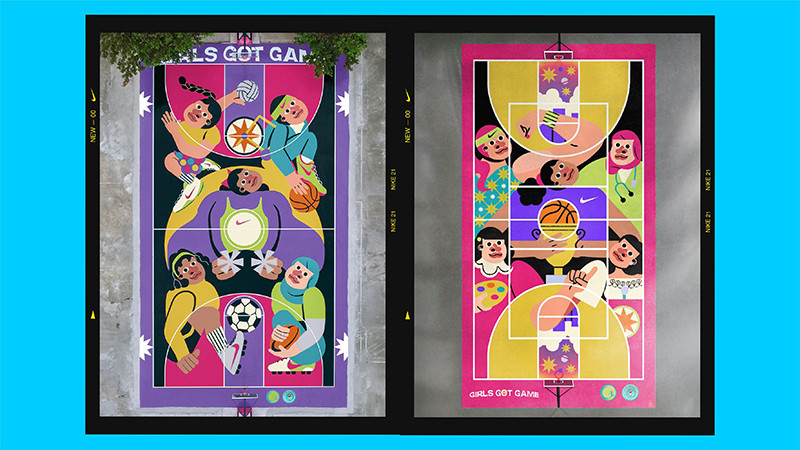
Ironically, her breakthrough moment arrived when one of the world’s biggest brands chose to embrace her work exactly as it was. Her first collaboration with Nike Philippines became a defining experience not only because of the brand’s global reach, but because the company encouraged her to stay true to the voice she had spent years developing.
For the project, Jill designed indoor and outdoor basketball courts inspired by the girls of Girls Got Game Philippines. Her signature exaggerated features remained, and she leaned into the quirks that defined her drawings, refining them for greater cohesion within the project.
(Photo: Nike Philippines)
“I just made them more intentional,” she explained. “More client-friendly, but without losing what makes my work mine.”
The experience reshaped how she thinks about collaboration, proving that working with large brands does not always require sacrificing one’s artistic identity.
“I didn’t have to change my art style,” she said. “I just had to learn how to operate in different rooms.”
Those “rooms,” as she describes them, represent the different audiences, industries, and contexts that artists encounter as their careers grow, and understanding how to move between them can be just as important as technical skill. Adapting to new spaces does not mean abandoning a personal voice; instead, it often means learning how to translate that voice so it resonates in different environments.
“Adapting doesn’t mean abandoning who you are.”
Jill’s illustrations have also appeared on Philippine Airlines boarding passes, Canon packaging, furniture textiles, music vinyl covers, notebooks, and gallery exhibitions. Past collaborations include illustrating personalized stationery for gift brand Ana Tomy to creating artwork for a children’s book published by Adarna House.
Despite her strong emphasis on personal voice and individual craft, Jill is quick to point out that creativity rarely thrives in isolation. Her evolving career taught her that while artists may develop their own style and perspective, sustaining that path often requires the encouragement, feedback, and the presence of people who help carry the weight of the journey.
“You can put all your eggs in one basket,” she said. “But you don’t have to carry that basket alone.”
Her support system includes family, friends, mentors, and fellow illustrators within Manila’s creative community, all of whom have played a role in helping her navigate both the highs and the uncertainties of a creative career. Even her dog, named Bean — a playful tribute that brings her story full circle back to Mr. Bean — has become part of that everyday source of comfort.
“Support systems carry you through every funny moment, every loss, every win, every challenge,” she said.
Jill continued, “Don’t be afraid to ask for help. You’d be surprised by how many people are willing to help you and are struggling the same way as you are.”
Art doesn’t need to be perfect
Throughout her discussion, Jill returned to the simple idea that had shaped her artistic journey from the beginning, linking everything she shared back to her core artistic belief.
Referencing Mr. Bean and his ever-present teddy bear companion, she reflected on how even the strangest characters are rarely alone. Behind every quirky figure or awkward moment is a quiet reminder of the people and the support systems that make creative journeys possible.
But beyond companionship, the lesson was also about commitment, staying true to one’s voice, trusting one’s process, and holding on to the things that genuinely spark joy.
“Life is serious. There will be pressure, rejection, and expectations. But life is also funny. It’s unpredictable, absurd, and crazy.”
For Jill, recognizing that humor, especially in the small, easily overlooked moments of everyday life, makes the difficult parts more bearable. It’s also what fuels her art. She believes creativity doesn’t always need to chase depth or perfection to matter.
“Art, it doesn’t need to be profound, it doesn’t need to be perfect, and it certainly does not need to be for everyone. Sometimes it can be simple, and sometimes it can just be for fun, and if it makes someone smile or laugh, then I think that should be enough.”
adobo Magazine is an official media partner of Graphika Manila 2026.
READ MORE:
Danaé Gosset on manifesting dreams into motion at Graphika Manila 2025
Design: Nike builds homecourts to invest in the next generation of Filipinas