
In a world of accelerating automation, our greatest asset isn’t speed or efficiency — it’s our capacity to feel, to imagine, to reinvent, and to be unapologetically, definitely human.
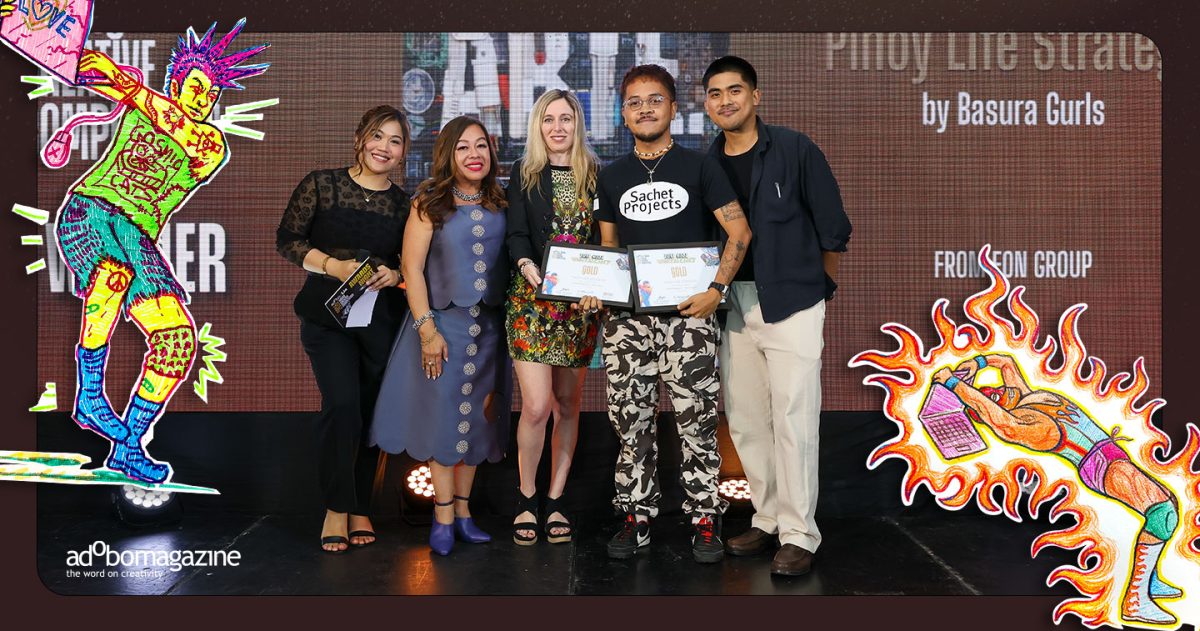
This is what Ginoe Ojoy and Arthel Tagnipez — collectively known as “Basura Gurls” of EON Group — demonstrated as this year’s adobo LIA Young Creative Competition 2026 Gold winners with their work, “Pinoy Life Strategy.” The winning entry also received the Client’s Choice Award from the Design Center of the Philippines.
“Winning this year’s competition gives me and my partner the chance to broaden our horizons and see what’s out there in the world and in turn, become more creative and more exploratory in our own work,” Ginoe told adobo Magazine in an exclusive interview.
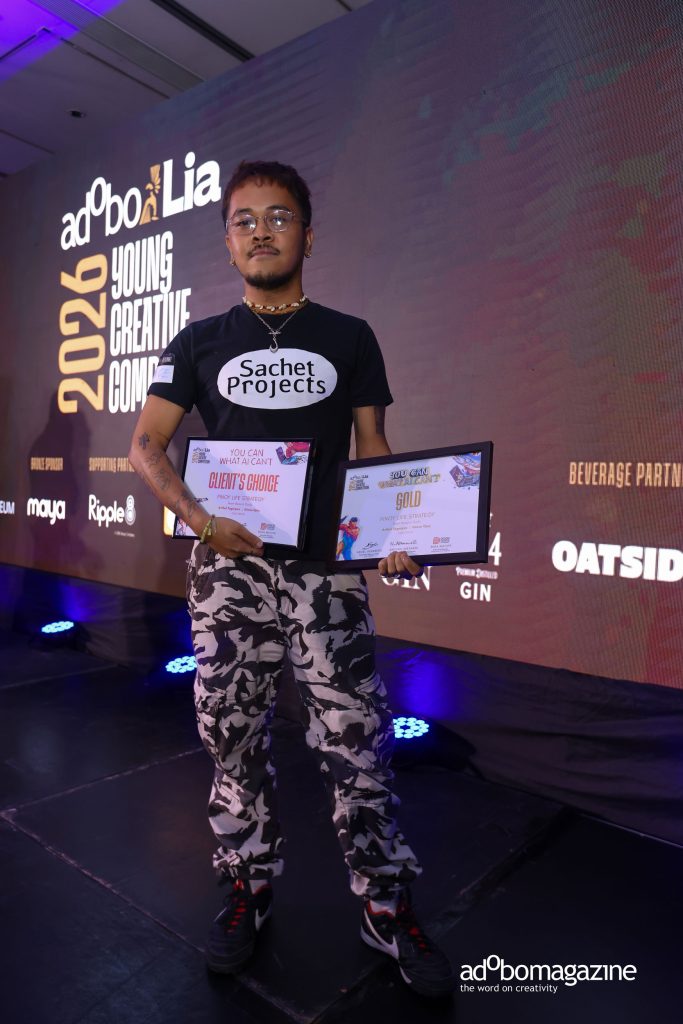
As winners, Ginoe and his partner, Arthel, have earned a slot in the Creative LIAisons Program in Las Vegas, which will take place in either September or October 2026.
They will stay at the Encore Wynn Hotel, which is considered one of the top hotels in Vegas. LIA will shoulder the flight and hotel accommodations for the two winners.
The creative process of ‘diskarte’
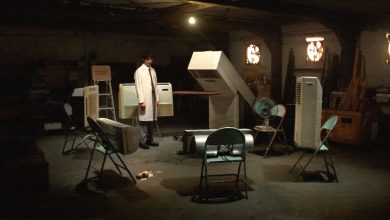
Recognized for its clarity, cultural insight, and execution, the work centers on diskarte, a uniquely Filipino mindset rooted in resourcefulness. Using discarded electronic parts, it presents a layered narrative about human ingenuity evolving beyond technology.
The idea began, as many creative breakthroughs do, with instinct. Watching the competition brief unfold, both Gino and Arthel felt what the former describes as “lukso ng dugo” which is an unexplainable pull, the sense that this was theirs to interpret. But rather than lean into the obvious, they leaned away from it.
“We were watching the live feed of Badong Abesamis discussing the brief, and my partner and I immediately started exchanging thoughts. There was a moment where we both felt that this was something we could really respond to. As artists, we’re not necessarily drawn to generative AI, so this brief felt like an exciting space for exploration — both in our work and in my own practice as a graphic designer and artist,” he said.
Ginoe added, “We felt that the brief really aligned with us, so we decided to pursue it.”
Not ones to rely heavily on generative AI, the pair saw the brief as an opportunity to assert something more tactile and more human. Their early concept revolved around “forgiveness,” a quiet reflection on outdated electronics, rendered obsolete in a world increasingly shaped by artificial intelligence. But for them, the idea felt incomplete and heavy. It framed technology as something discarded and left behind. So they shifted.
The duo then explored transformation, examining how electronic devices that no longer serve their original function can be repurposed into something new or reimagined for a purpose beyond their original use.
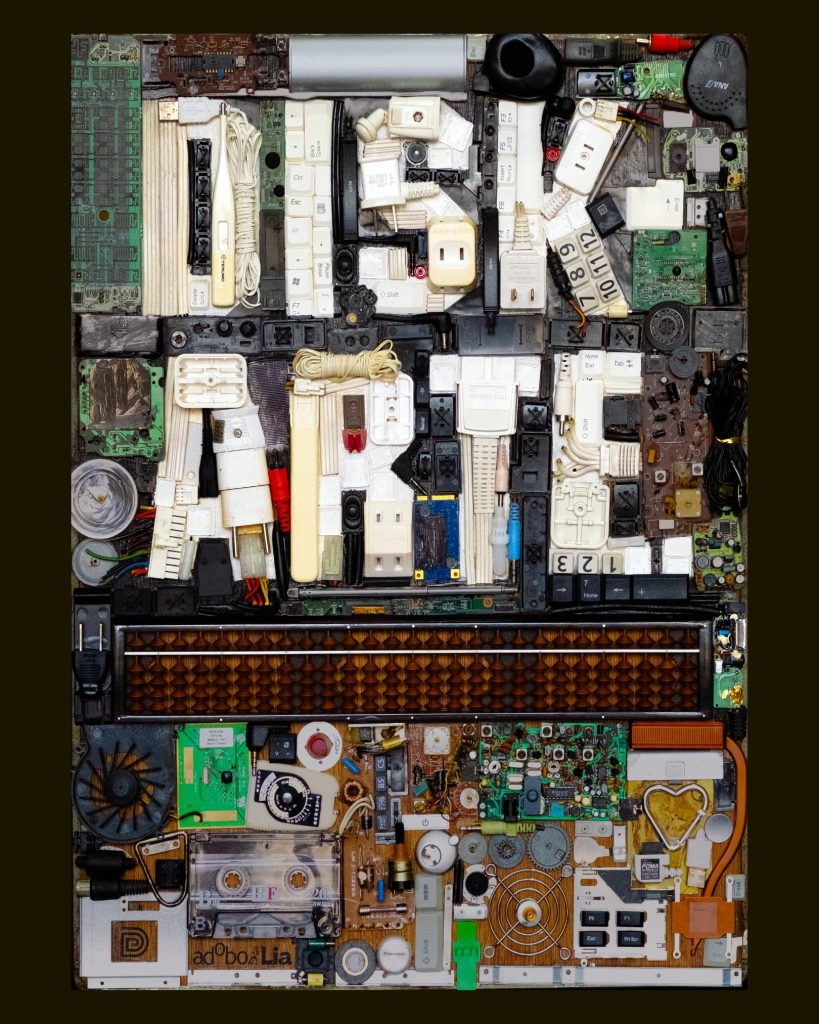
The final piece emerged as assemblage art: old electronics — including wires, fragments, and discarded devices — reconfigured into something entirely new, becoming symbols of transformation. In Ginoe and Arthel’s hands, these objects transcended their original purpose and became a statement on reinvention, authorship, and the enduring role of human creativity.
However, Ginoe admitted that building their winning artwork was not as easy as ABC. The most challenging part was working on the assemblage while juggling their day jobs.
“We had our daily tasks and responsibilities, and this kind of work really demands focus and time. There were a lot of moving parts, so budgeting our time, staying focused, and actually finishing the piece became a real challenge.”
Nonetheless, they pushed through anyway while navigating fatigue, protecting pockets of creative energy, and committing to the process.
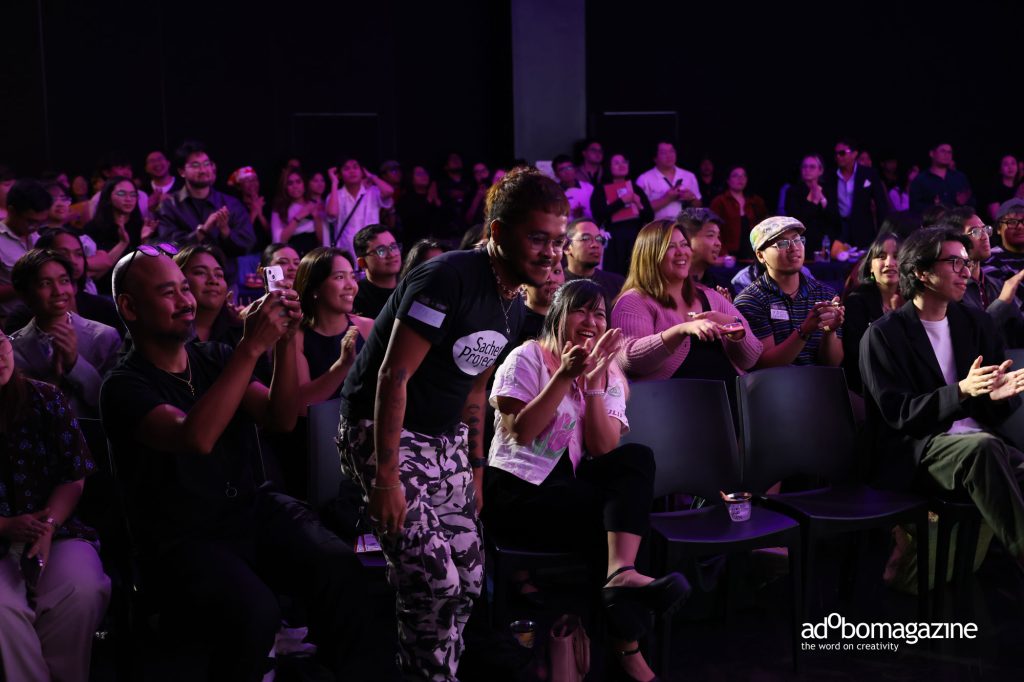
To be human is to be creative
For the duo, the adobo LIA stage is a platform that expands what feels possible. It’s a chance to take their ideas further, test them in new spaces, and continue exploring what creativity can look like in an evolving landscape.
Winning, then, feels less like a finish line and more like an opening.
“This year, my partner, Arthel, and I are already excited to join again. We really enjoy putting our ideas out there and testing them, and joining more competitions helps us grow and expand our horizons. We’re especially looking forward to what’s ahead, including Vegas, and experiencing America for the first time,” he exclaimed.
Ultimately, automation and authorship run quietly through their story. Generative AI may be reshaping industries, but for Ginoe and Arthel, it also sharpens the question of what it means to make something by hand, to think slowly, and to create with intention. As a result, their win doesn’t reject technology, but it repositions the human within it.
“Any kind of platform is really helpful for creatives in the Philippines,” Gino said, acknowledging the realities of the industry.
“It’s really hard to survive in the world right now, especially marami ang generative AI that’s trying to replace us. And this kind of award, I think, will help me and my partner be proof that to be human is to be creative.”
Their story is ultimately about transformation in all its forms: discarded electronics into art, limited time into something meaningful, and uncertainty into recognition. In a world that often prioritizes speed and output, Basura Gurls offer a different proposition — one that values process, presence, and the ability to see possibility where others see waste.
Similarly, they didn’t just win a competition at adobo LIA 2026. They reclaimed the narrative, and in doing so, they reminded us that even in an age of machines, creativity remains deeply, irreducibly human.
The adobo LIA Young Creative Competition 2026 gathered a new generation of Filipino creatives following the brief “You Can What A.I. Can’t,” highlighting the irreplaceable power of human thinking — rooted in intuition, emotion, originality, and lived experience.
Organized by adobo magazine in partnership with the London International Awards and the Design Center of the Philippines, this year’s competition expanded its reach to include participants from design studios, marketing agencies, and production houses, aged 21 to 34.
Leading the jury was Badong Abesamis, Founding Partner at GIGIL, joined by other distinguished industry leaders: Angie Tijam-Tohid, Executive Creative Director at Havas Ortega Group; Chino Jayme, Executive Creative Director at Ogilvy Philippines; Dante Abelarde, Executive Creative Director at McCann Worldgroup Philippines; David Guerrero, Creative Chairman at BBDO Guerrero; Greg Martin III, Executive Creative Director at Ace Saatchi & Saatchi; Jerry Hizon, Chief Creative Officer at Dentsu Creative Philippines; Joe Dy, Chief Creative Officer at VML Manila; Executive Director at the Design Center of the Philippines; Paul Vincent Mercado, Senior Director of Marketing & External Relations at Ayala Foundation; Pepe Torres, Group Chief Marketing Officer at MAYA; Raoul Panes, Chief Creative Officer at Publicis Groupe Philippines; and internationally recognized Illustrator and Graphic Designer Raxenne Maniquiz.
Other winners include Girlies Against The Machine of NuWorks Interactive Labs for “The Malasakit Receipt” (Bronze) and Team LUH Peace of JSR Group for “Generated Ideas Never Got Chewed Over”(Silver).
Due to the outstanding display of creativity and talent, the London International Awards decided to send both the Silver and Bronze awardees to join the LIAisons Virtual Program, a global one-to-one virtual coaching and networking program that gives emerging talent access to industry leaders and global mentorship.
READ MORE:
Inside Tony Harris’ leadership playbook: Discipline, curiosity, and hard truths