


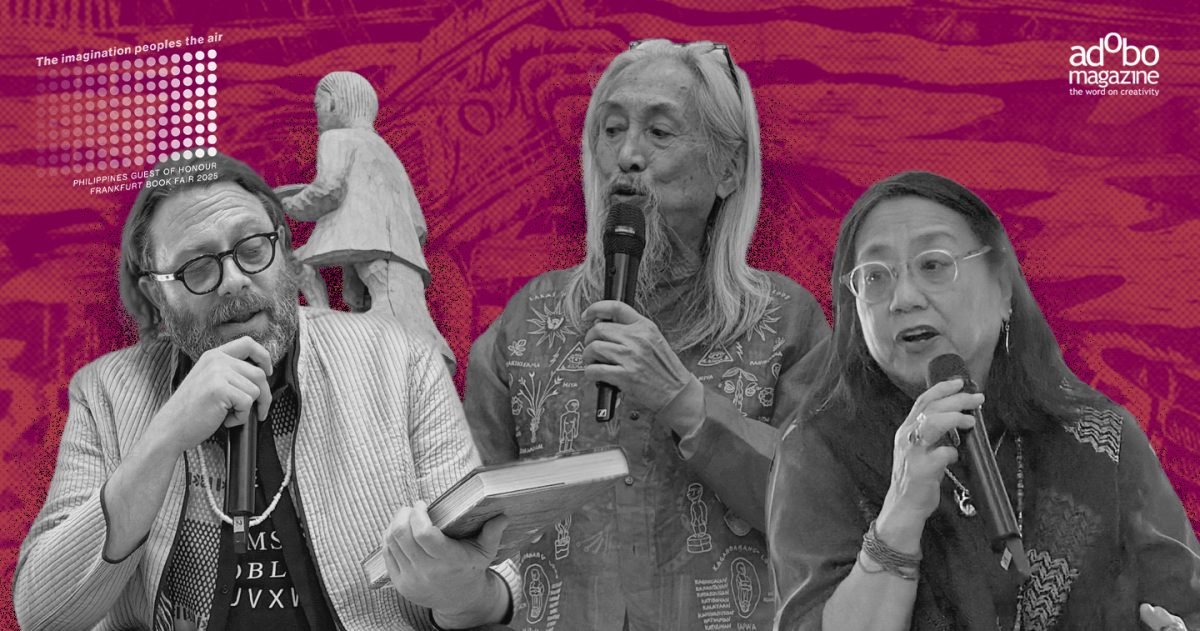
FRANKFURT, GERMANY – At the Philippine Stage of the Frankfurt Book Fair 2025, filmmaker, educator, and cultural worker Angel Velasco Shaw presented Markets of Resistance — an anthology of essays, poetry, and visual works by 44 contributors, mostly from the Philippines, with a few from Australia and Singapore.
Rooted in Angel’s family history and inspired by mentors like Benedict Anderson and National Artist Kidlat Tahimik, the book explores how markets, creativity, and kapwa — the Filipino philosophy of shared identity — shapes cultural survival in an increasingly globalized world.
From Family Markets to Cultural Movements
“For me, markets are where culture thrives. Where you get a sense of people, of community, of how they buy and sell,” Angel shared, recalling the influence of her great-grandmother and grandmother who sold and bartered in local markets. “That was the inspiration for ‘Markets of Resistance.’”


She traced how her early collaborations with the Baguio Arts Guild and artists such as Kidlat Tahimik shaped her understanding of creativity as community work. “How can I, as an outsider, an American-born artist and educator create convergences between cultures? It was Kidlat who inspired me to stop being a wall-bound artist,” she said.
Through Markets of Resistance, Angel revisited how art, exchange, and local traditions can resist commodification and reconnect people to shared histories.
The Art of Barter and Belonging
Angel’s reflections stem from her long relationship with Baguio, a city she described as “multicultural, layered, and full of movement.” It is there that she reimagined markets as spaces of dialogue rather than mere commerce.
Her six-month experimental course at the Philippine Women’s University, created with students and the Axis Art Project collective, turned these ideas into practice. Together, they transformed market stalls into pop-up galleries, bartered art for everyday goods, and celebrated Cordilleran histories through performances and installations.
“Bartering became not just an exchange of things,” Angel explained. “It became a restoration of trust, a rediscovery of kapwa.”
In Conversation: Angel Velasco Shaw, Kidlat Tahimik, and Kawayan De Guia
At Frankfurt, Angel shared the stage with National Artist Kidlat Tahimik and visual artist Kawayan De Guia for a conversation on kapwa, creativity, and cultural survival — themes central to both the book and their respective artistic journeys.
“Kapwa is an unconscious orientation to include the other,” Kidlat said. “In an industrial society where everyone competes, we must remember compassion, the kapwa spirit as cultural survival.”


Kawayan De Guia added, “There’s always that tension. That are we being represented or exoticized? Culture isn’t a spectacle, it’s survival.”
Their dialogue echoed the ideas explored by the late Katrin De Guia, Kidlat Tahimik’s German wife and mother of Kawayan de Guia, in her landmark book Kapwa: The Self in the Other — Worldviews and Lifestyles of Filipino Culture-bearers, which articulates kapwa as the core of Filipino identity: a worldview rooted in empathy, inclusion, and shared humanity.
Kidlat Tahimik on Rizal: Wearing the Barong Beneath the Suit
At the Philippine Stage, Kidlat Tahimik offered a stirring reflection on Jose Rizal, the country’s national hero, while holding a small sculpture of him.
He spoke about Rizal as a figure who mastered Western knowledge, “writing novels in Spanish, studying ophthalmology in Madrid, even building irrigation systems while in exile” yet stayed grounded in his Filipino soul.
As Kidlat put it, Rizal “wore his barong beneath his Western suit”, a poetic image of staying true to one’s culture, no matter how far one travels.
Kidlat also lightheartedly referenced Rizal’s reputation for having “a girlfriend in every port.” “He wasn’t a playboy,” Kidlat said with a smile. “He just made people feel at home because of his compassion and warmth.”
His reflection underscored a timeless truth: what makes Filipinos distinct is not just skill or intellect, but a deep sense of kapwa — that shared humanity Rizal embodied.
Kapwa as Creative Intelligence
For Angel, kapwa, “the self in the other” anchors not only Markets of Resistance but also her decades-long practice as an artist and educator. It is a call for inclusivity, empathy, and connection in every act of creation.
“Kapwa reminds us that art is not just about aesthetics,” she said. “It’s about connection, about seeing ourselves in each other.”
From the barter markets of Baguio to the global stage of Frankfurt, Markets of Resistance stands as both a testament to creative resilience and a call to reimagine culture as a collective act of survival.
As the panel closed, the conversation evolved into a shared reflection — a collective call to reawaken empathy, collaboration, and cultural continuity, reminding everyone that creativity, at its core, is an expression of kapwa.