


MANILA, PHILIPPINES – If you could gain 41% more time in your life, what would you do differently?
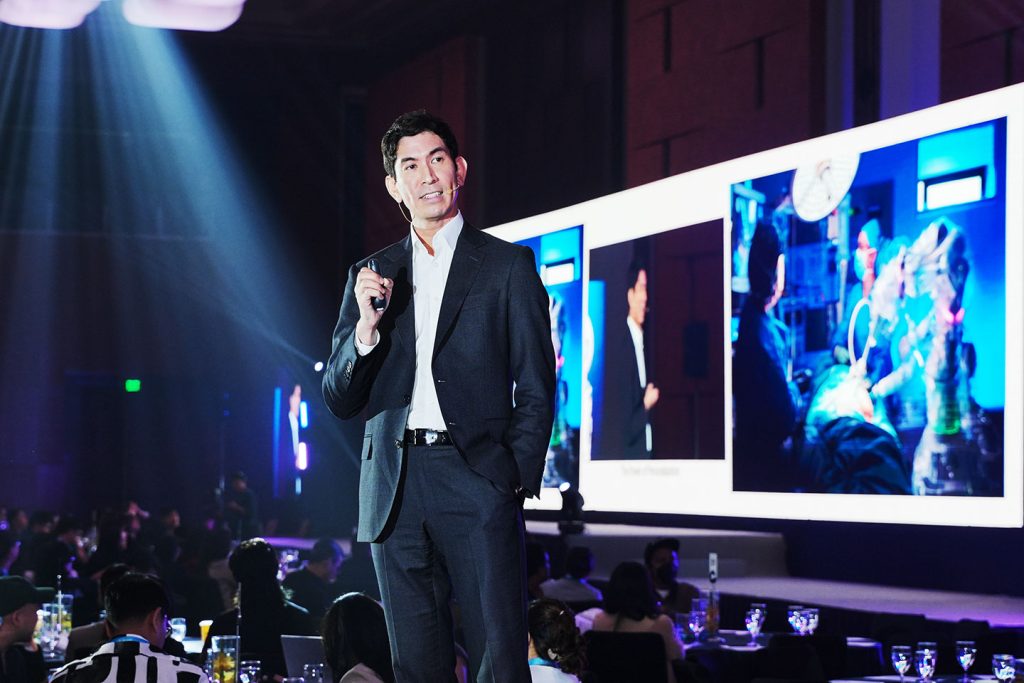
This thought-provoking question, posed by SpaceX and Facebook Emerging Technologies Expert and former Communications Executive Dex Hunter-Torricke at DigiCon 2025 on Thursday, October 16 at Marriott Hotel in Pasay City, set the stage for a powerful discussion on the monumental impact technology is having on the human experience.
As Dex noted, average human life expectancy has already jumped by 41% in one century. Yet, the real transformation isn’t just about living longer — it’s about how AI and emerging technologies are forcing us to live smarter, work differently, and lead with a clear vision of the future.
“We might not end up with anywhere that dramatic, but certainly there’s a future coming where even very near-term interventions might allow us to lead much healthier lives,” he said.
During his talk, Dex underscored how robotics and artificial intelligence are no longer theoretical but also driving tangible and life-saving changes.
For example, the Da Vinci surgical robot has performed millions of operations, with the UK government projecting that 90% of keyhole surgeries will soon use such robots, improving patient outcomes and recovery through greater precision.
“It’s much more precise than the human hand, which means that people tend to recover much faster,” Dex implied.


Furthermore, AI is unlocking biological mysteries at an unprecedented rate. He cited the Nobel Prize-winning work of his former colleague at Google DeepMind, who created Alphafold. This system “cracked a problem that had existed for more than 50 years in modern biology.”
While scientists spent decades decoding 170,000 proteins, AI has now decoded all 220 million, open-sourcing data to help scientists tackle major challenges like curing cancer with AI.
“Does your business rely on dealing with people? Does it involve having human customers? The people are about to change, and we’re going to keep changing because of the nature of our culture, the things that literally shape our space and our preferences in the most obvious ways, that’s all changing tune,” Dex told the crowd.
A new kind of entertainment — and engagement
The technological shift is also altering how we play, learn, and live within our communities. Entertainment, once defined by passive consumption, is now centered on deep engagement. For Dex, the digital revolution is making entertainment unrecognizable from just a generation ago.
Citing an example, he said that the gaming industry is eclipsing film, noting that 2.5 billion people globally now watch and play eSports every month, putting it on track to be the world’s most popular entertainment form in the next ten years.
“You can absolutely pack a 70,000-person sports stadium in South Korea to watch normal gaming,” Dex illustrated, adding that eSports might be the most popular entertainment in the world in the next 10 years.
Simultaneously, augmented reality and real-time AI assistants are poised to reshape daily interaction. The ability to overlay real-world data onto smart glasses, allowing a user to “walk down the street or meet a person at a conference, and you’re able to get a much greater amount of information about that person, to bring up conversational cues, to fact check things,” is swiftly moving from science fiction to daily life.
Even the fight against climate change is being transformed by AI. Fusion energy, long the holy grail of clean power, is drawing closer to realization because AI is “allowing us to optimize the functioning of fusion reactors.” Dex believes people around the world are “probably going to end up in a world with workable commercial fusion in just the next few years.”
Artificial intelligence is also driving progress in sustainability as it helps optimize reactor performance. Once confined to science fiction, fusion energy may soon become viable.


To illustrate, Dex shared his experience when he went to San Francisco in Los Angeles, where he saw driverless taxis in major U.S. cities. For him, it signals a profound change in urban planning where AI’s reach is striking in the midst of the race to save the planet.
“If you didn’t have to drive or commute by yourself, you could turn travel time into work time,” he said. “That would change where and how people live their lives.”
With this, Dex synthesized that if commuters can use their travel time for work or leisure, the necessity of living close to a city center for job opportunity diminishes. This could dramatically “change the nature of where a lot of people live their lives.”
Adaptation is survival
The global landscape is undergoing a radical transformation, driven by relentless technological acceleration and the looming, existential challenge of the climate crisis. But for companies and leaders, adaptation isn’t optional — it’s existential.
”If you’re a company that doesn’t take the future seriously, technology will outpace you,” Dex warned.
And beyond business, Dex said that the greatest challenge looms large at the climate crisis.
“You don’t have to treat climate change seriously,” he said pointedly, “but it takes you very seriously. There is no good future if we do not manage our vast consumption sustainably.”
Take responsibility for shaping the future
Dex went on to imply that the world is facing an exponential change that creates winners and losers rapidly in terms of adaptation in every company or organization.
“If you’re a company that doesn’t take the future seriously … your future might not just decline; it might be one where technology outpaces you entirely,” he said.
Hence, in this evolving world, Dex said that leadership must be defined by vision, emphasizing how leaders shouldn’t manage change, but rather how to lead when change is the only certainty. According to him, leaders must cultivate “a view on who we could become as people.”
He then cited the visionary approach of Steve Jobs and the creation of the iPhone — not merely as a product, but as a blueprint for the future.
“Steve Jobs had a vision of the future and the kind of society that could exist — one where technology and his creations had a meaningful place within that context. You need to have a clear view of who we could become as people.”
Similarly, he urged leaders to recognize their place within this new terrain and take responsibility for shaping the future. He emphasized that the technological breakthroughs emerging today are quickly transforming industries, businesses, and societies.
“The nature of the strategic choices will determine whether we can transform our society and the world around us,” he said.
Dex also challenged organizations to move beyond assumptions and unscientific decision-making, calling for a deeper, more analytical approach.
“We need to think about how we move beyond the unscientific fog of decision-making that surrounds many organizations of all of us. Just end up making assumptions. A lot of people make assumptions about the world around them, about the nature of their business, and how it’s grown. That’s not the right way. You need to have attribution. You need to understand scientifically the effect of your actions and the impact of your competitors’ actions. And that requires the three feet of actions, and that requires a tweaking of different sets of tools, methodologies, and skills.”
Ultimately, he reminded the audience that transformation begins with the self.
“Your manager is not gonna figure it out. Your board isn’t gonna figure it out. No one is a conflicted enemy, shock and say you must do these things to be successful 10 years from now, which means you need to be putting the time interests right back.”
He added, “Everything you do every single day compounds the choices you make today, which will snowball until a year from now, five years, 10 years from now, they become strategic choices which allow you to be greatly more successful, or if you didn’t do the work, you might end up failing. And so we need to do that right now, very, very quickly.”
Ending on a hopeful note, Dex concluded, “The future is not a time frame, it’s not an avalanche. You get to pick the future, and all of this ends up. That’s why you work in business. You are building things that change people’s lives, and you are some of the powerful leaders in history.”
adobo Magazine is an official media partner of DigiCon 2025.