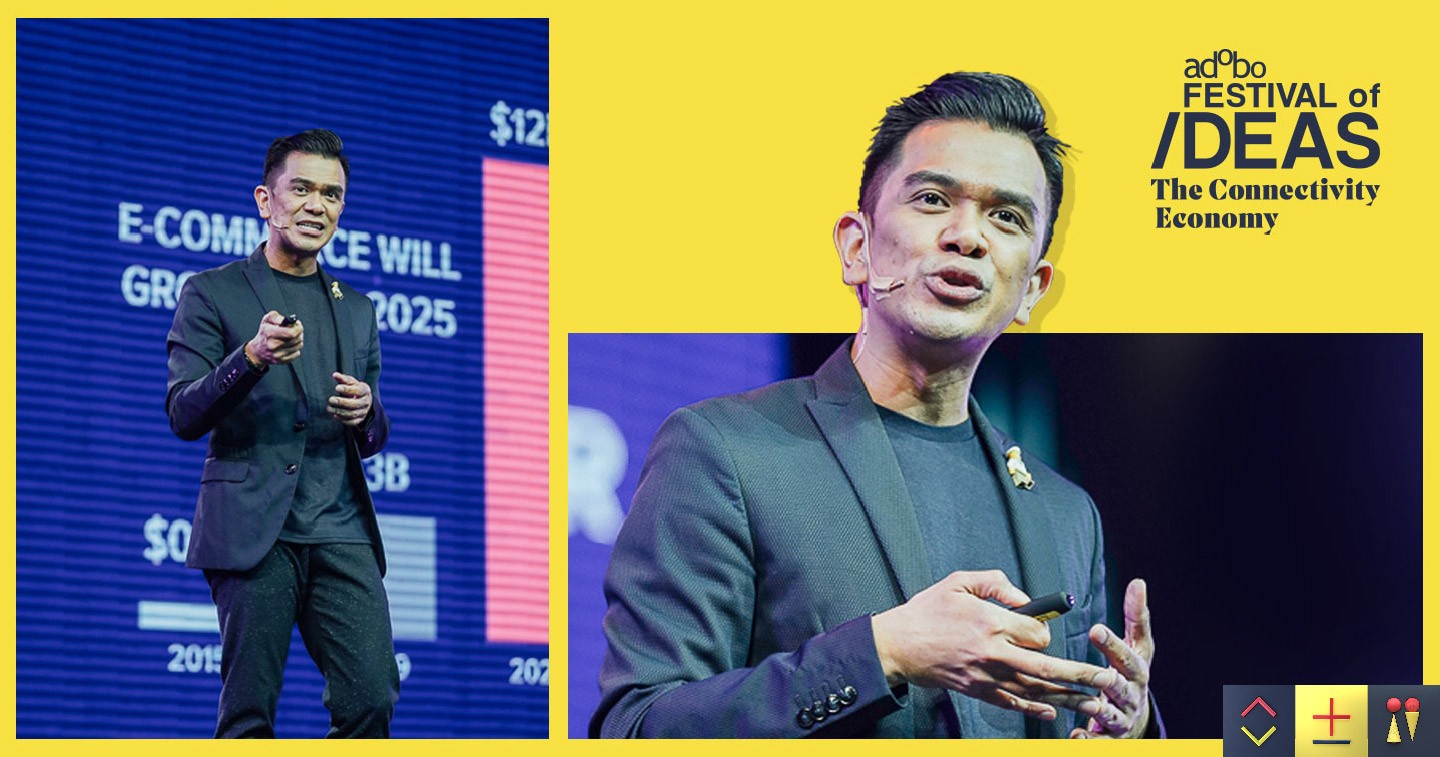
MANILA, PHILIPPINES – With buzzing awards seasons and goals built around reach and engagement, the creative industry can make it easy to forget that innovation isn’t just about chasing whatever novel idea will bag your agency metals or get more clicks. But Tuomas Peltoniemi is one to make sure people remember what innovation truly means.
In the ninth episode of adoboTalks Podcast | the business of creativity, Tuomas laid out his scope for what counts as innovation, what it takes for teams to meet those metrics and what that means for the future agency.
Tuomas has spent over two decades in digital, and today, as the Managing Director of Design and Digital Products Practise for Accenture Song in Southeast Asia, he continues to be a creative leader who makes sure to do his part in fostering a culture of innovation.
His packed jury experience includes being part of the Cannes Innovation Lions and the WARC Prize for Innovation jury, and he has even served as the Spikes Asia Innovation Jury President.
In Tuomas’ podcast episode, “Build Your Braintrust,” he discussed what he thinks innovation should really be about:
The permission to learn and pivot

Innovation can be easily reduced to a buzzword for anything new. But for Tuomas, the scope isn’t as broad.
“For me, innovation has to have one of two dimensions,” Tuomas said. “It’s [either] something that leads into helping capitalize on an opportunity or helping solve a problem of some sort.”
“Those problems don’t have to be defined narrowly,” he clarified. “These can be business problems, societal problems, or things we as humans face every day. But innovation has to have one of those two dimensions.”
So, how exactly does Accenture Song achieve innovation as he defines it?
Tuomas describes it as something hardwired into the structure of Accenture, which he illustrates via its three dimensions:
1. Accenture’s consulting capabilities;
2. the network’s deep technology, data, and AI capability;
3. and Accenture Song’s creative customer experience and digital innovation.
“That combination is the game changer,” he said. “When [it comes to] innovation we do for clients, it’s really at that intersection where that happens at its best.”
Culture, of course, is where big ideas like innovation either stay an abstract concept or become a concrete thing. So, Tuomas is emphatic that innovation cannot be an off-to-the-side initiative. Rather, it should be incorporated into the DNA of your team culture by establishing that pivoting is not only welcomed but anticipated.
“The moment you have an innovation program that’s separate from your core business, you’re going in the wrong direction.”
He recounts a project where his team quickly realized that the operating model they were creating for a client just wasn’t commercially viable. So, they simply welcomed the prompt to re-route.
“We ended up going in a completely different direction,” he recalled. “I’m very happy to say the client has a much better program than we ever imagined.” And all because the expectation and freedom to pivot as needed was built into their culture.
Innovation for the sake of it


Accenture Song has the structure and culture to create innovations, sure. But Tuomas also points out that creating the newest, shiniest solution isn’t enough to be true innovation.
The litmus test he lays out is simple: If there’s a problem that’s affecting millions, for example, and you only solve it for a couple of people through something novel, that’s more of R&D than innovation.
“It doesn’t then solve that opportunity or problem at scale,” he explained. “It’s a good sort of prototype of an innovation. And don’t get me wrong, I think these things are also needed to keep pushing the boundaries of the industry. But [innovation] has to be something that is done at scale so that it leads to some kind of solution that actually helps people in the long term.”
When it comes to what he thinks makes innovative ideas, he echoed the sentiment that guided him and his fellow jurors as they judged the Spikes Asia Innovation category: “We don’t need to look for ideas that right now have already scaled. But we need to look for innovative ideas that we can believably imagine being scaled.”
Among the projects Accenture Song has worked on that meets these criteria is “The First Digital Nation” for the government of Tuvalu, a nation whose status as a sovereign state is at risk if they lose their land to rising sea levels.
True to Tuomas’ point about innovation, this campaign, which created the digital twin of Tuvalu on the metaverse, wasn’t just unique storytelling or a clever use of tech. It became a tool for the protection and preservation of the island nation’s identity, cultural practices and stories. And by the time it launched, 9 nations had agreed to legally recognize the permanency of Tuvalu’s sovereignty, no matter what happens to its physical territory.
He gets energy from projects like these — projects that push the boundaries of technology and creativity not just because they can, but because they actually impact the lives affected by the challenges the innovation promises to address.
The future agency and AI’s place in it

Talk long enough about innovation and the conversation inevitably bends toward the near future. For Tuomas, the “future agency” he imagines we’re in for has three features.
One of them is a response to the challenge of relevance. So, he believes that a feature to anticipate is specialisation. “I think the future agency will have really deep capabilities in a particular industry, whether it’s airlines or banking or whatever that may be, to really solve the real problems of those businesses.”
Then, there’s the flexible team structure: more reliance on people who aren’t formal fixtures in their team. More agencies who take advantage of the permanent freelance type model have been popping up. So, for him, the future agency has to tackle the question: How do you embrace bringing people from outside of your payroll into the creative process?
“Imagine working on a running campaign and having somebody who’s a professional runner as part of your creative process,” he offered as an example. “Would that help or hurt? I think it would help.”
The third feature is obvious, but still needs to be acknowledged: On AI and technology, he said, “The future agency will definitely have that built into their model.”
After all, giants in various industries have already put material bets behind that thesis, and Accenture is one of them. In June 2023, the company announced a US $3 billion investment into its Data and AI practice.
While this covers generative AI, Tuomas clarifies that it also includes a broader AI toolkit. He assured that the investment goes into answering the question of how they can address challenges in businesses, the public sector and more.
“[The investment is] going into real sort of cases that you’ll be able to see out there,” Tuomas added. “And it’s at that sort of size and scale that can have a real impact on the world.”
What humans do best

Yet for all the acceleration and possibility, Tuomas remains clear-eyed about the concerns about generative AI in the creative space. Can it replicate the actual creative capabilities humans have demonstrated for centuries?
“I actually think you can get to great creative ideas faster if you [incorporate AI into your process], but if you want to rely solely on generative AI being the solution for creativity, I just don’t think that that’s going to be the case or should be the case,” he answered. “We should use AI for what only AI can do best, and then make sure humans do the things only humans can do best.”
When pressed on what exactly do people do best, he returned to his go-to example: Cadbury’s 2007 “Gorilla” spot, a brilliantly absurd 90 seconds of a drum-playing gorilla set to Phil Collins’ In the Air Tonight. For Tuomas, this pop culture moment is an example of what humans do best: the brilliant, unexpected connections that just click.
“I’m not entirely sure a generative AI would have come up with a concept that’s so out there but worked so well,” he mused. “Humans can make these unusual creative connections very, very well. [They] can really look at craft [and make] sure the craft comes to life really well.”
With this in mind, he believes that developing your team’s innovative mindset is a path that’s best optimised through the combination of human ingenuity and AI tools. And that at the end of the day, innovation necessitates taking a look at your company and figuring out the exact recipe to that blend.
“What are the parts where we genuinely can add an AI tool or generative AI into that bit of process and make it easier, better, faster, more compelling? And then what are the parts where humans absolutely should be driving and creating the impact that only we can have?” he asked. “I really think [figuring that out is] the way forward.”
Catch the insightful conversation with Tuomas Peltoniemi on Episode 9 of the adoboTalk Podcast on Spotify, YouTube, and Soundcloud. The adoboTalks Podcast | the business of creativity, is presented by adobo Magazine, the word on creativity and produced in partnership with The Pod Network and Hit Productions.