

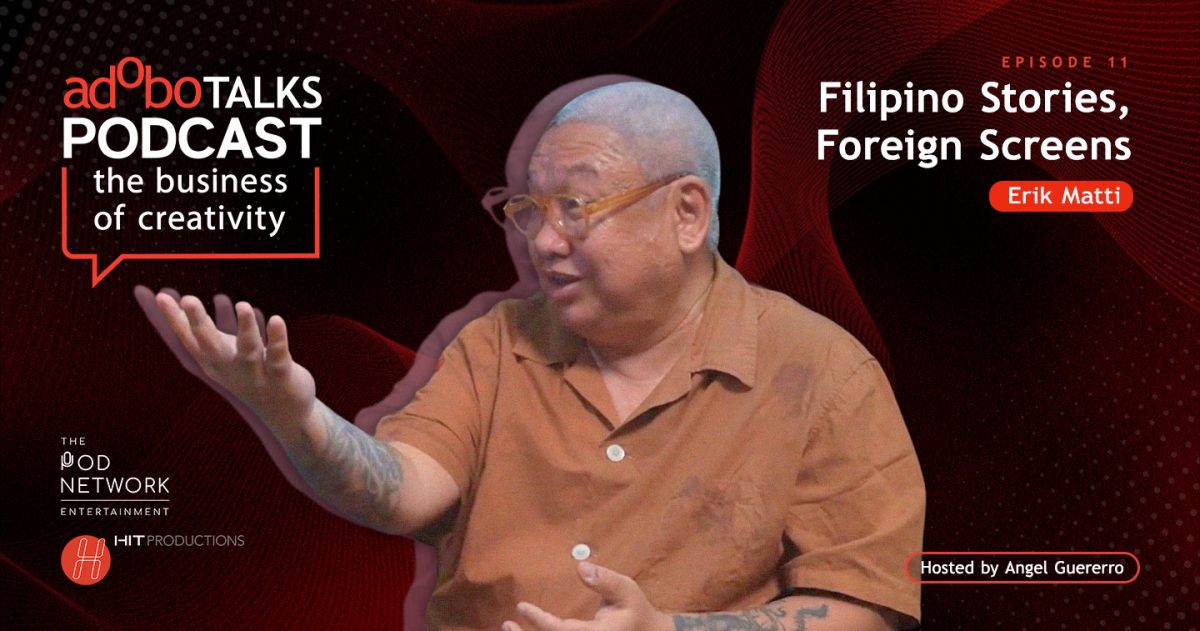
MANILA, PHILIPPINES – You may not believe it, but at one point, esteemed director Erik Matti was once a biology major. Then, a nursing student. And for many years, he was even an ad man. But as many Filipino cinephiles know, he kept finding his way back to movies. In this eleventh episode of adoboTalks| the business of creativity, Erik revisits the trajectory of his career that shaped the critically acclaimed filmography people know him for today.
Erik’s fingerprints are all over some of the country’s favorite haunting and gritty tales, like the Cannes-acclaimed On the Job and MMFF winners Seklusyon and Honor Thy Father, and more. With more than 30 years of experience in the industry, he’s had his fair share of the ups and downs of filmmaking.
In “Filipino Stories, Foreign Screens,” Erik shares with us key points of the beginnings of his film career, why he had to pivot into the ad world for a moment, and the deliberate choice to build Filipino films that speak beyond our borders.
A master storyteller in the making


Erik’s passion for the performing arts was something that survived every course change he made in college.
He first entered as a biology major. Then, he shifted to nursing. Then, finally to mass communications, where he built the foundation for what we now know would be an illustrious career. He was president of Masskara Theater Ensemble for about three years, a group founded by the late filmmaking legend who became his mentor: Peque Gallaga.
It was Peque, in fact, who brought him on to work on Magic Temple, a fantastical classic, where Erik earned his first writing credit for a feature film.
“I’m really proud about how I started in the industry,” Erik said. “There was a high demand coming from the mentor I was working with [and] a high demand in terms of not just thinking about actors, not just thinking about story, [but] also thinking about how it looks. I was just thinking up all these stories. I [didn’t] know if it’s even executable.”
The process he became acquainted with in those early years was highly collaborative. Someone generates a storyline, the team sits down to interrogate the bones, another writer adds their own work, and so on. It went like this until they had a working template of what the script was going to be.
This approach still informs his creative leadership today. “If you’re working on so many elements, you need to listen to a lot of people. You can’t just be the only voice that everyone has to listen to. Up to now, even when PAs point out that there’s something wrong and it’s valid, no one’s going to be shouted at for giving their opinion.”
Erik Matti, the ad man


Not long after, his directing break arrived: Scorpion Nights 2. Then came an in-house directing stint at Viva. But when he encountered some friction with the studio a few years later, it led to all his projects getting stalled.
While he felt that this left him with nowhere to go, he realized then that he did have a route to pivot to: “I said, maybe I could go into advertising.”
Erik got his foot in the door through “quick and roughs.” He explained that this was a P&G-coined testing pipeline. You get the brief, you do pre-production, you produce a proof-of-concept, and how it does in testing determines whether the idea graduates to full production — usually with a different, “official” team.
Matti churned through them until one “rough” turned out to be polished enough for a big FMCG brand. For Tide, he staged a homage to action cinema: a Lito Lapid-style hero dragged through the mud, then able to remove the stains with the household name detergent.
“It scored [so] high that they said, ‘We’ll just air this as is.’ And that’s when I [started getting] mainstream gigs.”
Even as he started to make a name for himself as a filmmaker in advertising, though, his main passion never changed. It was always going to be movies. It just so happened that advertising was what could sustain him as he navigated his film career.
“It pays really well, and that’s my problem,” he admitted. “Advertising is quite a selfish wife or mistress. Very selfish. If you don’t do a commercial for two, three months, agencies forget about you if you keep on saying no.”
At one point, he was shooting four to five commercials a month. And he knew that advertising wasn’t something he could do halfway if he wanted to commit to movies again.
Eventually, he told his own company the truth: it was time to slow down the ad work and make the hard, intentional turn back to movies.
Going beyond the Filipino formula

When Erik declared his desire to return to film, he didn’t mean just any movie that could sell tickets. He meant the kind of cinema he found when he looked at all the classics that have been taught in universities.
“They’re mostly tackling not just crime, not just horror, but more substantial themes and stories,” he expressed. “As much as you really want your movies to make money, you want to bring in some sort of depth into it.”
That dedication to creating substantial films was hard. The genres he gravitated toward — gritty crime thrillers and horror — were rarely the same that made theater’s lineups. Often working with stories that guaranteed him no spot on the slate, it took a while until he found the amount of recognition and investment his work is getting today.
While there’s no one project that we can credit for his level of fame now, On the Job, a sharp and unrelenting confrontation of corruption and crime in the Philippines, definitely played a significant part.
On top of its local acclaim, including multiple FAMAS and Star Awards wins, the title earned nominations from several international festivals. It was even selected to be part of the Directors’ Fortnight at the Cannes Film Festival in 2013.
“Nobody understood it when it was released in the local cinemas. It didn’t make so much money here,” Erik recalled. “But then there was Cannes. And when it was released in the US with the international cut, it eventually made it back here a year later through downloads.”
“The best things you hear about On the Job from the Philippine market? That’s [when] you heard it: a year later,” he said with a laugh.
He credits his success to the fact that he never stuck to just what the typical Filipino audience would enjoy.
“I realized early on that if we’re just going to rely on the local audience, and [they] ask for the same kind of stories that they’re used to, no other voice is going to come out of it except the ones who are just going to be subservient to those kinds of stories,” he said. “[I saw that I needed] to widen the market in order for me to be able to do what I want to do.”
Watered-down ideas and effort are not the way to go
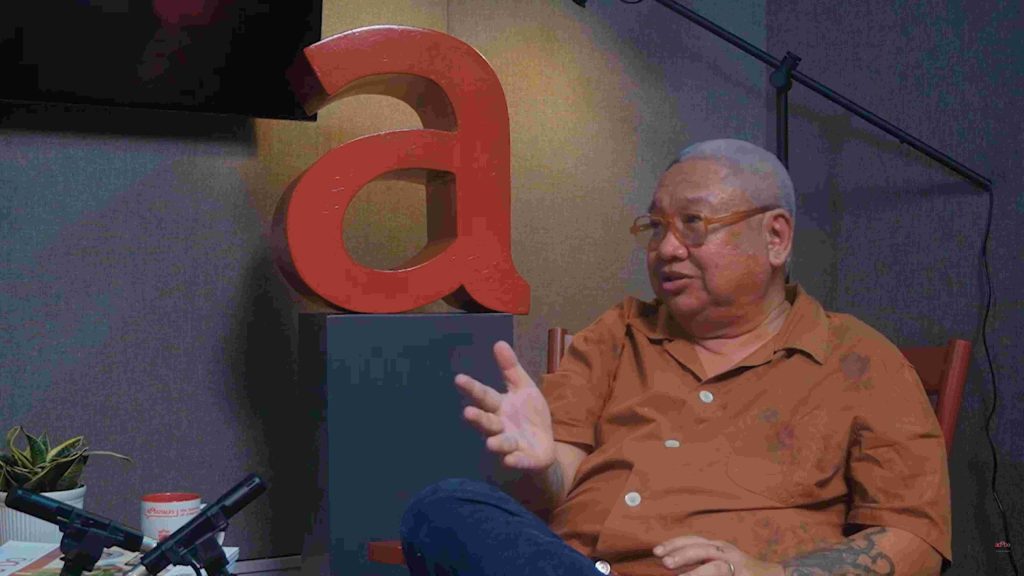
The fruits of this mindset didn’t end with On The Job. Erik kept pressing forward with films like BuyBust and Honor Thy Father. In fact, a sequel, On the Job: The Missing 8, made its debut at the 78th Venice International Film Festival, entering the Main Competition as a nominee for the Golden Lion.
The momentum continued into television. In 2024, his pitch for an immigrant crime series, The Squatter, won a €50,000 grant at the prestigious Series Mania.
Erik’s works can now be found across Netflix, Prime Video, and Max, too. And not just his previously released films, either. On the Job: The Missing 8 was adapted into a miniseries for HBO Asia that went on to earn an International Emmy nomination for Best TV Movie or Miniseries, and Erik also snagged a Best Director win at the ContentAsia Awards for his episode for Food Lore on HBO Asia.
One of his more recent projects, Call My Manager, a local adaptation of French TV show Call My Agent, even got greenlit as a Max Original series.
This is just further proof of how well Filipino stories and localizations of beloved titles can do on the global stage.
But to Erik, success in this is something you can’t reach by limiting your ideas.
“When [people pitch to us and] I look at the script, from the get-go, you can see that they’ve already edited it in order for it to fit a budget that they think a Filipino movie should [have].”
“We need to assert ourselves,” he emphasized. “We need to assert ourselves with the material we’re doing [and assert] that we deserve ambitious stuff.”
That seems to be the key here: success and artistry don’t come easy. Wherever you are in your creative career, you have to assert that dream with dedication to the craft.
“I wasn’t born an artist. I learned it,” Erik reminded. “[Ask] ‘Where do I want to go? Who do I want to be? What kind of films should I make?’ And you study it. You constantly study it.”
“It was tough starting out. You’re telling yourself, ‘I hope I’m gonna make it with my kind of stories.’ And good thing, [for me,] it did,” he said. “You [just] got to invest in yourself.”
Catch the insightful conversation with Erik Matti on Episode 11 of the adoboTalk Podcast on Spotify, YouTube, and Soundcloud. The adoboTalks Podcast | the business of creativity, is presented by adobo Magazine, the word on creativity and produced in partnership with The Pod Network and Hit Productions.