

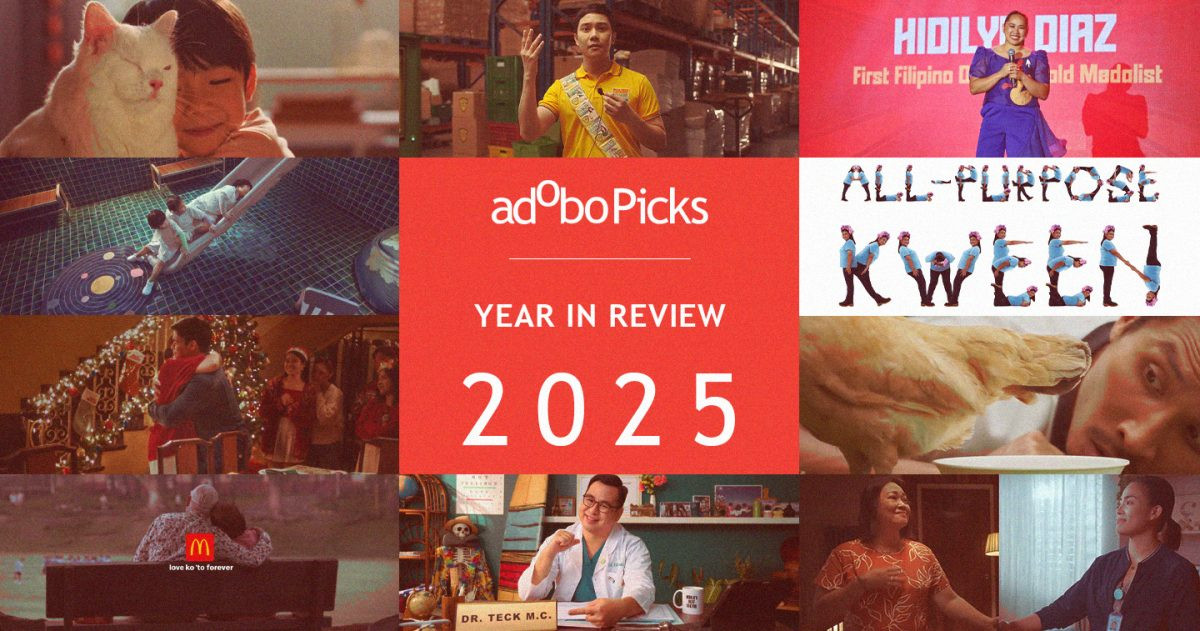
MANILA, PHILIPPINES – In 2025, creativity proved once again that its greatest power lies not in spectacle, but in connection. Across cultures and categories, the most resonant campaigns spotlighted by adobo Magazine this year returned to a simple yet urgent truth: humanity is the strongest platform of all.
At a time when brands are navigating rapid technological shifts, evolving social values, and increasingly fragmented attention, the campaigns that truly broke through were those that chose empathy over excess, and meaning over mere metrics. Hence, agencies and brands leaned into shared experiences, emotional intelligence, and cultural relevance by using creativity to bridge divides, reflect lived realities, and remind audiences that behind every data point is a human story.
Spanning January to December 2025, these Campaign Spotlight features from adobo Magazine defined the year through the lens of humanity and connectivity — showing how creativity can inform, comfort, challenge, and unite.
January: Everyday heroes and quiet love
The year began with campaigns grounded in community, gratitude, and the understated power of care. For instance, FairPrice’s Lunar New Year message, conceptualized by Homeground United (Omnicom Production and TBWA\Singapore) emphasized that love prospers in small, everyday moments — an idea that resonated across cultures. Ginebra San Miguel’s “Kabayani Kita” (You are a fellow hero) paid tribute to modern-day heroes whose acts of bayanihan often go unnoticed, reframing heroism as something lived daily, not reserved for grand occasions.
Travel and aspiration were also humanized early in the year. Cebu Pacific’s “Fly to Happy! Fly to the Philippines” positioned tourism as an emotional invitation rather than a transactional pitch, while Philippine Airlines’ “Sorpresa” (Surprise) reminded audiences that dreams, when nurtured with hope and generosity, can still come true.
Together, these campaigns set the tone for a year that valued heart over hype.
February: Access and enduring love
February’s campaigns underscored the importance of access such as opportunity, communication, and emotional connection.
For example, Jobstreet by SEEK encouraged jobseekers to pursue work they genuinely love, reframing employment as a path to fulfillment rather than survival. Hello Monday/DEPT’s ASL learning platform with NVIDIA highlighted how technology can break down communication barriers when designed with inclusion in mind.
On the emotional front, McDonald’s Philippines delivered a poignant reminder of love’s endurance through Love Ko ’To Forever! tapping into nostalgia and long-term commitment.
Meanwhile, Brazil’s Piracanjuba demonstrated how AI can be harnessed for social good by updating missing persons’ portraits and turning everyday milk boxes into tools of hope — proving that innovation can be deeply humane.
March: Craft and care
March saw creativity intersect with heritage and compassion.
On top of the campaign is Cebu Pacific’s Philippine Weaves campaign which revitalized intangible cultural traditions by embedding them into modern travel experiences through QR flight codes. This idea bridged past and present in a way that honored Filipino craftsmanship.
Pedigree’s celebration of mixed-breed dogs, on the other hand, further echoed themes of inclusivity, challenging notions of “purity” and elevating stories of love without labels.
These two campaigns showed that when brands invest in culture and care, they don’t just tell stories; they also help preserve identities and values.
April: Nature, and social courage
April’s work challenged brands to listen more closely to parents, communities, and even the environment.
Samsung and BBDO Bangkok transformed the abstract idea of energy loss into a tangible call to action for missing children, using wit to draw attention without diminishing urgency.
MommyPhone flipped the traditional baby monitor concept by focusing on parental well-being, reinforcing that care must be reciprocal.
Likewise, nature took on a voice of its own through Forest Carbon’s sensory-driven identity, while Gambol fearlessly addressed social taboos in Thailand with bold symbolism.
May: Trust in the age of AI
As artificial intelligence continued to reshape daily life, May’s campaigns focused on restoring trust and accountability. These include a campaign from Columbia Journalism Review who showcased an AI-powered initiative that confronted misinformation head-on, while McAfee’s “Keep It Real” used real stories and smart technology to expose online scams.
Locally, PLDT Global’s TinBo Mother’s Day campaign balanced innovation with emotion, reminding audiences that technology is most powerful when it strengthens human bonds.
Across markets, beauty and self-expression were also redefined, particularly for Gen Z, signaling a shift toward authenticity over aspiration. These ideas were exemplified by campaigns such as “Words Are Permanent,” by The Cybersmile Foundation in collaboration with adam&eveDDB London, that aimed to shine a stark spotlight on the long lasting emotional scars inflicted by online abuse especially among Gen Z; and Unilever’s toothpaste brand Closeup, together with MullenLowe Singapore which redefined oral care to a beauty-first approach and bringing beauty to the oral care aisle.
June: Pride and purpose
June highlighted creativity with conviction. Pride campaigns emphasized the importance of visibility and allyship, amplifying trans voices and advocating for safer digital spaces. This idea came to life through the launch of “Play Through the Hate” — a joint effort between DDB MNL and LGBTQI human rights organization Babaylanes, aiming to turn a simple act of support into something powerful: watching trans creators’ content from start to finish.
Jollibee’s “Bida Best, Bida Pinoy” (Be the best, Be a Filipino) also executes this idea by celebrating Filipino excellence on a global scale, reinforcing cultural pride while remaining inclusive.
Award-winning efforts like Dentsu Creative Taiwan’s “Unfreeze My Rights” demonstrated how creativity can move beyond awareness and toward policy-level conversations in order to cement the role of advertising as a catalyst for societal progress.
July: Humor and new forms of bonding
In July, humor became a gateway to honesty.
GIGIL’s GrabMart campaign used sitcom-style storytelling to address everyday doubts with relatability and charm, while Friso’s AI Audio Book 3.0 showcased how emerging technology can deepen, rather than dilute, family connections.
Even heavy topics like Alzheimer’s were approached with grace, using universally understood symbols to foster empathy without exploitation to reinforce that sensitivity is a creative strength. Thanks to Alzheimerfonden’s new campaign, created by Stockholm-based agency Kid.
August: Mental Health and modern work
August placed emotional well-being at the forefront.
Another campaign from Jobstreet by SEEK entitled “We See You” acknowledged burnout, anxiety, and unseen struggles in the workplace, while Prudential Hong Kong and Ogilvy’s “Furkid” campaign recognized pets as emotional anchors in modern families.
Moreover, American multinational clothing and accessories retailer Gap partnered with global girl group KATSEYE for their “Better in Denim” fall campaign, spotlighting some of the brand’s favorite fits from 2000s which was modernized today.
September: Redefining worth and presence
September’s work challenged audiences to rethink self-worth and pace.
In particular, Sephora’s “Perfect Shade” campaign expanded beauty narratives across APAC, while L’Oréal Paris and McCann India reframed confidence as self-belief rather than perfection through the brand’s global “Lessons of Worth” initiative.
Meanwhile, Samsung’s AI Home campaign echoed this sentiment by championing the value of doing less and living more.
October: Empowerment through creativity
October celebrated empowerment across professions and passions. These ideas were brought to life by Spotify’s RADAR Creators Philippines platform that elevated local storytellers while reinforcing the importance of representation in global platforms.
Campaigns such as Cathay Pacific and Leo Singapore’s “Tripment” to cure vacation deprivation and KesselsKramer’s campaign for the Dutch organization The Universities of the Netherlands also reimagined rest, recognition, and respect particularly for educators and workers whose contributions often go unnoticed.
Ultimately, creativity here became a tool for visibility and validation.
November: Family, and real connection
As the year approached its end, campaigns leaned into emotional warmth.
To illustrate, campaigns from McDonald’s and Ogilvy reframed breakfast through the universal need for rest; Tinder promoted mindful dating in a swipe-driven culture; and Nescafé and Leo Thailand reminded audiences of the simple comfort of human warmth.
Also, Jollibee’s Christmas film once again captured the evolving nature of family, proving that inclusivity and emotional truth remain timeless storytelling anchors.
December: Democratizing care and cultural joy
December closed the year with purpose-led innovation and cultural celebration.
For instance, Palawan ProtekTODO’s sachet insurance model addressed economic realities with empathy, making protection accessible to more Filipinos. Meanwhile, Canva Pro and GIGIL’s Ey-assets campaign with Kween Yasmin transformed internet culture into a playful yet inclusive design language. These campaigns showed that joy, representation, and utility can coexist.
Looking back at 2025, humanity and connectivity are still the North Star. These campaigns proved a clear pattern that the most impactful campaigns weren’t those that shouted the loudest, but those that listened most closely as they observed real behaviors, respected lived experiences, and used creativity as a bridge — not a barrier.
In a year defined by technological acceleration and cultural complexity, adobo Magazine’s Campaign Spotlight stories reaffirm one enduring truth: the future of creativity isn’t just smarter or faster — it’s profoundly, intentionally human.