

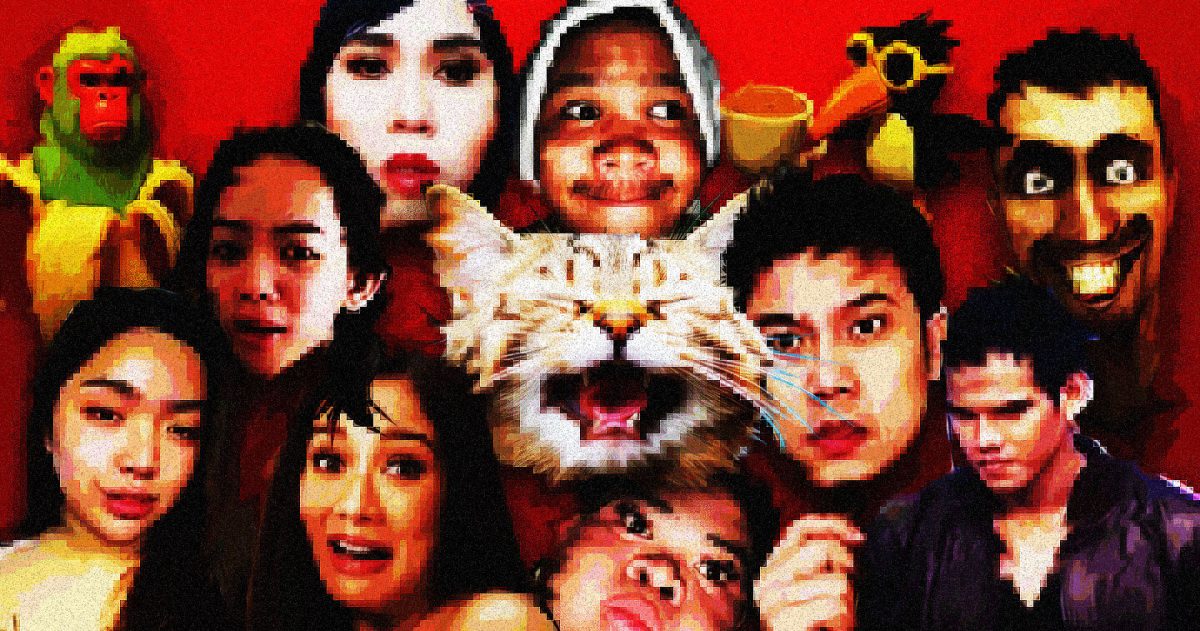
CEBU, PHILIPPINES – After attending BaiCon 2025 in Cebu City from July 18 to 20, 2025, adobo Magazine’s Senior Content Manager Ivan Medina flew back to Manila with a deeper grasp of how content creators are shaping today’s Filipino internet culture. But before the weekend began, one question lingered: Why is the roster composed mainly by creators known for brainrot content? This piece is a reflection of that question, and what it reveals about Gen Z humor, culture, and the strange genius about the divisive topic.
My last weekend in Cebu felt like a fever dream. It was as if my social media For You Page came to life. And in many ways, it did.
If you asked me what my FYP looks and sounds like, I’d point you to my coaster ride from Fili Nustar Hotel to Plaza Independencia during the first morning of BaiCon 2025.
“Diba Pinoy si Kehlani?” (Is Kehlani Filipino?)
“Ay, oo! Half-Bisaya siya.” (Yes! She’s half-Visayan)
“Hindi, Ilocano ang mama niya.”(No! Her mother’s Ilocano)
“Ay, binago na?” (Oh. They changed it already?)
Did that conversation make sense? It did at the time. Should it make sense? It could, but it doesn’t have to.
Does brain rot actually rot?
Internet humor is hard to pin down. Miss one day online, and you risk losing context for a joke already spiraling through thousands of TikToks and tweets. It’s unfiltered, highly referential, and absurd, but also incredibly self-aware. It functions as a living shorthand, and most of it falls into what we call “brainrot” content.
Brainrot content looks dumb on purpose. It’s made up of sped-up video clips, reaction GIFs, strange edits, and viral slang that often feels meaningless until it suddenly makes perfect yet chaotic sense. It doesn’t try to be polished or profound, and that’s the point.
Though brainrot is believed by Gen Z, many critics including academics and mainstream media have questioned its value. The term “brain rot” was named Oxford University’s Word of the Year 2024, in part because of growing concern that excessive consumption of low-value or repetitive digital content could harm attention span, memory, and mental clarity.
A study from Harvard has linked prolonged doom scrolling to cognitive fatigue and diminished focus. Yet, many still reclaim the term with irony, not as a diagnosis, but as a prognosis that being hyper-online doesn’t equal brainless. If anything, brainrot is what happens when creativity adapts.
Fluent in brainrot
While brainrot content may not sit comfortably next to “higher” forms of creativity, it stands on its own — and, I’d argue, it is also evolving into a higher form itself. It’s not just noise for noise’s sake. It’s a signal disguised as silliness.
Pinoy brainrot humor, specifically, is disarming. It’s more than meme culture — it’s cultural commentary wrapped in chaos. It’s how Gen-Z Filipinos cope with a world and a country that feel like they’re collapsing in real time.
Queer creative and internet personality Nyel Estrada put it best in an interview with adobo Magazine: “Pinoy brainrot humor reflects this generation’s deeply ‘unserious’ attitude.” It’s one that masks a serious amount of lived experience with dark humor, absurdity, and a refusal to take anything, especially power, too seriously.
Nyel cites Cebuana creator Kimburghly’s viral TikTok audio — “Kunwari magma-mall, nag-dala na pala ng resume” — as a perfect example. In the videos that used her audio, people casually stroll through malls, resumes in hand, handing them out like flyers. It’s unserious, yes, but it’s also a painfully accurate picture of job hunting, hustle culture, and economic anxiety in the Philippines today.
It’s not haha funny. It’s what-the-hell-did-I-just-watch funny, and that’s the point. The randomness, the deadpan delivery, the absurdity around something painfully real — that’s what makes it peak brainrot.
“I believe consuming or creating brainrot doesn’t kill one’s creativity,” Nyel said. “At best, it’s an extension.” Coming up with that kind of humor — the kind that makes people laugh and feel strangely seen — takes a specific creative muscle. One that more and more Filipino creators have learned to flex, fluently.
It’s no coincidence that much of what feels new to the rest of the world has already gone viral in the Philippines. From the rise of men liking matcha lattes, to the Labubu toy craze, and even the viral Dubai chocolate which was made iconic by a Filipino pastry chef, these trends were first cultivated, memed, and elevated by Filipino internet users long before they hit the global radar.
The Philippines isn’t just keeping up with internet culture; I believe we’re helping define it. Pinoy creators aren’t just fluent in brainrot — they’re shaping the internet’s mother tongue.
The attention economy
Since the global pandemic reshaped our media diet, short-form videos have exploded. Platforms like YouTube Shorts, Instagram Reels, and TikTok have democratized content creation, pushing audiences toward faster, bite-sized formats.
This shift from longer, more in-depth media to snackable content didn’t just change how we consume — it changed why we consume. Before, people watched videos to unwind. Now, scrolling is the thing we need a break from. We’ve entered an era where doing nothing feels like a real pause.
Short-form content feels like a quick creativity hit for some. But as Filipina voice artist and internet personality Inka Magnaye points out, it’s a band-aid solution. “Like cigarettes for the brain,” she said — comforting in the moment, but quietly addictive.
The danger lies in repetition. The more you consume content that’s fast, fleeting, and fragmented, the more your brain begins to mimic that rhythm. “You begin to think in clipped thoughts,” Inka warned. You jump from idea to idea without depth, struggle to sit with complexity, and lose patience for nuance.
Bacolod-based vlogger Nisa — better known online as Nisa Nuggets — echoes Inka’s concern. She finds it wild, even a little alarming, how much media the people can now consume in just minutes — herself included. With playback speed controls and fast-forward features, even bite-sized content is being shaved down further.
Nisa started vlogging in 2018, when YouTube long-form was king. The platform let her tell fuller stories — the kind that captured her journey through nursing school, her victories, and everyday misadventures. But now, she admits she’s drawn to short-form content because that’s where the crowd is — and in today’s attention economy, your crowd is your currency.
She’s noticed a clear difference between fans who found her through TikTok and those who’ve followed her YouTube journey. She can tell by the way they talk to her. TikTok viewers recognize the punchlines, whereas YouTube fans know the person behind them — her quirks, her stories, her voice. And maybe that’s the trade-off: in a world trained to think in clips, depth becomes a luxury, and attention becomes the rarest form of loyalty.
Scroll-stopping influence
This shift hasn’t just changed how creators tell stories — it’s also reshaped how brands show up. Many rush to short-form platforms simply because that’s where the buying public spends its waking hours, all while trying to manufacture their next viral moment. But lately, something has clicked. After years of trying to “hack the algorithm,” brands are beginning to understand that they can’t outsmart a hyper-aware generation — one that can instantly spot what’s scripted, sense when a creator is faking it, and scroll past an ad that’s trying too hard to go viral.
Instead of engineering virality, brands are learning to trust those who already speak the internet’s mother tongue. The best algorithm hack? Let content creators do the hacking for you. This has fueled the rise of affiliate marketing and the creator economy, especially in the Philippines where internet fluency is currently second nature.
BaiCon 2025 made a strong case for this shift. Held in the culturally rich city of Cebu, the event brought together hundreds of content creators (majority of them being brainrot creators) and some of the country’s biggest brands.
It was a win-win: brands gained access to the internet’s most creative and influential minds, while creators scored meaningful exposure and new partnerships. In the clearest way possible, BaiCon proved that creativity is the ultimate economic multiplier.
The medium is the message
While brainrot and short-form content have been dismissed as lowbrow or mindless, I believe there’s more depth to it than we often give it credit for. It’s a mirror — a chaotic, irreverent, deeply coded reflection of culture. It speaks in a language only those immersed in it can truly understand.
Does it rot your brain? Maybe. But perhaps it also reveals how the brain — and culture — adapts. As Marshall McLuhan once said: “The medium is the message.” And in a world overwhelmed by crisis, distraction, and constant collapse, the message embedded in short-form content is not always the content itself; it’s the conditions that shaped it and the fractured, fast-paced reality it reflects.
You don’t go to TikTok for deep thought. You go there to escape the deep end. The irony is, in doing so, you also tap into the collective psyche of a generation that’s navigating uncertainty with humor, chaos, and coded clarity.
Brainrot content isn’t the end of creativity, nor its killer — it’s what creativity looks like when the world leaves you no room to breathe.