
Everyone wants to lead. Few are willing to do what it actually takes.
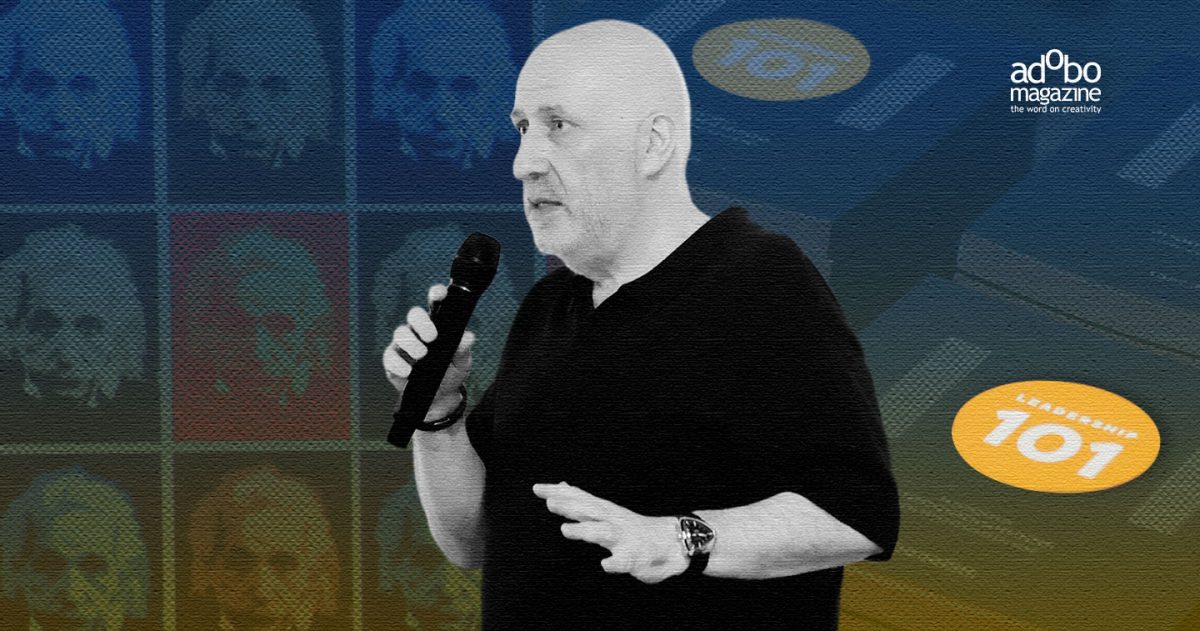
In a world that celebrates quick wins and fast promotions, Tony Harris, who brings over 30 years of global leadership experience in advertising having led offices across Manila, Tokyo, and Hong Kong for networks such as BBDO and RKCR/Y&R, offers a reality check: leadership cannot be rushed. It is built slowly through reflection, discipline, curiosity, and the willingness to constantly improve.
During the adobo Magazine Leadership Masterclass “Your Turn to Lead: How to Get to the Top… and What to Do When You Actually Get There,” Tony unpacked what truly shapes effective leadership. Drawing inspiration from the life and thinking patterns of Albert Einstein, the session explored the habits, mindsets, and hard truths that define enduring leaders.

Landmarks of leadership
Tony, who is best known in the Philippines as the co-creator of the award-winning It’s More Fun in the Philippines campaign, begins with a premise that runs counter to the modern obsession with shortcuts. Leadership, he argues, cannot be accelerated.
“There can be no shortcuts to becoming a good leader. The people who are catapulted into leadership will not be good leaders, because leadership takes effort,” he emphasized.
Tony, also the author of the book Leadership 101, added that leadership requires desire, commitment, and constant self-examination. Self-examination should be a daily practice and leaders must constantly question their assumptions, interrogate feedback, and ask themselves what they may have overlooked.
“You have to own your own development. You have to say, ‘I want this. I want to become a leader. I want to sit there.’ Sometimes you may feel reluctant, but ultimately you’ve got to say, ‘That’s a responsibility I’ll take on,’ and I will do everything in my power to get there,” Tony said.
“You also have to keep looking at yourself — your own perspective — and ask, ‘how are you doing?’ Can you be better? In the end, you need to commit to being the very best you can.”
Tony also underscored a key leadership habit: creating space to think. In fast-paced workplaces, leaders often equate activity with productivity, and yet, the best decisions frequently emerge from moments of deliberate pause. Breaking routine, stepping outside the usual workspace, and scheduling time specifically for focused thinking can open doors to fresh ideas and creative insight.
“You have to create space to think. You have to find time. It seems bizarre in a world of technical communication on the go all the time, but you have to find your time.”
The third landmark Tony believes leaders should consider is seeking fresh perspectives. He warns against getting trapped in insular decision-making, where leaders rely only on familiar viewpoints.

For him, diverse opinions, constructive disagreement, and deliberate challenges to prevailing assumptions strengthen strategic thinking. Sometimes, that means playing devil’s advocate or comparing opposing arguments side by side before committing to a decision.
Fourth on the list is creating a space for curiosity.
Curiosity, he suggests, is the engine that keeps this process moving. Leaders should foster environments where questioning and debate are encouraged. Rather than positioning themselves as the ultimate authority, effective leaders ask open-ended questions that spark dialogue and uncover insights their teams may already hold.
“You should create an atmosphere in which you want to know more. Everybody should know more. You should want to know more, always,” he shared.
Schwerpunkt and mentorship
Furthermore, the session delved on the idea that leaders must learn to focus their attention where it matters most. Hence, Tony pointed to the concept of schwerpunkt, a German term describing the center of gravity — the point where effort produces the greatest impact. For leaders, this means identifying the areas where their judgment and experience add the most value, rather than attempting to manage every detail themselves.
“Your schwerpunkt is your maximum impact, and you need to know what your schwerpunkt is. Where can you really influence it? Because that’s what you should always be doing, is going where you can create the most benefit, particularly becoming a leader.”
Mentorship also plays a critical role. Tony encourages leaders to actively seek trusted advisors who can challenge assumptions, reveal blind spots, and offer perspective during difficult moments.
“The mistake that new leaders make is thinking that they have to make every decision themselves. They can’t talk anything through. And that demonstrating a need for further information is a sign of weakness. It’s a sign of strength,” he said.
Leadership, however, is not just about receiving guidance; it is also about giving it. Tony argues that leaders have the responsibility of lifting others along the way. Mentoring colleagues, helping teams navigate challenges, and creating opportunities for others to grow builds the kind of impact that extends beyond individual success.
“You lift others as you go. You return the favor so that, as people mentor you, you mentor other people,” Tony said.
He continued, “It’s wrong to think about it. People have issues. Look at the issue. Don’t look at who’s bringing it. Just look at it as the issue and help them work it out.”
Finally, Tony reminds leaders that the journey never really ends. Leadership is not a fixed achievement but an ongoing process of learning and recalibration. Effective leaders continuously evaluate their own performance, seek feedback, and reset their goals as circumstances evolve.
Hence, leadership is not a destination. It is a practice.
“Learning is not a problem for schooling, but a lifelong attempt to acquire it. Honestly, it never stops. Being a leader never stops. Every day is a school day. You will keep learning. You will keep going to do things.”
Tony concluded the first half of the masterclass with one last nod to Einstein, reminding the audience that leadership, even in the age of AI, must be fundamentally human.
“Leadership is very much about emotional intelligence, both in dealing with people and dealing with problems.”

Truths leaders discover on the job
After using eight landmarks to outline the ideals of leadership, Tony offered a more pragmatic set of insights about the realities of being in charge. According to him, stepping into leadership also reveals realities that few people openly discuss.
At the core of his message is a mindset he calls the “Tony Harris ABC,” a framework he believes every new leader should adopt: Accept nothing, Believe nobody, and Challenge everything.
Tony noted that this framework doesn’t equate to being combative. He believes that progressive leadership requires questioning the status quo but encouraging people to approach situations with curiosity, courage, and critical thinking rather than simply accepting things as they are.
“Now, that doesn’t mean to be aggressive, because that’s very bad, but you probably need to change to make changes, because they need growth, action, progress, advancement, so challenge those things. And if somebody tells you, ‘but it’s always been done that way.’ So what? Accept nothing. Believe nobody. Challenge everything.”
Sound decision-making and accountability
Tony also highlighted how leadership changes workplace dynamics almost immediately. Someone who was once a peer suddenly becomes the subject of closer scrutiny. But leadership shifts that reality.
“When you become a leader, all eyes are on you,” Harris said. “They are looking at you… examining everything you do.”
The transition requires intentional behavior. Leaders must understand that their actions carry new meaning, and that visibility is now part of the job. Rather than seeking popularity, the focus should shift to sound decision-making and accountability.
Another difficult adjustment, Tony noted, involves workplace relationships. Promotions can expose tensions that were previously hidden. While colleagues may describe themselves as friends, Harris believes leadership often tests that assumption.
“Everybody says, ‘But they’re my friend at work. Well, friendship is unconditional.”
If resentment or competition surfaces after a promotion, the relationship may not have been friendship at all in the first place.
“If they have a problem with it, then they’re not your friend. They’re a rival you haven’t spotted.”
Tony warned against thinking that you are the smartest person in the room.
“If you are the smartest person in the room, you really are in trouble. Hire people who are better than you, smarter than you, better at what they do than you are, because if you’re the smartest, you’re in trouble, because you’re not the expert. You’re not there to be the expert. You’re there to be the helicopter,” he explained.
Building strong teams, after all, means hiring people whose expertise exceeds your own and trusting them to contribute fully.
Altitude and perspective
Tony added that leadership is about altitude, not technical skill, and that succession is a non-negotiable responsibility.
“You’re there to look at everything and make the decision. You’re not there to go, ‘I’m really good at this.’ You need to always be thinking about who takes over, who’s going to be better than me, who’s next, because I will move on, who will take over for me. Sort out your succession. Never be the smartest person.”
Tony also talked about perspective. For him, leadership requires thinking beyond immediate outcomes and understanding the ripple effect decisions can create over time. He described this as seeing the world not just in three dimensions, but in four dimensions — recognizing the consequences that unfold long after a choice is made.
“You have to see everything, not just in 3D but 4D. Everything has consequences. If I promote A, B will leave. Can I live with that? No, I can’t live with B leaving. I’m gonna have to rethink that promotion. Everything has a consequence.”
“The more you think in 4D… the more you think about the consequences of things, the better it will be,” he added.
Tony, similarly, deals with the emotional realities of being a leader, and this implies that even accomplished professionals experience doubt when stepping into leadership. New responsibilities bring pressure, uncertainty, and the occasional bout of imposter syndrome. Tony acknowledged that leaders often lose sleep wondering whether they are truly ready for the role.
But instinct matters. The same instincts that helped someone rise to leadership are often the ones that guide them once they arrive.
“That’s actually why they put you in charge, because your instincts are good and they’ve got you so far. So keep trusting them. Somebody, somewhere believed you were the right person for this. You have to reclaim that faith. You owe it to them.”
The masterclass ultimately reframed leadership as something that starts — not ends — when someone reaches the top. Titles may grant authority, but leadership itself is built through everyday choices: carving out time to think, inviting new perspectives, asking better questions, and investing in the growth of others.
For Tony, the measure of leadership is not simply what a leader accomplishes personally, but what they leave behind including the people they develop, the culture they shape, and the thinking they inspire. Because once you reach the top, the real challenge is not getting there. It is learning how to lead.
“Work hard and be nice. Start that from day one, and you will get people committed,” he concluded.
READ MORE:
Recruitment platform Borderless PH launched by Aya Montebon and Tony Harris
Structure meets soul: Cecil Ravelas on healing, sustainability, and leadership