
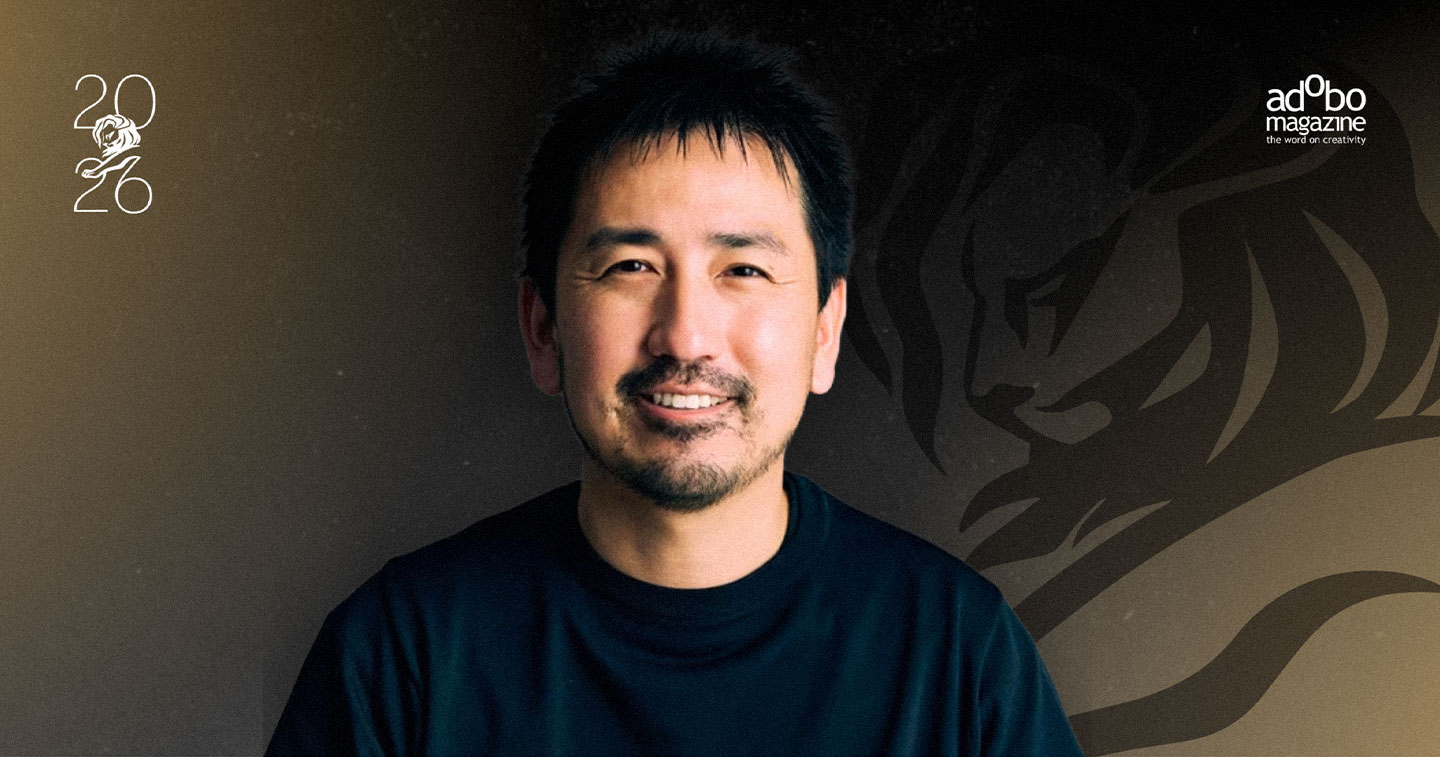
Kazuhiro Shimura, Executive Creative Director of Dentsu Inc., has been selected as Jury President for the Innovation category at the Cannes Lions International Festival of Creativity, the world’s largest creativity festival held last June 22 to 26, 2026.
During his speech at the event, Kazuhiro asked, “What is innovation in our industry?” He proposed that in this age of AI,
the way we think about innovation must evolve.
In this exclusive interview with adobo Magazine, Kazuhiro explores more about the idea of redefining innovation and the role of innovation in success.
Defining Innovation Today
adobo Magazine: “Innovation” is used loosely across the industry. In the context of Cannes Lions 2026, what does it actually mean now — and has the word become diluted as everything from AI tools to brand activations gets labelled “innovative”?
Kazuhiro Shimura: The term “innovation” may now be used more broadly, but I do not think it has lost its meaning. If anything, it has become more important.
For me, innovation in the creative industry is not about celebrating technology itself, nor simply about ideas no one has seen before. Those things matter, but they are no longer enough.
In the age of AI, concepts can be generated in seconds. Meaningful change still has to be built.
In the past, innovation was often judged by whether a new concept could be proven. Proof of concept mattered. What defines innovation now is not simply whether a concept can be proven, but whether it can create meaningful change through ideas and technology.
That is why I set “From Proof of Concept to Proof of Change” as the direction for this year’s judging. “Does this work?” was no longer the final question; it was the starting point. The more important question was: “What has this already changed—and what could it change next?”
Creativity can create change not only through communication, but through products, services, and systems. To expand the possibilities of creativity, our industry must pursue not merely “innovative communication,” but innovation itself.
What Actually Wins in Innovation Lions
adobo Magazine: When the jury is behind closed doors, what really decides the winners — groundbreaking invention, real-world utility, or the most compelling narrative around innovation?
Kazuhiro Shimura: Guided by “From Proof of Concept to Proof of Change,” we used three lenses during the on-site judging: Proof of Change, Possibility of Change, and Power of Change.
Proof of Change examined what the idea had already changed. Possibility of Change considered what it could realistically change next. Power of Change looked at the idea’s inherent ability to drive meaningful change.
Even a groundbreaking invention can remain a beautiful proof of concept if it has no real-world utility. What we valued most was the relationship between the idea and the change it creates.
Narrative is important, but the Innovation Lions category cannot be judged on narrative alone. Many times during judging, we deliberately set the narrative aside and asked ourselves: what is the true value of this idea, and what change can it actually create?
Evolution of the Entries
adobo Magazine: Have Innovation Lions entries genuinely evolved into deeper, more systemic solutions — or are we still seeing a volume of surface-level tech experiments repackaged as “transformation”?
Kazuhiro Shimura: Yes, I believe the strongest entries showed that evolution. What stood out this year was how far creativity had moved beyond marketing.
Across the entries, we saw solutions working at the level of systems, products, and society.
At the same time, work that simply wraps existing technology in a narrative and presents it as “transformation” is becoming harder to reward. What matters is not surface-level novelty, but whether the idea has changed something—or can credibly do so.
AI and Creative Authorship
adobo Magazine: With AI now deeply embedded in production and ideation, where do you draw the line between human-led innovation and machine-accelerated output — and does authorship still matter in judging?
Kazuhiro Shimura: The Innovation Lions category looks further ahead than many others. AI will naturally be embedded in every kind of work. In that world, drawing a strict line between “AI-led” and “human-led” innovation is becoming less meaningful. We increasingly treated human–AI collaboration as the norm rather than the exception.
That said, the human side of the work still matters deeply. As AI accelerates production, the human ability to set direction, make decisions, accept responsibility, and carry an idea through to reality becomes even more important.
That was especially clear during the live presentations, when the jury was often moved by the passion, accountability, teamwork, and determination of the people who had brought each project to life.
Authorship still matters, but its meaning is shifting. It is less about who physically produced each element and more about who set the direction, what passion and intent drove the work, who made the critical decisions, who accepted responsibility, and who stayed committed until the idea became real.
Campaign Thinking vs Systems Thinking
adobo Magazine: Is the industry still stuck in “campaign mode,” even in Innovation Lions — or are we finally seeing work that escapes advertising logic entirely and becomes real-world infrastructure?
Kazuhiro Shimura: In Innovation Lions, work that remains within campaign logic can feel limited. If the outcome is awareness, buzz, or a one-off activation, it may be excellent communication, but it does not necessarily amount to excellent innovation.
Great campaigns have many other homes at Cannes. Our shared attitude was to reward ideas that go beyond advertising to change society.
The strongest entries were not messages; they were mechanisms for change. Creativity took the form of products, tools, platforms, services, materials, healthcare interventions, and energy systems.
Judging Without a Shared Language
adobo Magazine: Innovation Lions brings together technologists, creatives, scientists, and marketers. In reality, how hard is it to reach consensus when everyone is judging excellence through completely different definitions of value?
Kazuhiro Shimura: It is not easy. But that difficulty is precisely what makes the category so valuable—and so compelling.
The Innovation Lions category is not judged through a single discipline. A technologist may look at technical originality. A creative may look at the power of the idea. The business side may look at scalability. A scientist may question the evidence supporting the work and the validity of its claims.
The hardest part was the initial calibration, because the meaning of innovation differed greatly across countries, disciplines, and areas of expertise.
Once we had a shared foundation, we could disagree productively without talking past one another, and consensus became much more achievable.
Where the Next Wave Is Coming From
adobo Magazine: Much of the industry claims to be focused on climate, health, mobility, and AI. Which sectors are actually producing meaningful innovation?
Kazuhiro Shimura: The potential exists in every sector, but I do not think the next wave will come from any single one. The most meaningful innovation begins with real human needs and insights. Health, climate and energy, mobility, and accessibility are strong examples. In these fields, creativity has to move beyond communication and become part of the solution itself—helping to design, implement, and deliver change in the real world.
AI is not a standalone sector, but a horizontal capability that cuts across every field. It can accelerate the path from idea to prototype, but meaningful change still depends on human direction, domain expertise, responsibility, and execution. AI is becoming a member of the team.
The Winning Work & Why It Won
adobo Magazine: Looking at this year’s Grand Prix and Gold winners in Innovation Lions, what actually separated them from the rest? Please describe the Grand Prix work and explain why it won.
Kazuhiro Shimura: What separated the Grand Prix and Gold winners was not novelty alone, but the depth of collaboration, implementation, and brand commitment behind them. Both turned ambitious ideas into mechanisms for change and embodied “From Proof of Concept to Proof of Change.”
The Grand Prix winner, adidas “SUPERNOVA ADAPTIVE,” is a powerful example. adidas did not simply design a shoe for athletes with Down syndrome; it co-created one with them over time. The result was not a prototype or a symbolic gesture, but a performance running shoe built for real-world use. Rather than being treated as a special product, it was launched through the same channels and at the same price as other running shoes, while being held to the same design standards.
It did more than create a new shoe; it expanded the opportunity to run for athletes with Down syndrome. This showed what becomes possible when athlete insight, brand scale, creative thinking, product expertise, and leadership commitment come together. For me, it also offered a hopeful model for agencies: not only communicating change, but helping to build the collaborations that make change possible.
The Gold winner, Renault “Utrecht Energized,” operated at city-system scale, connecting mobility, energy, citizens, and infrastructure to help design a new model of urban life.