

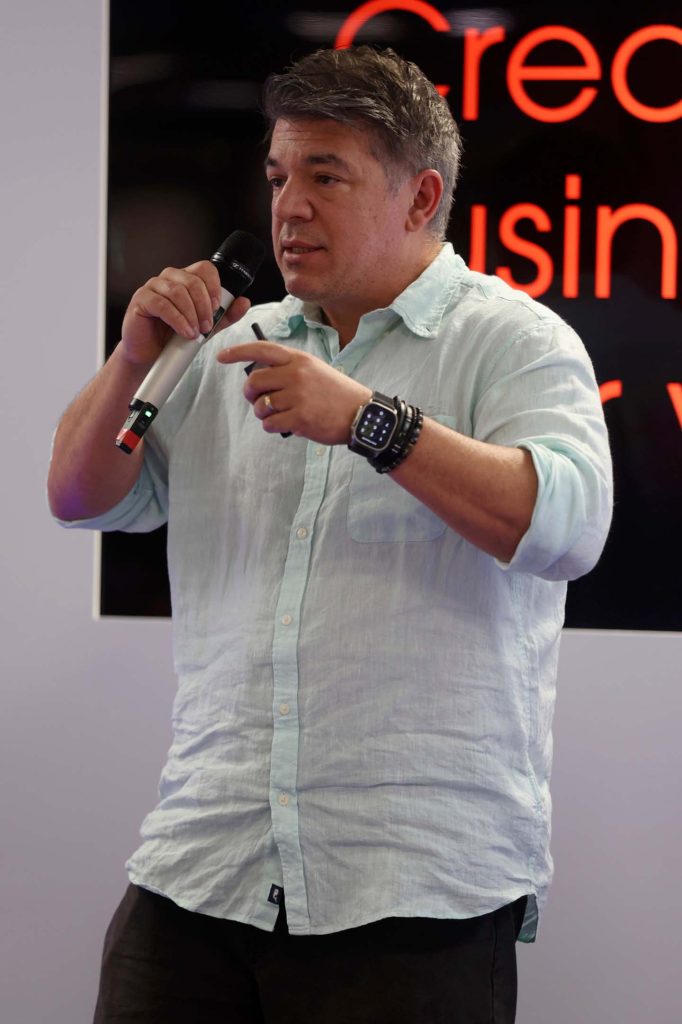
In a packed basement stage at the Cannes Lions International Festival of Creativity, Luiz Sanches, Global Chief Creative and Design Officer of Kimberly-Clark, delivered one of the week’s most revealing sessions, not about campaigns, but about the changing chemistry between brands and agencies.
Having spent years as Partner and Chief Creative Officer at BBDO before crossing over to the client side, Sanches now occupies a rare vantage point: understanding creativity from both sides of the table.
His message was clear: creativity has returned to the center of business, but its future depends on trust, friction, and deeper collaboration.
“Trust,” Sanches said, “is going to be the most important word for the future of our business.”
That trust, he argues, is what brands must build in a world increasingly clouded by misinformation, AI-generated noise, and fragmented attention. For Kimberly-Clark, this means identifying transformational human moments not merely functional product benefits and building stories around them.
He illustrated this with a powerful metaphor: the first diaper and the last diaper. Across a human life, both represent moments of vulnerability and transformation. For Sanches, these are the emotional truths brands must anchor themselves in. It marks a decisive shift from transactional to emotional branding.
He likened it to a Spotify playlist: consumers no longer respond to categories they respond to emotional curation, to what feels personal and relevant. Brands, like playlists, must now make people feel something.
And therein lies the business case.
Sanches cited Havaianas as proof of emotional branding’s commercial power: a product with low manufacturing cost but enormous emotional and cultural value. The margin, he implied, is built not on utility, but on meaning.
This is where the client-agency relationship becomes critical. “The agency remains the most important partner,” he said, but acknowledged that many agency structures were built for a different era. The pace of technology, media fragmentation, and AI acceleration demands faster, leaner, and more integrated collaboration.
At Kimberly-Clark, Sanches has built what he describes as a hybrid ecosystem: part agency, part client where creativity sits inside the business rather than orbiting around it.
This, he says, allows brands to prototype faster, collaborate more openly, and bring sharper cultural relevance to market. But he warns against one thing: over-politeness.
One of the strongest provocations of the session was his belief that creative leadership today risks becoming too accommodating.
“Creative leaders are becoming more like hosts in a restaurant,” he said, “instead of fighting for what they believe.”
For Sanches, friction is not dysfunction—it is fuel.
Without tension, debate, and opposing points of view, creativity loses its edge. Unlike math, he reminds us, branding is not a formula. It is emotional, subjective, and deeply human. That humanity becomes even more important in the AI era.
While Sanches embraces artificial intelligence as a powerful productivity tool, he believes the industry is still in its infancy in understanding how AI and human creativity can coexist. As machine-generated content becomes ubiquitous, the differentiator will no longer be perfection.
Instead, he introduced a compelling new standard: perfect imperfection.
“The new perfection,” he said, “is human.”
It is the accidental blink, the imperfect frame, the unscripted moment those flaws that signal authenticity and emotional truth.
At Cannes, where conversations about AI have dominated the Palais, Sanches’ perspective offered a timely counterpoint: technology may scale creativity, but humanity defines its value.
Perhaps his most important takeaway for agencies and clients alike was this: the future of creativity will not be built through rigid systems, but through flexible, collaborative ones.
And for an industry constantly chasing the next innovation, that may be the most radical idea of all.