
The Gerety Awards has recognized some of advertising’s most outstanding campaigns for several years, with winning entries meticulously selected by jurors who are among the industry’s leading creative voices.
Named after renowned copywriter Frances Gerety, who coined the slogan “A diamond is forever,” the Gerety Awards marks the first time a jury has been brought together to select the best in advertising — all advertising, not just advertising made for women — through the female lens.
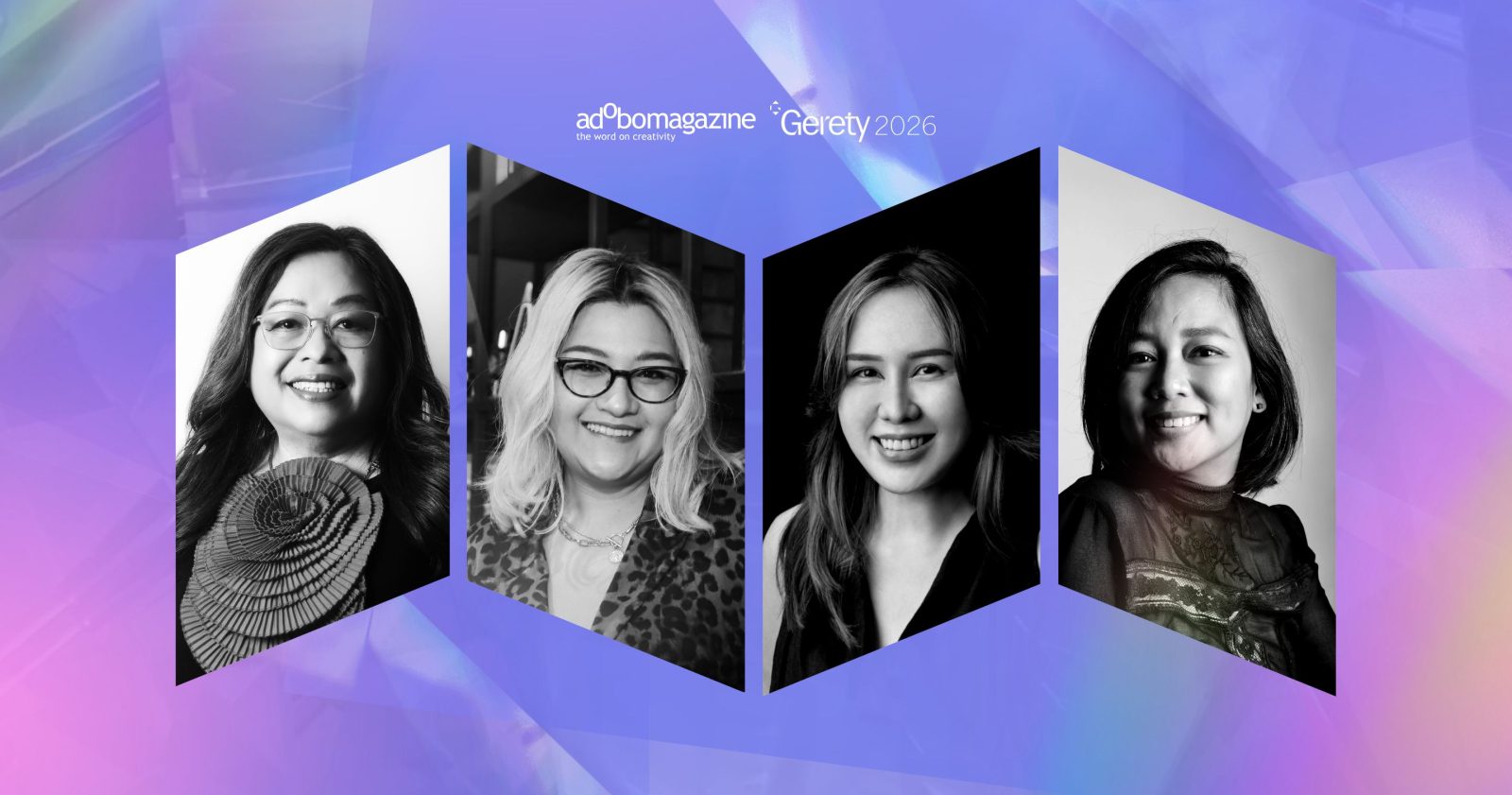
On June 17, 2026, adobo Magazine hosted a special edition of adobo Talks featuring members of the all-female Bangkok jury, headed by Jury President Kanokkan “Pare” Rinnachit, Managing Director at Yell Bangkok, along with Meyvi Wedelia Geeska, Creative Director at GUT Asia, and Nonie Tobias-Azores, Creative Director at Dentsu Creative Manila. All three judged the Craft, Entertainment, Work for Good, and Effectiveness Cuts categories.
Angel Guerrero, Founder, President, and Editor-in-Chief of adobo Magazine, hosted and moderated the Jury Insights.
Bringing another perspective
Each jury member shared valuable insights, with Nonie highlighting her belief that the Gerety Awards brings an additional perspective through its all-female panel — one that has been “historically underrepresented” in the industry.
“The more diverse the perspectives in a judging room, the better the chances of recognizing work that truly connects with a broader range of people,” Nonie said.
Pare, who has previously judged the Gerety Awards, felt the vibe was “different” this time around, with a lot of empathy in the judging room. This made it harder for the jury to select entries. Still, the longer they stayed and conversed with each other, the deeper their discussions became — asking more questions and trying to understand the thinking behind every piece of work.
“For me, I loved the vibes and learned something from each one,” she added.
Healthy debates, stronger decisions
In any jury lineup, divided opinions are common, and Gerety was no different. In the end, however, the jury members found common ground, with each bringing a valuable perspective to the discussion.
As Pare described it, every selected piece gave the judges something to discuss, and she felt a genuine sense of admiration in the room when her co-jurors spoke about the work they loved.
“When there were different opinions, it was usually because we were choosing between several great pieces of work,” she said.
Diving into specifics, Pare noted that many of their discussions focused on craft and the story behind the execution. In the Craft Cut category, for instance, the jury was mindful of the current role of artificial intelligence and took extra care to ensure campaigns were judged fairly and consistently.
Nonie pointed out the Visual Effects subcategory under Craft Cut as an example, noting that there were “a few interesting debates” during the judging process.
“There were questions about whether the execution lived up to the concept. Some jurors pointed out issues in the visual transitions, and there were moments where the use of AI felt a bit obvious and not as polished as it could have been,” she recalled, without naming the specific campaign.
Meyvi, meanwhile, shared her experience judging the Effectiveness category, where one entry made the entire room “sharper.” The campaign in question had “piggybacked” on a trend that was already everywhere, then simply “put a brand name on it.”
“If the trend would have grown exactly the same way without the campaign, what did the brand actually do? The discussion made everyone sharper about what we actually mean when we reward effectiveness,” she said.
Standout campaigns
Although every judge identified a variety of standout campaigns, their varied perspectives enriched the deliberations. All three agreed on Oreo Cows by VML for Oreo as one of their favorites. The campaign featured Belted Galloway cows — whose distinctive markings bear a striking resemblance to Oreos — and sought to elevate the iconic ritual of dunking the cookies in milk into a culturally resonant moment in Mexico.
Meyvi, who presented the entry, praised the campaign’s cinematography, scriptwriting, and the strength of its cast performances.
“The simplicity of the starting point stays consistent throughout all the touchpoints, which also makes it a well-integrated campaign,” she said.
Nonie then presented Nolingual Font by Yell Bangkok for Pumpui, which stood out to her for its “sheer level of thought and craftsmanship.” The campaign featured a typeface designed to resemble Korean Hangul at first glance, but is in fact Thai writing.
“Even without understanding either language, I could appreciate the intelligence, effort, and precision that went into it. It’s the kind of work that reminds you that great design can communicate beyond words,” Nonie explained.
Pare presented GOATS GOT BAGS by Scholz & Friends Berlin for GOT BAGS — a campaign that began with a typographical error by an Albanian shepherd from Himarë, who searched “GOAT BAG” and mistakenly placed an order from GOT BAG. The agency leaned into the mix-up, producing a mockumentary rooted in absurdism and authenticity.
“GOATS GOT BAG’ showed how a bold idea, even with a limited budget, can create something truly memorable,” she said.
Staying relevant and effective in the age of AI
As the Jury Insights session progressed, the discussion shifted to how creatives can remain relevant and effective in an age shaped by AI.
Nonie opened the conversation, saying that while AI tools have made it much easier to produce work, it has become harder to make work that “actually earns attention.”
“For me, great creative work today has to do two things at the same time: it has to be instantly engaging in an already crowded space, but also grounded in a real human or cultural truth,” she explained.
Pare echoed this, noting that her work has always been about people and that putting people first remains her guiding principle. As technology continues to evolve at a rapid pace, she believes the real challenge lies in ensuring that the work never loses its human aspect.
“AI can help us work in new ways and bring ideas further, but it can’t replace a real understanding of people,” Pare said.
Meyvi agreed, arguing that the industry must continue creating work that is “deeply human” — rooted in lived experience, craft, voice, and instinct — because those qualities make for the very foundation of work that lasts.
In a room full of accomplished creatives, the Bangkok Gerety jury made one thing clear: the tools may change, but the standard for truly great work remains the same. It has to be brave enough to take risks, honest enough to reflect real human truths, and crafted with enough intention that no algorithm could have made it on its own.
adobo Magazine is an official media partner of the The Gerety Awards 2026.
READ MORE:
Gerety Talks x ADFEST 2026: Why creativity shouldn’t always make sense